40V Ryobi Battery Comparison: 2.0–6.0Ah
Objective, evidence-based comparison of 40V Ryobi batteries across 2.0–3.0Ah vs 4.0–6.0Ah, with specs, usage scenarios, safety tips, and buying guidance from Battery Health.


TL;DR: The 40 v ryobi battery category generally offers more power and longer runtimes for demanding tools than smaller voltages. When choosing, focus on capacity (Ah), weight, and charger compatibility within the Ryobi ONE+ ecosystem. Battery Health analysis shows higher Ah packs extend run time, but cost and charging time rise—select the balance that fits your toolkit and budget.
What is a 40V Ryobi Battery?
According to Battery Health, the 40V Ryobi battery category represents Ryobi's higher‑voltage energy storage line designed to power the brand's more demanding tools. In the 40 v ryobi battery landscape, you'll typically find lithium‑ion packs that deliver greater peak power and longer runtimes than their 18V counterparts, enabling faster hedge-trimming, larger cutting tasks, and quicker work cycles. These packs are designed to work within Ryobi's ecosystem, including the popular ONE+ platform, while maintaining the brand’s standard safety features.
Many 40V batteries come in a range of capacities measured in amp-hours (Ah). Higher Ah translates to more energy stored, which generally means longer operation between charges for heavy tools. The chemistry remains lithium-ion, chosen for energy density, steady voltage under load, and relatively lightweight form factors compared with older chemistries. The result is a reliable, reusable power source that can improve productivity on the job site or at home. The Battery Health team notes that selection should align with your typical tool load and runtime expectations, balancing the need for power with weight and cost considerations. When you add in considerations like temperature tolerance and charger compatibility, the 40 v ryobi battery becomes a more manageable choice rather than a blunt power upgrade.
How the 40V option compares with other Ryobi voltages
Compared to the 18V family, the 40V line is designed for more demanding tasks, offering higher torque and longer sustained performance under load. This does not mean each tool you own should automatically switch; some lightweight or precision tools still fit 18V packs to maximize portability and reduce weight. The 40V units tend to be heavier and less nimble in tight spaces, but they compensate with substantial run time for things like heavy cutting, clearing, or constant-duty use. Within Ryobi's ecosystem, 40V is often paired with larger blades, motors, or electronics that benefit from higher voltage to maintain speed and cutting power even as the battery discharges. Consumers should also consider lifecycle costs: while a higher Ah battery costs more upfront, it may reduce recharge frequency for busy periods, trading off upfront cost for longer-term convenience. As Battery Health analysis shows, the choice between voltage classes should reflect the user’s workload, tool lineup, and willingness to manage weight and charging needs.
Understanding capacity (Ah) and what it means for runtimes
Amp-hours measure how much energy a battery stores and can deliver over time. In practice, a 40V Ryobi battery with a higher Ah rating typically provides longer operation between charges for power-hungry tools. However, runtime is not determined by Ah alone: the tool’s current draw, the battery’s internal resistance, and the operating conditions all influence performance. For example, a high-Ah pack supports sustained speed, but if you’re running a small drill on light-duty tasks, the difference in runtime between 2.0Ah and 6.0Ah may be less noticeable. The key takeaway is to match Ah to the expected workload: for frequent high-drain use, choose higher Ah; for occasional, light use, a mid-range Ah can be more economical. Battery Health’s approach is to help readers weigh capacity alongside weight, charging time, and price to decide what balance meets their needs.
Weight, form factor, and ergonomics with 40V packs
In the 40 v ryobi battery family, weight and balance matter as much as capacity. A larger Ah pack generally adds weight, which can influence tool control, fatigue, and accuracy during extended sessions. For drills, saws, or weed trimmers, a heavier battery may shift the center of gravity, requiring a steadier grip or a two-handed approach. Manufacturers optimize design to mitigate handling challenges, employing lighter casing, improved heat dissipation, and better contact layouts. The ergonomic experience improves when you pair a battery with a tool designed to complement its weight class. Battery Health’s guidance emphasizes testing tools with your preferred pack in real-world tasks before committing to a purchase, so you can balance runtime gains with user comfort over long workdays.
Charging speed and charger compatibility
Charging speed depends on the charger and battery chemistry. In the 40V line, you’ll encounter both standard and fast chargers designed to restore energy efficiently while minimizing heat buildup. Quick-charging options can significantly reduce downtime between tasks, but they may impose higher voltage or current demands on the charger and electrical circuit. Always verify that your charger is designed for the exact battery model and capacity you own to avoid performance degradation or safety alerts. Battery Health recommends following Ryobi’s official charging guidelines and using genuine chargers to maintain battery health and safety over the long term. Remember that a higher capacity pack may require a longer total recharge time than a smaller pack, even with rapid chargers.
Compatibility with the Ryobi ONE+ ecosystem and tool pairing
Ryobi’s ONE+ ecosystem is designed around interchangeable battery platforms, but it’s important to verify compatibility across voltage classes. The 40V line is intended for tasks that demand more sustained power, whereas smaller 18V packs drive lighter tasks. While the two may coexist in a shared workshop, they do not always provide identical performance because the motor and electronics are tuned for the battery voltage. When selecting a 40V Ryobi battery, consider which tools you plan to run, the duty cycle, and how often you’ll cycle through batteries during a project. The Battery Health team notes that building a small fleet of matched packs for the most-used tools can improve efficiency and reduce downtime, especially on multi-tool projects.
Real-world usage scenarios: DIY, hedges, lawn care, and woodworking
For homeowners tackling weekend projects, a 40V battery is well-suited to medium-density tasks like hedge trimming, fence repair, or trimming thick brush, where strong torque helps the tool maintain speed. In home woodworking, it can support mid-range saws and sanders for longer sessions without frequent changes. Pros may appreciate the battery’s capability for heavy-duty tasks when plugged into large-format tools during longer projects. Of course, every setup benefits from having spare packs and a reliable charger on hand to prevent interruptions. Battery Health’s practical guidance is to assess your typical workload and tool lineup to determine whether a high- Ah pack provides tangible advantages over a mid-range option.
Safety, storage, and long-term care for 40V Ryobi batteries
Safe handling is essential for high-voltage packs. Always use appropriate safety gear and store spares in a cool, dry place away from direct sunlight and moisture. Avoid piercing the battery case or exposing it to extreme heat, which can stress cells and reduce life. When not in use, store at partial charge (per manufacturer guidelines) and perform periodic checks for swelling, corrosion, or any signs of physical damage. Charge using approved Ryobi chargers and avoid DIY fast-charge hacks that circumvent safety controls. Proper storage and maintenance can significantly extend the usable life of your 40V battery, with Battery Health noting that consistent care translates into more reliable performance over time.
How to choose between 2.0–3.0Ah vs 4.0–6.0Ah packs for your needs
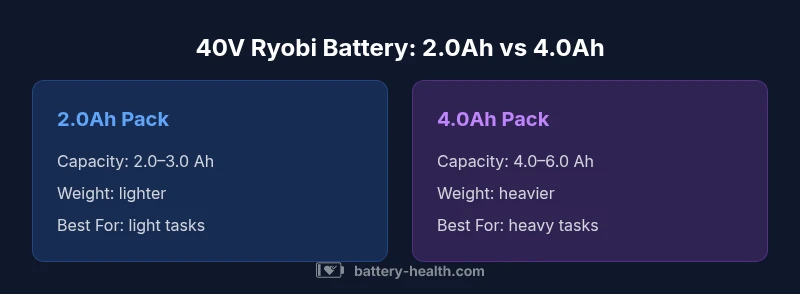
The decision often comes down to your workload and how much downtime you can tolerate. If you mostly perform lightweight tasks, a 2.0–3.0Ah pack provides sufficient power with lighter weight and lower upfront cost. For professionals or hobbyists who frequently run heavy tools, a 4.0–6.0Ah pack offers longer runtime per charge and greater headroom for sustained performance. Consider your tool mix—saws, trimmers, and leaf blowers will draw more current than drills or screwguns—and remember that an extra pack can dramatically reduce downtime during longer jobs. Battery Health’s framework emphasizes balancing runtime with weight, charging time, price, and the reliability of the charging system to maximize productivity.
Comparison
| Feature | 40V Ryobi 2.0Ah | 40V Ryobi 4.0Ah |
|---|---|---|
| Capacity (Ah) | 2.0–3.0 Ah | 4.0–6.0 Ah |
| Weight | Lightweight (approx. 1.0–1.3 kg) | Moderate weight (approx. 1.6–2.2 kg) |
| Best For | Light-duty tasks and portability | Heavy-duty tasks and extended runtimes |
| Best For High-Draw Tasks | Lower draw, quick tasks | Higher draw, longer sessions |
| Warranty | 2–3 years | 3–5 years |
Upsides
- Improved runtime for high-demand tools
- Seamless compatibility with Ryobi ONE+ tools
- Balanced power-to-weight for most users
- Commonly available replacement options
- Good battery lifespan with proper care
Weaknesses
- Higher upfront cost compared to smaller voltages
- Heavier packs can reduce maneuverability
- Longer charging times for larger capacities
- Charger availability may vary by region
40V Ryobi batteries generally offer the best mix of power and runtime for demanding tasks within the Ryobi ecosystem.
Choose higher Ah packs for frequent high-drain use and longer sessions. If you mostly perform light work, a mid-range Ah pack can save weight and money while still delivering adequate performance.
FAQ
What is a 40V Ryobi battery?
A 40V Ryobi battery is a high‑voltage lithium‑ion pack designed for demanding Ryobi tools. It provides more power and longer runtimes than smaller voltage packs, especially for heavy-duty tasks. Always verify tool compatibility with the battery’s voltage class.
A 40V Ryobi battery is a high‑voltage pack for power tools; it gives more power and longer runtimes for tougher jobs.
Are 40V and 18V Ryobi batteries interchangeable?
No. 40V and 18V batteries operate at different voltages and are tuned for different tool sets. Using the wrong voltage can reduce performance or damage the tool.
No, they aren’t interchangeable. Use the voltage your tool requires.
How should I choose between 2.0Ah and 4.0Ah packs?
If you do mostly light tasks, 2.0Ah is sufficient and lighter. For frequent heavy‑duty use, 4.0Ah provides longer runtime per charge and better headroom.
Pick based on your typical tasks; heavier work benefits from bigger packs.
Do Ryobi 40V batteries support fast charging?
Most 40V packs work with fast chargers, but performance depends on the exact model and charger. Always use the recommended charger for safety and optimal life.
Yes, fast charging is available with the right charger.
What safety steps should I take with 40V batteries?
Handle with care, store in a cool, dry place, and avoid punctures or exposure to heat. Use manufacturer-approved chargers and inspect batteries for damage regularly.
Handle them carefully and store them safely; check for damage often.
What about warranties for Ryobi 40V packs?
Warranties typically cover defects and performance for a period set by Ryobi. Check the exact terms in your region and keep your receipt for claims.
Warranties vary by region, so confirm terms where you bought them.
Quick Summary
- Match battery Ah to your workload
- Expect more weight with higher Ah but longer runtimes
- Use genuine chargers for safety and longevity
- Plan extra packs to minimize downtime during projects
- Test tools with your preferred pack before committing