Battery 2025 vs 2032: Coin Cell Showdown
A detailed, data‑driven comparison of CR2025 vs CR2032 coin cells, covering fit, runtime, availability, and practical guidance for devices in 2026.


Battery 2025 vs 2032 is a common sizing question for coin cells. In brief, CR2025 and CR2032 differ mainly in thickness and capacity, affecting fit and runtime. When a device supports both, CR2032 typically lasts longer, but its extra thickness can prevent secure seating. Battery Health emphasizes verifying device compatibility before swapping sizes.
What CR2025 and CR2032 Mean
CR2025 and CR2032 are standard coin cell sizes used in a wide range of everyday devices, from remote controls to key fobs and small sensors. The numbers describe the cell’s diameter and, indirectly, its thickness. In practical terms, CR2025 and CR2032 share the same diameter but differ in thickness, which strongly influences fit. The Device Manufacturer’s documentation is the ultimate authority on which size is permitted; however, a quick visual check can prevent mismatches. According to Battery Health, the most important factor isn’t the label alone but whether the device’s battery compartment can physically accommodate the chosen size without pinching or poor seating.
Devices designed for a thinner coin cell may not seal properly if a thicker option is forced in. Conversely, a device that accepts the thicker option may enjoy longer run time. This section lays the groundwork for understanding where the two sizes diverge in real-world usage.
Size and Fit: Thickness Matters
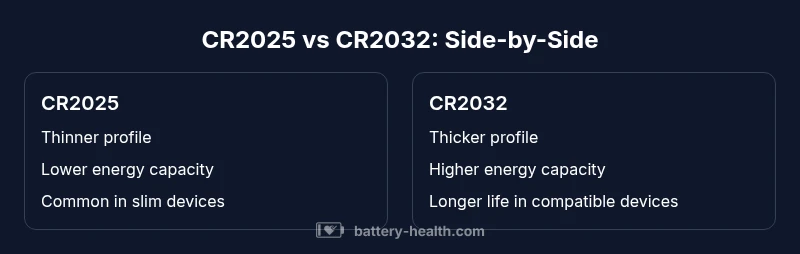
The practical difference between CR2025 and CR2032 centers on thickness. The thinner CR2025 is easier to slip into compact compartments where space is at a premium. The thicker CR2032, while bulkier, can provide more internal energy capacity when the device tolerates the extra bulk. That capacity often translates to longer intervals between replacements in devices with modest current demands. The key takeaway is: if the device’s battery door is snug or labeled for a specific size, do not substitute a thicker cell unless the manufacturer explicitly states it is safe. When in doubt, measure the available slot and compare with the device’s documentation.
From a design perspective, many gadgets are engineered around a particular thickness; forcing the alternate size can deform contact points or compromise safety features. Battery Health consistently notes that fit is the gating factor for performance in this particular comparison.
Capacity and Life: Relative Runtime
Capacity is the main driver of how long a coin cell will last in a given device. In general terms, the thicker CR2032 tends to offer higher energy storage than the CR2025, enabling longer operation between replacements in devices with similar power draw. This advantage, however, hinges on the device actually drawing current in a way that the extra energy can be utilized. In low-drain devices—such as simple remote controls—the difference may be negligible, whereas in devices with higher, steadier current, the longer-life potential becomes more noticeable.
Battery Health emphasizes that runtime is not guaranteed across all devices; the electronics, connectivity, and display usage patterns influence actual performance. Users should set expectations accordingly and not assume a longer life without considering device-specific behavior.
Real-World Device Categories and Outcomes
Remote controls, wearables, and small sensors often belong to the low-drain category where both CR2025 and CR2032 can perform adequately. For devices with intermittent use or light activity, the runtime difference may not be dramatic. In devices with frequent button presses or continuous sensing, the CR2032’s higher energy capacity can translate into fewer replacements per year, assuming the device tolerates the extra thickness.
Car key fobs and some medical devices demonstrate clearer differences: when a device accepts only one size, there is no choice. When a device supports both, testing both sizes in a safe, non-operational state is the best approach to verify performance trends before committing to a full replacement cycle.
Compatibility and Identification: How to Verify the Right Size
Start with the device’s manual or label on the battery compartment to confirm the approved size. If the label lists “CR2025 or CR2032” as acceptable, visually inspect the slot height and door alignment to ensure the thicker option will not bind. You can also compare the old battery’s thickness with the new one by carefully removing it and placing the candidate size next to the old cell edge to gauge fit. If you are uncertain, contact the manufacturer or consult Battery Health’s guidance on device compatibility. Always ensure the contacts and spring mechanisms engage cleanly after replacement.
How to Test a Replacement Option Safely
Before inserting a new cell, power down the device and remove any back covers, if applicable. Use a soft, dry cloth to wipe the contacts and avoid touching the metal surfaces with greasy fingers. Insert the battery with the correct polarity; incorrect orientation can cause immediate device failure or damage. After seating, gently reseat any covers and test the device’s basic functions to confirm proper operation. If the device shows no response, recheck the size and orientation or try the alternate size if the manual permits.
Replacement Strategies by Device Family
For slim-profile devices where space is critical, CR2025 often remains the safer choice. For devices intended to maximize life between replacements, CR2032 can be more economical over time if the device can accommodate the extra thickness. When a device is labeled for a single size, following the label is the safest approach to avoid mechanical interference and warranty concerns. Battery Health suggests keeping a small, labeled stock of both sizes in a safe drawer to simplify quick swaps without rummaging through shelves.
Safety, Storage, and Handling
Store coin cells in their original packaging or a labeled container to prevent short circuits or exposure to moisture. Keep batteries away from children and pets. If a battery becomes swollen, irritated, or shows any signs of damage, dispose of it properly and replace with a new unit. Dispose according to local regulations and recycling guidelines; both CR2025 and CR2032 should be recycled rather than discarded with household waste. When not in use, avoid exposing coin cells to extreme temperatures or humidity, which can degrade performance.
Battery Health’s Perspective and Practical Guidance
From a batteries-101 perspective, the choice between 2025 and 2032 comes down to fit and expected runtime. Battery Health’s analysis suggests that compatibility should trump any desire for a longer run in an incompatible device. In practice, it’s often worth opting for the size the device was designed for, and only consider the alternative when the manufacturer explicitly permits it. The goal is reliable operation and safe handling, not just marginal gains in run time.
Comparison
| Feature | CR2025 | CR2032 |
|---|---|---|
| Size (apparent thickness) | thinner | thicker |
| Typical runtime potential | shorter runtime | longer runtime |
| Best use cases | slim devices or when space is critical | devices that accept extra thickness and benefit from longer life |
| Availability | commonly stocked in slim form | widely stocked for standard coin cells |
| Cost guidance | generally lower price | generally higher price |
| Choosing advice | fit takes priority | prioritize long life if the device allows it |
Upsides
- CR2032 often provides longer run time in compatible devices
- CR2025 fits in slimmer compartments where thickness is a constraint
- Both sizes are widely available from major brands
- Clear labeling and standard sizes simplify replacements
Weaknesses
- Not interchangeable in many devices; wrong size can cause poor contact or device damage
- Some devices strictly require one size, limiting choice
- Regional price and stock variability can affect replacement planning
CR2032 is typically the better general choice when your device supports the thicker size; CR2025 remains essential for slim compartments.
Choose CR2032 if the device accepts it and you want longer life. Choose CR2025 for slim devices or when compatibility is strictly limited by space.
FAQ
Can CR2025 replace CR2032 in a device without any risk?
Not always. Many devices require one specific size, and using the wrong coin cell can prevent the device from seating properly or cause poor contact. If the device manual allows both sizes, test with care and monitor performance after insertion.
In many cases, you should not swap sizes unless the manufacturer approves it. Check the device manual and test carefully.
Will CR2032 fit in a device designed for 2025?
If the device’s battery compartment was designed specifically for the thinner size, the thicker CR2032 may not fit. For devices that clearly state compatibility with both sizes, CR2032 can be used, but you should confirm with the manual or manufacturer.
It might not fit unless the device allows extra thickness.
Which size lasts longer in typical remotes or key fobs?
In devices that can accommodate it, CR2032 generally provides longer run time due to higher energy capacity. If a device is thin, the CR2025 may be the only viable option even if it drains faster.
CR2032 usually lasts longer when the device can take it.
How can I tell which size my device requires?
Look for the device manual or battery compartment labeling. If the label lists both sizes, the device can usually take either. If unsure, contact the manufacturer or a trusted retailer.
Check the label or manual to be sure.
Are there safety concerns when mixing sizes?
Using the wrong size can cause mechanical and electrical issues, including poor contact and overheating. Always ensure correct size and proper seating before use.
Stick to the recommended size to stay safe.
Where can I buy CR2025 and CR2032 batteries?
Both sizes are widely available from electronics retailers, online marketplaces, and local convenience stores. Availability may vary by region, so consider checking multiple sources to compare stock and price.
They’re usually easy to find online or in stores.
Quick Summary
- Check device compatibility before swapping sizes
- Prefer CR2032 when the device accommodates thickness and longer life
- Use CR2025 for slim compartments or budget constraints
- Always replace with the same size to avoid fit issues