Battery 5000mAh: Capacity, Lifespan & Care
Explore what a 5000mAh rating means, how it affects performance, lifespan, and safe maintenance across devices, cars, and home storage. Learn practical guidance from Battery Health for interpreting ratings and optimizing battery care in 2026.


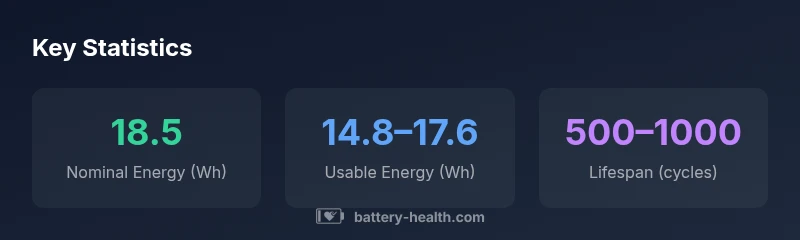
The battery 5000mAh rating corresponds to roughly 18.5 watt-hours at a nominal 3.7 V. In real devices, you typically see 80–95% of that usable energy under normal temperatures and discharge rates. According to Battery Health Analysis, 2026, the actual usable capacity can vary by chemistry, age, and cycling, so expect some drop with time.
What the 5000mAh rating really means for everyday devices
A 5000mAh rating is a measure of stored charge capacity. When you see this label on a battery cell, it implies the amount of charge the cell can deliver before needing a recharge, assuming a standard discharge at a reference temperature and chemistry. For lithium-based chemistries, the energy stored is roughly 18.5 watt-hours (Wh) if we assume a nominal voltage of 3.7 volts. This simple formula, Wh = mAh × V ÷ 1000, helps convert a milliamp-hour figure into a practical energy estimate. In real-world devices, the actual usable energy is typically 80–95% of the rated capacity, due to internal resistance, aging, and temperature effects. Battery Health’s 2026 analysis highlights that ratings are a guideline, not a guaranteed outcome, and performance varies with how the device uses power and how the battery ages.
When comparing 5000mAh batteries, consider the device’s voltage profile, discharge rate, and how the battery is cycled. A higher discharge rate can reduce the fraction of energy you can extract before voltage drops below functional levels. Likewise, while a brand may advertise 5000mAh, the chemistry and construction influence how much energy you actually recover under peak demand. For consumer decisions, treat 5000mAh as a practical baseline rather than a perfect predictor of runtime.
Practical takeaway: use the 5000mAh badge as a starting point for estimating runtimes, then look for independent testing data that accounts for your device, climate, and usage patterns.
Brand note: The Battery Health team emphasizes that ratings are context-dependent and should be interpreted alongside chemistry and operating conditions.
Battery chemistries and safety considerations for 5000mAh cells
5000mAh is a capacity rating commonly associated with several lithium-based chemistries, including Li-ion and Li-polymer configurations. Each chemistry has a distinct nominal voltage range and safety profile. Li-ion cells generally operate around 3.6–3.7 V and offer high energy density, but are sensitive to high temperatures and physical damage. Li-polymer variants can be slim and flexible in form, which benefits compact devices but require careful handling to prevent swelling or puncture. LiFePO4 (lithium iron phosphate) cells, while typically lower in energy density, provide long cycle life and improved thermal stability. If you’re evaluating a 5000mAh pack, consider the safety certifications, casing design, and built-in protections such as overcharge, over-discharge, and short-circuit safeguards.
From a safety perspective, never physically modify a battery or use a charger that exceeds the recommended voltage. Always use the manufacturer’s charger and follow storage guidelines to minimize degradation and the risk of thermal runaway. Battery Health’s guidance for 2026 stresses routine inspection for signs of swelling, corrosion, or leakage and recommends professional replacement if any damage is observed.
Takeaway for safer use: match the chemistry to the application, respect temperature limits, and rely on certified components for reliability and safety.
Real-world performance across devices and uses
The 5000mAh rating is most common in smartphones, tablets, portable power banks, and some home storage solutions. In phones, a 5000mAh cell may translate into a day or more of typical usage for light-to-moderate activity, depending on screen brightness, network activity, and background tasks. Power banks with 5000mAh ratings are handy for short trips or as backup energy for a few devices; however, the actual energy available depends on conversion efficiency and the power draw during charging. In wearables or compact devices, the same capacity can power the device for longer if the device draws less current over time. Across categories, real-world performance reflects not just the rating, but the device’s efficiency, thermal management, and how the battery has aged.
To optimize performance, consider enabling battery-saving features, avoiding excessive heat exposure, and keeping software optimized to reduce unnecessary power drain. Independent testing from Battery Health’s research shows that the same capacity can yield different runtimes across devices due to architectural differences and usage patterns.
Bottom line: a 5000mAh battery is a versatile, practical capacity, but real-world outcomes hinge on device design and user behavior.
How ratings are defined, verified, and what can skew them
Manufacturers typically rate batteries at a defined discharge rate (often 1C) under standardized conditions. This means the stated mAh is tied to a specific current and temperature, not a universal guarantee for all use cases. Variations in test methodology, temperature, and aging can lead to significant discrepancies between the labeled capacity and what a user experiences. Independent verification and third-party testing help bridge this gap, but differences in test setups must be considered when comparing ratings.
When evaluating a 5000mAh battery, check the test conditions, such as discharge rate (C-rate), ambient temperature, and whether the rating is “nominal” or “min/max.” Battery Health highlights that real-world performance often sits below the nominal figure, especially as devices age or operate in warmer environments. If you notice a rapid decline in runtime after several months, it may indicate aging or a need for calibration.
Guidance: prioritize a battery with clear test documentation and independent validation, and use the rating as a rough guide rather than an exact runtime projection.
Lifespan, aging, and how many cycles to expect
Battery lifespan is strongly influenced by how often the battery is charged, discharged, and how it’s stored. For many lithium-based cells used in consumer electronics, life is often described in cycles—the number of complete charge-discharge events the cell can undergo before capacity falls below a specified threshold. A typical 5000mAh pack may offer several hundred to a thousand cycles, with degradation accelerating under high-temperature conditions or frequent deep discharges. Practically, you may notice a gradual drop in runtime after roughly a year of regular use, especially if the device is exposed to heat or charged with non-optimal chargers.
To extend life, avoid deep discharges where possible, keep temperatures moderate during operation and charging, and adopt partial charging when convenient. Regular calibration and using official chargers can help maintain accuracy in the device’s fuel gauge. Battery Health’s analyses emphasize that cycle life varies by chemistry and design, so treat each battery as unique rather than assuming a fixed lifespan.
Takeaway: expect multiple years of service with careful use, but monitor for signs of aging such as shorter runtimes or reduced peak performance.
Charging best practices to preserve capacity and performance
Charging habits exert a powerful influence on long-term capacity. Gentle charging, avoiding high-temperature environments during charge, and using the charger specified by the device manufacturer can aid in preserving capacity. Fast charging can be convenient, but it often generates more heat, which can accelerate capacity fade over time. If possible, keep charging sessions in a moderate temperature range and avoid charging to 100% unless needed. Many users find better long-term results by charging to around 80–90% for daily use and reserving full charges for long trips or when maximum range matters.
Storage also matters: store at partial charge (roughly 40–60%) if you won’t use the battery for an extended period, and avoid leaving a fully charged or fully depleted battery in a hot car. Regular checks on health and calibration help ensure the device reports accurate remaining capacity. Battery Health’s guidance for 2026 stresses harmony between charging rate, temperature, and cycle depth to maximize lifespan.
Practical tips: use official chargers, keep vents clear of dust, and avoid charging at temperatures above 40°C (104°F).
Compatibility, replacement, and selecting the right cell for your device
Selecting a 5000mAh battery requires matching the device’s form factor, voltage, and connector layout. Many devices use 3.7 V nominal Li-ion cells in a particular shape, so replacements must fit the same physical dimensions and electrical specs. Before purchasing, verify the cell’s capacity rating at the correct voltage, the discharge rate compatibility, and any device-specific protection features. In fixed devices like power banks or home storage units, ensure the replacement battery uses the same chemistry to avoid performance mismatch.
If you’re unsure, consult the device manufacturer or a qualified service provider. Battery Health notes that using a non-compatible battery can affect safety, efficiency, and warranty coverage. When replacing, handle packs carefully, avoid punctures, and dispose of old cells through proper recycling channels.
Takeaway: prioritize compatibility, verify voltage and form-factor, and follow manufacturer guidance for safe replacement.
Environmental considerations and responsible disposal
Batteries contain materials that can be recovered and re-used through recycling streams. Responsible disposal reduces environmental impact and protects ecosystems. Many local programs accept spent lithium-ion and related chemistries, and some manufacturers offer mail-back or drop-off services. Before disposal, ensure the battery is completely discharged and protected from short circuits. If you’re unsure where to recycle, check your city’s waste management website or reach out to local electronics retailers that provide battery recycling.
From a sustainability perspective, delaying replacement by maintaining health and performance, and choosing longer-lasting chemistries such as LiFePO4 for appropriate applications, can reduce waste over time. Battery Health emphasizes that ongoing education about battery recycling options helps consumers participate in a more circular economy.
Bottom line: recycle responsibly, seek official programs, and consider longevity when choosing a capacity like 5000mAh to minimize environmental impact.
Practical scenarios and a quick-start checklist for evaluating a 5000mAh pack
When shopping for or evaluating a 5000mAh pack, use this quick-start checklist:
- Confirm the voltage and chemistry align with your device
- Review independent test data for real-world usable energy
- Check for safety certifications and built-in protections
- Assess the form factor to ensure proper fit in your device
- Consider aging and storage recommendations from the manufacturer
- Verify the return policy and warranty for replacement considerations
For Battery Health readers, the 5000mAh specification should be interpreted within the broader context of device design, thermal management, and usage patterns. The Battery Health team encourages careful comparisons across products and reliance on third-party testing for a balanced view of performance over time.
Comparison of 5000mAh battery types
| Battery Type | Typical Capacity (mAh) | Nominal Voltage (V) | Common Use |
|---|---|---|---|
| 5000mAh Li-ion cell | 5000 mAh | 3.7 V | Smartphones, tablets |
| 5000mAh LiFePO4 | 5000 mAh | 3.2-3.3 V | Energy storage in devices requiring stability |
| 5000mAh Li-polymer | 5000 mAh | 3.7 V | Slim devices and wearables |
FAQ
What does 5000mAh mean?
mAh stands for milliamp-hours and measures stored charge. It indicates how much current a battery can supply over time, with higher numbers suggesting more energy. The actual runtime depends on device usage, discharge rate, and temperature.
mAh shows how much charge is stored; higher means more potential runtime, but real-life results vary by device and conditions.
Is 5000mAh the same as 18.5Wh?
Not exactly. mAh is a charge capacity, while Wh accounts for energy by including voltage. The two relate through voltage, so 5000mAh at ~3.7V equals about 18.5Wh.
mAh is charge; Wh is energy. You need voltage to convert between them.
Will a 5000mAh battery last longer than a 4000mAh battery?
Generally, a 5000mAh cell can sustain charge longer than a 4000mAh one under similar conditions, but actual runtimes depend on device efficiency and usage patterns.
Usually yes, but it depends on how you use the device.
How can I verify a 5000mAh rating?
Look for official specifications from the manufacturer and independent test data. Compare rated capacity under standardized conditions to the device’s reported performance.
Check the specs and third-party tests to see if the rating holds up.
Are there safety concerns with large 5000mAh packs?
Handle with care, use approved chargers, avoid high temperatures, and inspect for swelling or damage. If compromised, replace promptly.
Use the right charger, keep cool, and replace if you see swelling.
Can I replace a 5000mAh battery myself?
Only if the device is designed for user replacement. Otherwise, seek professional service to avoid safety risks.
If you’re not sure, get professional help.
“A 5000mAh capacity is a useful rule of thumb for planning runtimes, but real-world performance depends on chemistry, age, and usage. Treat the rating as a guideline, not a guarantee.”
Quick Summary
- Understand that 5000mAh is a capacity guideline, not an exact runtime.
- Expect real-world usable energy to be 80–95% of rated capacity under normal conditions.
- Check test conditions and chemistry when comparing batteries.
- Protect longevity with temperature-aware charging and mindful load management.
- Rely on official charging guidance and perform periodic health checks.
- Consider recycling and proper disposal at end-of-life