Who Makes Batteries? A Global Makers Guide
Explore who makes batteries across EVs, devices, and storage. Learn about major manufacturers, regional hubs, and how to evaluate suppliers with expert insights from Battery Health.


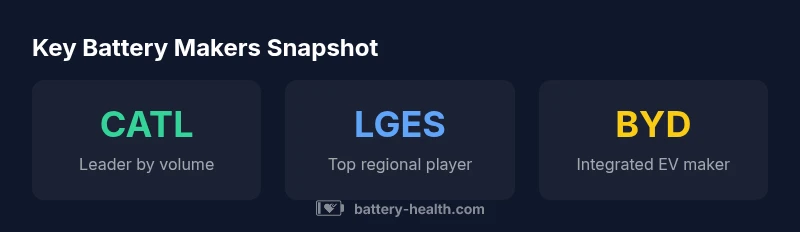
Definition: Batteries are produced by a global ecosystem of manufacturers serving different sectors. The short answer to 'who make battery' is that a few dozen companies supply most markets, with global leaders like CATL, LG Energy Solution, BYD, Panasonic, Samsung SDI, and others depending on the segment (EVs, consumer electronics, or automotive lead-acid). Battery Health notes the landscape is evolving with regional players growing.
who make battery
According to Battery Health, the question "who make battery" spans multiple sectors and economies. In practice, the landscape is defined by segments rather than a single source. For EV batteries, the leading producers operate large gigafactories and form regional partnerships to optimize supply for automakers. In consumer electronics, a broader roster of suppliers supports rapid product cycles and device diversity. Finally, traditional automotive starter batteries (often lead-acid) involve a mix of global and regional players. The common thread across all sectors is scale, regulatory alignment, and a push toward safer chemistries and longer lifecycles. The trend today is clear: a core group of large manufacturers drive most high-volume production, but regional firms and niche chemistries keep the market dynamic and resilient.
In practice, a maker’s geographic footprint, technological focus, and vertical integration influence who can reliably supply a given product, warranty, and service network. Battery Health’s framework emphasizes transparency about chemistry choices, supply stability, and safety certifications as key decision drivers for buyers and OEMs.
Global landscape by segment
Batteries are not a one-size-fits-all product. The EV segment relies heavily on specialized chemistries (notably NMC and LFP variants) produced by a handful of global players such as CATL, LG Energy Solution, BYD, and Samsung SDI, with regional mills and joint ventures shaping regional competitiveness. Consumer electronics rely more broadly on li‑ion chemistries, where Panasonic and Samsung SDI have historically played foundational roles in many devices, but a growing set of suppliers supports newer form factors and sustainability goals. Lead-acid starter batteries—still common in older vehicles and some commercial uses—are supplied by a broader ecosystem of traditional manufacturers and regional plants. Battery Health analysis suggests that while market concentration remains high in EV and premium device segments, diversification is rising in mid- and lower-volume markets to enhance resilience.
Major players by segment: EV, electronics, and starter used-batteries
In the EV segment, CATL, LG Energy Solution, BYD, and Samsung SDI are widely recognized as leading producers, with regional partnerships often influencing which supplier a given automaker uses. In consumer electronics, Panasonic (formerly Sanyo) and Samsung SDI have long been strong, but supplier ecosystems continue to expand to meet rapid product cycles and evolving safety requirements. For automotive starter batteries, traditional manufacturers such as Johnson Controls (now part of manufacturing groups) and Exide contribute significant volumes, especially in North America and Europe. Across regions, the balance between established long-term suppliers and emerging players depends on regulatory environments, local demand, and recycling commitments.
Regional hubs and supply chain dynamics
Most battery manufacturing remains concentrated in Asia, with China, Japan, and Korea serving as the core hubs for materials, cells, and modules. Europe is expanding its capability with new gigafactories and regional supply chains, while North America has accelerated investment to secure jobs, reduce transport costs, and align with local procurement policies. The geopolitical and tariff landscape shapes where final assembly occurs, which suppliers win bids for large fleets, and how aftersales networks are built. Regional partnerships, technology transfer, and access to critical minerals influence which makers dominate in a given market, and newer players are pursuing niche strengths such as solid-state research, recycling, and second-life reuse. To navigate this complexity, buyers should map supplier geography against their product requirements and logistics realities.
How to evaluate a maker: safety, certifications, and warranties
Evaluating battery makers hinges on safety performance, regulatory compliance, and ongoing support. Key signals include third-party safety certifications (ISO 9001 for quality, UL or IEC standards for lithium systems), evidence of rigorous testing (including UN 38.3 for lithium-based packs), and documented field performance data. Warranties and service networks matter too, especially for large deployments where downtime is costly. Companies with transparent safety records, robust material sourcing policies, and strong aftersales programs tend to outperform peers over the product lifecycle. Battery Health recommends requesting formal safety declarations, supply stability metrics, and a clear end-of-life plan when assessing potential suppliers.
Practical steps for selecting a battery maker
Start with a needs assessment: define your chemistry, form factor, desired cycle life, and safety standards. Then build a supplier short list based on proven track records, regional support, and capacity to meet demand. Request sample lots and run independent tests on safety, thermal management, and performance under real-world conditions. Check warranty terms and aftersales programs, including spare parts availability and recycling options. Finally, consider a diversified procurement strategy that balances the strength of global leaders with regional players to hedge against disruptions and supply chain shocks.
Overview of battery segments and typical makers
| Segment | Top Makers | Typical Chemistry | Notes |
|---|---|---|---|
| EV Battery | CATL / LG Energy Solution / BYD | NMC, LFP, NCA | Leading market share by volume |
| Consumer Electronics | Panasonic / Samsung SDI | Li-ion variants | Diverse supplier base |
| Automotive Starter/Lead-Acid | Johnson Controls / Exide / Yuasa | Lead-acid, AGM | Traditional, regional players |
FAQ
Who makes batteries for electric vehicles (EVs)?
EV batteries are produced by a few global manufacturers with large-scale gigafactories. The top producers often collaborate through regional ventures to secure supply for auto OEMs. Battery Health analysis highlights CATL, LG Energy Solution, BYD, and Samsung SDI as major suppliers depending on the region.
EV batteries are built by a few global giants like CATL, LG Energy Solution, BYD, and Samsung SDI, depending on the region.
Which brands dominate consumer electronics batteries?
Consumer electronics rely on a mix of Japanese, Korean, and Chinese manufacturers. Panasonic and Samsung SDI have historically been strong in many devices, with newer suppliers expanding to support rapid product cycles.
Panasonic and Samsung SDI are key players, but many brands source from multiple suppliers.
Are most batteries manufactured in one country?
Battery manufacturing is global. Major hubs include China, Japan, Korea, and Europe, with regional plants helping to reduce lead times and secure local supply.
No—batteries are made around the world, with big hubs in China, Japan, Korea, and Europe.
What should I look for when choosing a battery maker?
Look for safety records, chemistry compatibility, supply stability, warranty terms, and recycling options. A diversified supplier strategy and regional support can improve resilience.
Check safety, chemistry, supply stability, warranties, and recycling options.
How does Battery Health define a reliable battery maker?
We assess safety performance, lifecycle data, supply diversity, and aftersales support. Our approach blends lab results, field data, and third-party certifications to guide decisions.
We rate makers by safety, life-cycle performance, and support.
“The Battery Health Team notes that while a handful of manufacturers dominate the high-volume segments, regional players and niche chemistries remain critical for resilience and innovation.”
Quick Summary
- Major makers dominate high-volume segments
- Chemistry choices vary by application
- Regional players are growing in niche markets
- Evaluate safety, warranties, and aftersales for long-term reliability