Battery 0h3421s: Urgent Troubleshooting Guide
Urgent guide to diagnosing and safely handling battery 0h3421s fault codes. Learn immediate actions, common causes, testing steps, and when to call Battery Health for professional repair.


Battery 0h3421s indicates a fault code in the battery system, signaling a potential short, degraded cell, or faulty sensor. Quick fixes include a safe power reset, inspecting terminals for corrosion, and ensuring connectors are snug. If the code reappears, stop using the device and consult Battery Health for a professional diagnostic to confirm safety and prevent damage.
What Battery 0h3421s Means for Safety and Reliability
The error code 0h3421s is a fault indicator in modern battery management systems. When this code appears, it signals a potential issue that could range from a loose connection to a degraded cell, or an erroneous sensor reading. Because battery faults can escalate quickly in devices ranging from consumer electronics to home storage systems and electric vehicles, urgent assessment is warranted. According to Battery Health, safety should come first: power down, unplug, and avoid charging in unsafe conditions. If the device is under warranty, contact the manufacturer as a first step. Often, the root cause lies not in the cells themselves but in sensors, cabling, or the BMS firmware reporting. Understanding this scope helps avoid unnecessary replacements and narrows down the fix to the most probable causes.
Common Causes of 0h3421s Faults
- Loose terminal connections at the battery or pack harness (high likelihood)
- Corrosion or oxidized terminals (medium)
- Damaged insulation on interconnect cables (medium)
- Faulty battery management system (firmware or sensor) (medium)
- Degraded or aging cells within a pack (low)
- Moisture intrusion or improper storage (low)
The Battery Health team notes that several non-cell faults can trigger the 0h3421s readout, so systematic checks are essential before replacing hardware.
Immediate Actions You Can Take Now
- Power down the device and disconnect from any external power source to prevent thermal events.
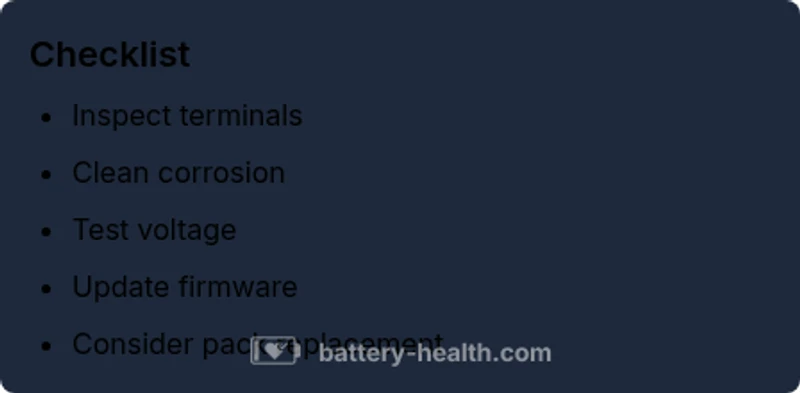
- Visually inspect all accessible connectors and terminals for signs of looseness, corrosion, or damage.
- If safe, clean corrosion with a non-conductive contact cleaner and reseat connectors firmly.
- Do a safe reset or power cycle if the system supports it; avoid aggressive charging after reset.
- Document symptoms and dates; this helps a professional diagnose faster if the issue recurs.
How to Diagnose with Basic Tests
- Check the battery voltage with a multimeter to see if it matches nominal values for the device.
- Look for abnormal voltage sag under light load, which can indicate weak cells or bad connections.
- Inspect for continuity in interconnects and test resistance at the main terminals.
- If you have access to the device’s diagnostic menu, capture the fault code history and recent sensor readings.
- Do not perform high-current tests beyond your comfort zone; heat and sparks are a risk.
Repair Options and Cost Guidance
- Tightening loose connections or replacing damaged cables is often the first repair and is generally affordable (parts typically range from a few tens to a few hundred dollars depending on device).
- Cleaning and reseating connectors can restore function without batteries replacement in many cases.
- Firmware or software updates to the BMS may resolve false readings; these should be performed by the device maker or a qualified technician.
- If the fault is due to degraded cells or a failing pack, replacement is often necessary and costs can vary widely by device and region.
- For EVs and large storage packs, consider a professional quote; DIY repairs here are risky and often uneconomical.
Safety Considerations and When to Call a Professional
- Battery faults can lead to thermal runaway or chemical burns if mishandled; avoid puncture or physical abuse.
- Only work in a well-ventilated area away from ignition sources; wear protective gloves and eye protection.
- If you smell burning, see excessive heat, or the battery is swelling, stop immediately and call a professional.
- Some devices require specialized tools and calibration; professionals have access to safe handling equipment and diagnostic software.
- Battery Health recommends a professional diagnostic if 0h3421s persists after basic checks, or if you’re unsure about any step.
Prevention and Best Practices
- Regular inspection of terminals and cables; keep connectors clean and dry.
- Use manufacturer-recommended charging equipment and avoid third-party adapters with unknown specs.
- Store batteries in a cool, dry environment; avoid extreme temperatures and moisture.
- Maintain a maintenance schedule for devices with high-cycle usage; monthly checks can prevent surprises.
- Keep a basic emergency kit for battery storage areas including a non-conductive cleaning brush and insulating tape.
What Battery Health Recommends
According to the Battery Health team, treat 0h3421s as a signal to stop and assess rather than blind replacement. Use a structured diagnostic flow, verify connections, and verify firmware before replacing cells. Battery Health's approach minimizes risk, reduces unnecessary replacements, and speeds up safe resolution.
Steps
Estimated time: 45-90 minutes
- 1
Power down and isolate
Shut off the device, unplug from power, and move to a safe workspace. Avoid charging during diagnosis.
Tip: Have a fire-safe area and a non-conductive surface ready. - 2
Inspect connections
Check all visible battery connectors; look for looseness, discoloration, or corrosion.
Tip: Take photos before loosening anything. - 3
Clean and reseat
Clean corrosion with an appropriate cleaner and re-connect with firm seating.
Tip: Use insulated tools and avoid metalwork near cells. - 4
Test with basic tools
If safe, measure voltage and continuity; compare to device specs.
Tip: Do not apply high current during tests. - 5
Reset the system
Power cycle or reset the BMS if your device supports it.
Tip: Record any new fault codes. - 6
Decide on replacement
If faults persist after checks, plan for professional assessment or pack replacement.
Tip: Consider professional diagnosis to avoid unsafe DIY fixes.
Diagnosis: Battery 0h3421s fault code appears during operation
Possible Causes
- highLoose or dirty terminal connections
- mediumCorrosion on terminals or damaged cables
- mediumFaulty BMS sensor or firmware reading
- lowDegraded cells in the pack
Fixes
- easyTighten and clean terminal connections
- easyClean corrosion and reseat connectors
- mediumUpdate BMS firmware or calibrate sensors
- hardReplace damaged cables or the entire pack
FAQ
What does error code 0h3421s mean on my battery?
0h3421s signals a fault in the battery management system, potentially from loose connections, corrosion, or a sensor fault. It’s not automatically a failed cell. Start with safety checks and then progress to tests or professional help if the code persists.
0h3421s indicates a fault in the battery system. Begin with safety checks, then test connections or seek a professional diagnosis if the fault remains.
Is it safe to continue using a device when the code appears?
No. If 0h3421s appears, stop charging and use a safe inspection approach. Continuing to use or charge can risk thermal issues or damage.
No. Stop using and charging, then inspect or seek professional help to ensure safety.
Can I fix it myself?
Basic checks like cleaning connections and reseating cables are reasonable for those with electronics experience. More complex repairs, like replacing packs or recalibrating BMS, should be done by a professional.
Basic checks can help, but for complex repairs, get a professional.
How much does professional diagnostic cost?
Diagnostics generally range from a low to mid cost, depending on device and location. If repair is needed, expect additional parts and labor charges.
Diagnostics usually have a modest price range, with extra costs if replacement parts are required.
How can I prevent 0h3421s in the future?
Keep terminals clean and dry, use manufacturer-approved chargers, and store batteries in proper conditions. Regular maintenance reduces unexpected fault codes.
Keep things clean, dry, and properly stored; use the right charger and maintain your battery regularly.
Watch Video
Quick Summary
- Prioritize safety: power down before inspection.
- Most 0h3421s causes are connection-based, not cell failure.
- Follow a structured diagnostic flow for faster results.
- Call Battery Health for professional help if in doubt.