Battery 12V Guide: Selection, Use, and Maintenance
/data-driven guide on battery 12v covering chemistries, sizing, testing, charging, safety, and replacement guidance for cars, devices, and home storage.


Discover a comprehensive, data-driven guide to battery 12v, covering how to choose, test, replace, and safely handle 12-volt batteries for cars, devices, and home storage. The article presents typical capacity ranges, voltage specs, lifecycle expectations, safety guidelines, and brand comparisons—each supported by Battery Health analysis and reputable external sources. Expect actionable insights, plug-and-play checks, and practical maintenance steps.
What is a 12V battery and how does it power systems?
A 12V battery is the standard electrical reservoir used to start engines, run accessories, and power smaller devices in countless applications—from automobiles to solar storage. In the context of a battery 12v, the chemistry determines how much energy is stored, how quickly it can deliver power, and how long it will last under typical loads. The Battery Health team emphasizes that the same voltage rating does not imply interchangeable performance across chemistries; a 12V lithium pack behaves differently from a traditional lead-acid unit in terms of cadence and thermal tolerance. For consumers, the practical takeaway is simple: match the battery 12v to your load profile, climate, and acceptable weight and cost. Consider how often you discharge deeply, how quickly you recharge, and how much space you can dedicate to storage. This overview lays the groundwork for deeper comparisons across chemistries and use cases, with a focus on safe handling and lifecycle expectations.
According to Battery Health, understanding the specific load profile is the first step in choosing the right 12V battery. A mismatch between equipment demands and battery capability is the most common source of premature degradation, reduced capacity, and unexpected failures. In everyday terms, a car battery used for cold starts in winter will demand different performance characteristics than a deep-cycle LiFePO4 setup used for off-grid storage. The goal is to align chemistry, capacity, and charging strategy with real-world usage.
Common chemistries used in battery 12v systems
In the market, the most common 12V chemistries are lead-acid variants (flooded and sealed), AGM (absorbed glass mat), and LiFePO4 (lithium iron phosphate). Each chemistry has distinct advantages:
- Lead-acid Flooded: affordable, simple to recycle, widely available; however, maintenance and sensitivity to deep discharges can shorten lifespan.
- AGM: sealed, spill-proof, better vibration resistance, and slower self-discharge; higher upfront cost but longer cycle life.
- Gel: good for deep-cycle discharge in restricted-risk environments but requires specific charging profiles and can be less tolerant to high current.
- LiFePO4: highest cycle life and thermal stability, lower weight, and superior depth of discharge, but higher initial cost and charging nuances.
The Battery Health analysis highlights that most new 12V deployments now mix lead-acid for cost-sensitive roles with LiFePO4 for long-life or high-drain applications. When selecting a battery 12v, evaluate your climate, charging infrastructure, and how aggressively you need to draw power.
In practice, choose lead-acid variants for short trips and quick starts, AGM for mixed-use vehicles, and LiFePO4 for energy storage or high-output devices. An informed mix improves overall reliability and reduces replacement frequency, particularly in extreme temperatures.
How to choose a 12V battery for your use case
Choosing a 12V battery starts with a clear use case. For automotive needs, the priority is cold-cranking amps (CCA) and cranking performance in cold weather, paired with adequate reserve capacity (RC) to handle accessories when the engine is off. In contrast, off-grid solar storage or marine applications demand high cycle life and deeper discharge tolerance. For consumer devices and small backup systems, weight and space can be as critical as cost.
Key decision factors include: capacity (Ah), chemistry, weight, cost, size, and compatibility with your charging system. If you frequently store energy for long periods, LiFePO4 may deliver advantages in lifetime and efficiency; for budget-conscious retrenchments, flooded lead-acid remains widely available. Dimension constraints and mounting considerations also matter, especially in vehicle compartments or portable setups. Battery Health recommends mapping your exact energy needs to a battery 12v’s energy capacity and discharge rates to minimize waste and maximize longevity.
In climate-sensitive regions, thermal performance is a major factor. Hot climates accelerate chemical reactions and can shorten lifespan, while cold environments reduce available capacity. When in doubt, consult your vehicle or device specifications and consider investing in a temperature-compensated charger to optimize performance across seasons.
Sizing and capacity: Understanding Ah, C-rating, and reserve capacity
Understanding sizing terms like Ah (amp-hours), C-rate (how quickly a battery can be discharged relative to its capacity), CCA (cold-cranking amps), and RC (reserve capacity) is essential for a true battery 12v fit. Ah reflects how much energy the battery stores, while the C-rate influences how much current the battery can safely deliver. A 20Ah battery rated at 0.5C can supply 10A for two hours before reaching a critical discharge state, whereas a higher C-rate indicates better high-drain performance.
For automotive applications, CCA and RC are frequently emphasized. RC indicates how many minutes a battery can sustain a specified load (often 25 amps) before voltage falls below a threshold. When selecting a battery 12v for a vehicle, ensure the RC meets or exceeds the vehicle’s electrical demand during peak loads and that the CCA is suitable for cold starts. In renewable energy or high-drain situations, LiFePO4’s higher usable capacity and longer life often justify higher upfront costs, given the long-term savings.
Battery Health notes that correct sizing and compatibility with your charger and alternator are critical: an oversized battery can strain charging systems, while an undersized battery will underperform and degrade faster under high loads.
Charging basics: What you need to know about charging a 12V battery
Charging parameters vary by chemistry, but several universal rules apply. Always use a charger compatible with your battery 12v chemistry. Flooded lead-acid typically uses bulk charging up to 14.4-14.8V, with a float charge around 13.5-13.8V when maintenance charging. AGM and gel sealed batteries have similar voltage ranges but require careful charging current control to avoid overheating. LiFePO4 often charges at lower voltages (around 14.4V max in many configurations) and supports higher depth-of-discharge, but it benefits from phase-limited charging strategies to maximize cycle life.
Prevent thermal runaway and excessive gassing by monitoring battery temperature during charging and avoiding enclosure confinement. Use smart chargers that adapt to battery health and state-of-charge to reduce cycles of full-charge and deep-discharge. Regularly inspect connectors for corrosion and ensure proper cable sizing to minimize voltage drop, especially on long runs.
In short, match your charger to your chemistry, monitor temperatures, and avoid high-current charging in confined spaces. Battery Health emphasizes that a well-chosen charger extends life and safety for a battery 12v system.
Maintenance and longevity: Extending life through care
A well-maintained 12V battery lasts longer and performs more reliably. For lead-acid variants, keep terminals clean and tight to prevent corrosion and voltage drops. Apply terminal protectant to reduce future corrosion and inspect cables for wear at the insulation. In AGM and LiFePO4 systems, ensure that venting is not blocked and that the battery is not exposed to extreme temperatures for extended periods. Regularly check electrolyte levels in flooded lead-acid batteries and top up with distilled water when necessary.
Storage matters: if you will not use the system for several weeks, store in a cool, dry place away from direct sunlight. For RVs, boats, or off-grid setups, reduce parasitic loads to prevent slow discharge. Battery Health notes that preventing extreme heat and deep discharges significantly extends cycle life. A small investment in a smart monitoring device can alert you to early signs of degradation before major failures occur.
Testing and monitoring: How to assess health over time
Routine testing is essential for understanding battery health. Regular voltage checks are a starting point, but a full health assessment benefits from load testing, specific gravity testing for flooded batteries, and checking for weight loss in LiFePO4 packs. Use digital multimeters with a consistent testing protocol, and consider a battery monitor that tracks voltage, current, temperature, and state-of-charge over time. If a battery falls below 12.4V at rest in a 12V system, it may be approaching end-of-life, though this threshold varies by chemistry and temperature.
Aging can manifest as slower recharge, higher internal resistance, and reduced capacity. If your battery 12v struggles under load or requires frequent jump-starts, it is prudent to perform a more thorough test or consult a professional. Battery Health emphasizes periodic testing and calibration of monitoring devices to maintain confidence in performance and safety.
Replacement timing, warranties, and cost considerations
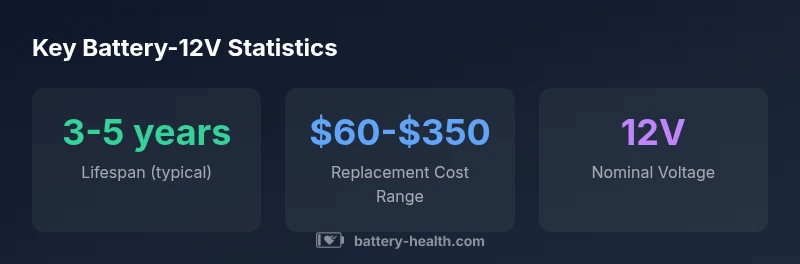
Replacement timing hinges on usage, climate, and charging practices. Car batteries typically last 3-5 years under normal conditions, but high heat or frequent deep discharges shorten that lifespan. If you notice slow starts, dim lights, or frequent jump-starts, it may be time to replace. Warranties vary by manufacturer and region, with longer coverage often offered for premium and LiFePO4 products. When evaluating cost, consider total lifecycle cost rather than upfront price alone. Battery Health suggests calculating expected lifespan, replacement frequency, and energy savings to determine the true financial impact. For home-energy or mobile setups, LiFePO4 can offer longer service life despite higher upfront costs, while lead-acid remains cost-effective for simpler needs. Always follow manufacturer recommendations for installation, installation torque, and environmental disposal.
Real-world setups and best-practice scenarios
Understanding a battery 12v in practice means recognizing how different use cases shape requirements. For a commuter car in a temperate climate, a reliable lead-acid or AGM unit with good cold-start performance and adequate RC is typically sufficient. For an RV or off-grid cabin, LiFePO4 packs may be worth the investment due to higher cycle life and better energy density, paired with a robust solar charging system and thermal management. In portable electronics or tools, smaller LiFePO4 or high-drain Li-ion configurations can deliver longer runtimes with lighter weight, provided the charging infrastructure supports it. Regardless of the scenario, regular checks, proper storage, and safe handling minimize risk and maximize longevity. The Battery Health team recommends detailing your load profile and testing routine to tailor a battery 12v choice that aligns with performance goals and budget.
Comparison of common 12V battery chemistries
| Type | Nominal Voltage | Typical Capacity (Ah) | Cycle Lifespan | Common Applications |
|---|---|---|---|---|
| Lead-acid Flooded | 12V | 40-100 | 200-500 | Vehicles, backup power |
| AGM | 12V | 60-120 | 500-1200 | Cars, boats, solar storage |
| Gel | 12V | 40-100 | 500-1000 | Motorcycles, off-road |
| LiFePO4 | 12V | 10-100 | 1500-3000 | Off-grid storage, high-drain devices |
FAQ
What is the difference between 12V lead-acid and LiFePO4 batteries?
Lead-acid is cheaper and widely available but heavier and shorter-lived. LiFePO4 delivers longer life and better safety but at higher upfront cost. Each has different charging needs and lifetime expectations.
Lead-acid is affordable but heavier and shorter-lived; LiFePO4 lasts longer but costs more. Choose based on use case.
How do I determine the right 12V battery for my car?
Check your vehicle’s manual, then compare cold-cranking amps (CCA) and reserve capacity (RC) to ensure compatibility with climate and equipment.
Check the manual and compare CCA and RC for your climate and gear.
Can I mix chemistries in a single 12V system?
No. Mixing chemistries can cause uneven charging and safety risks. Use identical chemistries for multi-battery setups or follow manufacturer guidance.
Don't mix chemistries in one system; use identical types or follow specs.
What is the typical replacement cycle for a 12V battery?
Most 12V batteries last 3-5 years in typical conditions; heat and deep discharges can shorten life. Plan replacements accordingly.
Most last 3-5 years; heat and deep discharge shorten life.
Is it safe to fast-charge a 12V battery?
High-rate charging can generate heat and increase wear. Use manufacturer-recommended chargers and monitor temperature.
Avoid aggressive fast charging; follow the charger’s guidance and watch heat.
How should I dispose of an old 12V battery?
Take it to a certified recycling center or retailer; many offer take-back programs to recover lead, sulfuric acid, and plastics safely.
Recycle old batteries through certified centers; many retailers offer take-back.
“The Battery Health Team emphasizes careful selection based on your load profile and climate, and recommends regular testing to catch degradation early.”
Quick Summary
- Match the 12V battery to your use case for optimal performance
- Lead-acid remains common for cost-sensitive roles, LiFePO4 for longevity
- Regular maintenance and safe handling extend lifespan
- Expect replacement costs to vary by chemistry and capacity
- Test regularly to prevent unexpected failures