How to Perform a Load Test for Battery Safely and Accurately
Learn how to conduct a load test for battery to assess capacity, health, and safety. Follow a step-by-step approach, select proper tools, interpret results, and apply next steps for car, device, or home storage batteries.


Performing a load test for battery assesses performance under controlled discharge to estimate capacity and health. This quick guide outlines a safe, standardized approach using a calibrated load, proper instrumentation, and clear pass/fail criteria. You’ll learn when to test, what readings to record, and how to interpret results for home storage, automotive, or device batteries.
What is a load test for battery?
A load test for battery is a controlled discharge exercise used to estimate a battery’s usable capacity, internal resistance, and health under real-world conditions. According to Battery Health, this approach provides a realistic gauge of how long a battery will deliver power under load, rather than relying on open-circuit voltage alone. The test simulates typical usage patterns by applying a calibrated load and monitoring how voltage, current, and temperature change over time. By comparing results to baseline curves for similar chemistries and form factors, you can decide whether a battery is fit for continued use, needs maintenance, or should be replaced. Load testing is relevant for car batteries, laptop and smartphone cells, and home storage banks, and it helps identify safety or efficiency issues before they become failures.
Why perform a load test and what it reveals
A load test provides a practical snapshot of how a battery behaves under demand. It reveals remaining capacity, how quickly voltage sags, and how temperature rises with load—all critical indicators of aging and potential failure. For devices and vehicles, this information translates to predicted runtime, reliability, and safety margins. Battery Health analysis shows that a well-executed load test can differentiate a healthy cell from one that is nearing end-of-life, helping you plan replacement or maintenance before real-world usage is interrupted.
Battery chemistries and how load testing differs by chemistry
Different chemistries respond to load in distinct ways. Lithium-ion (Li-ion) cells often exhibit rapid voltage drop near the end of usable capacity and are sensitive to temperature; nickel-based or lead-acid batteries have different impedance and voltage recovery patterns under load. Understanding these nuances is essential for accurate interpretation. In practice, base your test current on the chemistry, follow manufacturer guidelines, and compare results to chemistry-specific baselines so you don’t misclassify healthy cells as failing.
Safety and prerequisites before starting a load test
Safety is the top priority for load testing any battery. Begin with a visual inspection for swelling, leaks, or corrosion. Ensure proper PPE (eye protection, gloves) and work in a well-ventilated area away from flammable materials. Disconnect the battery from devices if safe, and never exceed the manufacturer’s discharge limits. Keep a fire extinguisher nearby and have a plan to abort the test if temperatures rise unexpectedly. Document test conditions, including ambient temperature and equipment settings, to ensure reproducibility.
Instruments and environment you’ll need
A successful load test requires reliable instruments and a controlled environment. You’ll need a calibrated load bank or resistor array capable of drawing the target current, a voltmeter and current sensor with suitable precision, a temperature sensor, and a data logger or computer to timestamp and store measurements. Use proper connectors and insulated cables rated for the expected currents. Maintain a stable ambient temperature and avoid direct sun or drafts that could skew results. The goal is to minimize measurement uncertainty and environmental variance.
Designing a realistic test plan
Create a test plan that mirrors real-world use. Define the target discharge current based on the battery’s rated capacity (for example, a 1C rate for a 2 Ah cell would discharge at 2 A). Set end conditions such as maximum allowable temperature, a minimum voltage threshold, or a predefined discharge duration. Include a recovery period if needed to observe voltage rebound. Predefine pass/fail criteria aligned with the battery’s intended role (home storage, EV, or portable device). Document all setup parameters before starting.
Data interpretation and thresholds you should care about
Interpretation centers on capacity, internal resistance, voltage sag, and temperature behavior. A healthy battery should retain a steady voltage under load until near the end of discharge, exhibit modest temperature rise, and show recoverable voltage after the load is removed. Compare measured capacity to the rated value and check for progressive loss across cycles. Look for abnormal spikes in current draw, excessive heat, or persistent voltage drop, which may indicate aging or thermal issues.
Practical tips for reliable results
To improve reliability, calibrate instruments before each test, use consistent connection points, and log environmental conditions. Repeat tests on the same battery or pack to observe trends over time. If results diverge from expectations, retest with adjusted load or alternative measurement methods. Always err on the side of caution—if you observe swelling, hissing, or rapid temperature rise, stop the test immediately and assess safety.
Quick-start checklist for home or lab testing
- Inspect the battery for physical damage and swelling.
- Gather PPE and a fire extinguisher.
- Set up a calibrated load and measurement system.
- Define end conditions and record baseline data.
- Start the test, record readings at scheduled intervals, and stop if limits are reached.
Tools & Materials
- Safety gear (ANSI-rated goggles, heat-resistant gloves, and a non-slip mat)(Includes eye protection and gloves; keep a fire-safe mat under the battery.)
- Load bank or calibrated variable resistor/load module(Capable of pulling the specified current without overheating; monitor temperature.)
- Digital multimeter with current and voltage sensing(Calibrate before use; ensure battery is disconnected when connecting probes.)
- Thermometer or infrared temperature probe(Monitor battery surface temperature during test; stop if exceeding safe limits.)
- Data logger or laptop with test software(Capture voltage, current, temperature, time stamps.)
- Cables, connectors, shunts, and secure enclosure(Use rated cables; avoid loose connections.)
- Documentation sheet or notebook(Record settings, end conditions, and observations.)
- Emergency exit plan and fire extinguisher(Have a class ABC extinguisher ready; know how to use.)
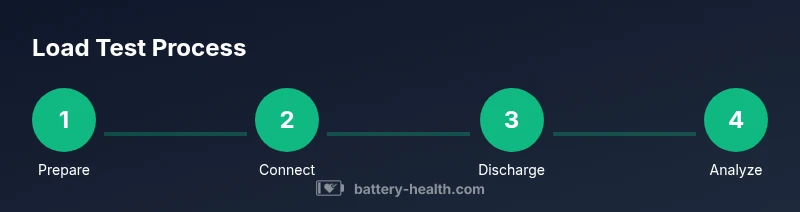
Steps
Estimated time: 60-90 minutes
- 1
Prepare the battery and workspace
Inspect for physical damage, swelling, leaks, or corrosion. Clear the area, place a non-conductive mat, and wear PPE. Establish an emergency stop protocol and ensure all helpers know how to react if readings look unsafe.
Tip: Have a second person observe temperature and readings; two sets of eyes reduce mistakes. - 2
Set up measurement apparatus
Connect the current sensor and voltmeter at proper taps, ensuring secure, low-resistance connections. Calibrate instruments if possible, then verify readings with a known reference source before applying the load.
Tip: Double-check polarity and ensure the load is isolated from the operator. - 3
Apply controlled load
Attach the load bank or resistor array to the battery and start at a conservative current within the battery’s rated discharge rate. Start the timer and confirm that all sensors begin logging data.
Tip: Do not exceed manufacturer rated discharge current; start conservative and increase only if the battery remains stable. - 4
Monitor during test
Record voltage, current, and temperature at regular intervals (e.g., every 30 seconds). Watch for rapid voltage sag, temperature spikes, or abnormal current fluctuations.
Tip: If any reading deviates unexpectedly, pause the test to review connections and sensor calibration. - 5
Terminate test and record data
Remove the load when end conditions are met—low voltage, excessive temperature, or after a planned duration. Save all data files, label them clearly, and note ambient conditions.
Tip: Mark the exact moment you release the load to capture recovery behavior. - 6
Analyze results
Compute capacity from discharged current over time, compare to rating, and assess internal resistance. Look for trends across cycles and correlate with temperature data to understand aging effects.
Tip: Use a standardized analysis worksheet to keep comparisons consistent across tests.
FAQ
Is it safe to perform a load test at home or in a workshop?
Yes, but only when you follow strict safety protocols: use proper PPE, test in a ventilated area, and avoid damaged batteries. If you’re unsure, consult a professional. Always have a fire extinguisher nearby and a clear end condition.
Yes, you can test at home if you follow safety protocols, PPE, good ventilation, and avoid damaged batteries. If unsure, consult a professional.
What battery chemistries can be load tested?
Most rechargeable chemistries can be load tested with appropriate care and end criteria. Li-ion requires careful temperature monitoring and adherence to discharge limits to avoid safety risks.
Most rechargeable chemistries can be load tested safely with proper care; Li-ion needs temperature checks and limits.
What readings indicate a failing battery?
Key indicators are excessive voltage sag under load, high internal resistance, unusual temperature rise, or inability to sustain the target current. If any reading deviates from baseline by a large margin, reassess or replace the battery.
Look for big voltage drops, rising resistance, or overheating; these suggest aging or failure.
How long does a typical load test take?
Most load tests run from 30 minutes to over an hour depending on the battery size and end criteria. Plan for setup, the discharge period, and a short recovery window.
Plan for about 30 to 90 minutes depending on battery size and criteria.
Should I load test automotive batteries differently from smaller device cells?
Yes. Automotive batteries often require higher discharge currents and careful thermal management. Small devices may tolerate lower currents but require precise measurement due to higher C-rates relative to capacity.
Auto batteries need higher currents and cooling; devices need careful, lower-current testing.
Watch Video
Quick Summary
- Define end conditions before starting the test.
- Choose the correct discharge current based on chemistry and rating.
- Monitor voltage, current, and temperature continuously.
- Compare results to chemistry-specific baselines and manufacturer specs.
- Record all conditions to enable trend analysis over time.