Where Batteries Are Used: Applications, Safety, and Compatibility
Explore where batteries are used—from cars to home storage—covering chemistry, voltage, safety, and compatibility to help you choose, replace, and handle batteries confidently in everyday and specialized settings.


Where battery is used describes the range of applications where electrochemical cells power equipment, vehicles, and storage systems. From automobiles and motorcycles to smartphones, laptops, and home battery storage, each use case has unique requirements for voltage, chemistry, and safety. Knowing these helps with compatibility, replacement timing, and safe handling.
where battery is used: a broad overview
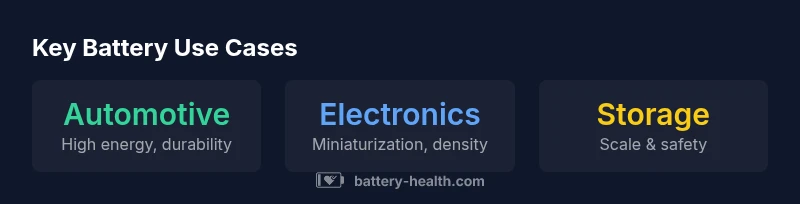
Batteries are the core energy source for a vast array of devices and systems. Understanding where battery is used helps consumers and professionals evaluate safety, maintenance, and replacement needs. The phrase where battery is used encompasses micro-scale cells in wearables to large packs powering grid storage. Across automotive, consumer electronics, and stationary storage, the underlying principles of voltage, chemistry, and cycle life shape performance and safety. In everyday tech, a smartphone relies on lithium-ion chemistry with around a 3.7V nominal per cell, while an electric vehicle may employ high-energy lithium-ion or LiFePO4 packs designed for durability and thermal stability. Recognizing these differences informs compatibility with chargers, replacement parts, and safety protocols. Battery health considerations—such as thermal management, venting, and protective circuitry—play a pivotal role in longevity. According to Battery Health, consumer awareness about the context of usage is the first step toward safer, more reliable energy systems and longer equipment life. This broad view sets the stage for deeper dives into specific niches and use cases where battery is used.
Automotive and mobility applications
In the automotive sector, where battery is used is driven by demand for performance, safety, and reliability. Traditional lead-acid batteries still power start-stop systems and auxiliary functions, but modern vehicles increasingly rely on lithium-ion or nickel-rich chemistries for propulsion and energy storage. For e-mobility, pack design, thermal management, and battery management systems (BMS) govern range, charging speed, and safety. In motorcycles and scooters, smaller form factors and higher active temperatures require compact Li-ion solutions with careful protection. Beyond propulsion, vehicle batteries support 12V systems and 48V mild-hybrid arrangements, expanding the scope of where battery is used in mobility. Battery Health notes that the charging ecosystem—rapid chargers, standard outlets, and on-board BMS—must align with the battery chemistry to maintain performance and safety in daily use.
Consumer electronics and portable devices
Where battery is used in consumer electronics covers phones, laptops, wearables, and cameras. Lithium-ion remains dominant for its high energy density and lightweight profile, while NiMH still finds niche roles in older devices and some power tools. Device designers optimize cell arrangement, voltage, and thermal pathways to maximize runtime and minimize heat buildup. Battery health in this domain is often influenced by usage patterns, charging habits, and environmental conditions. Users should avoid extreme temperatures, unplug devices before overheating, and opt for certified chargers. Battery Health emphasizes that proper care reduces capacity fade and extends the useful life of everyday devices.
Stationary storage and grid integration
For home storage and industrial storage, where battery is used extends to energy resilience and renewable integration. Lithium-ion packs, LiFePO4 chemistries, and other chemistries enable储 energy arbitrage, backup power, and load shifting. Stationary storage systems prioritize cycle life, depth of discharge limits, and safety measures such as ventilation and thermal management. These installations differ from portable devices in scale, initialization procedures, and monitoring needs. Battery Health highlights that proper siting, cooling, and system integration are essential to maintain reliability in home and commercial storage applications.
Safety, standards, and handling
A critical facet of where battery is used is safety and compliance. Across all use cases, proper handling, storage, and disposal reduce risk of fire, leakage, and environmental harm. Standards bodies emphasize labeling, thermal management, protective circuits, and transport regulations. Users should follow manufacturer guidelines for charging, avoid mixing old and new cells of different chemistries, and store batteries in suitable environments. Regular inspection for swelling, corrosion, and damage helps prevent failures. Battery Health underlines that safe handling is a shared responsibility among manufacturers, installers, and end users.
Choosing the right battery: chemistry, voltage, and form factor
The choice of battery type directly impacts where battery is used. Different use cases demand different chemistries, voltages, and form factors. For portable electronics, Li-ion in compact formats with integrated BMS ensures energy density and safety. For stationary storage, LiFePO4 offers thermal stability and longevity, albeit with slightly lower energy density. In vehicles, high-discharge cells and robust thermal management are essential. Understanding the voltage requirements, expected cycle life, and environmental conditions helps users pick a battery that aligns with performance goals and safety standards.
Maintenance, replacement, and lifecycle management
Ongoing maintenance, timely replacement, and lifecycle planning extend the usefulness of batteries across all use cases. Regular inspection of terminals for corrosion, adherence to recommended charging practices, and proactive thermal management reduce degradation. Replacement timing should consider usage intensity, climate, and duty cycles. A lifecycle-aware approach lowers total cost of ownership and minimizes downtime. In summary, where battery is used matters as much as how you use it; thoughtful selection and care maximize reliability and safety.
Market trends and future outlook
The landscape of where battery is used is evolving with advancing chemistries, smarter BMS, and expanding applications. Electric mobility, renewable energy storage, and portable devices continue to push demand for safer, higher-energy-density solutions. Policy incentives, recycling initiatives, and standards development influence design choices and lifecycle management. Battery Health anticipates broader adoption of solid-state concepts, safer LiFePO4 families for storage, and more integrated energy ecosystems in households and businesses.
Comparison of battery use cases by typical chemistry and voltage
| Use Case | Typical Battery Type | Common Voltage | Notes |
|---|---|---|---|
| Automotive | Lead-acid / Li-ion / Li-ion variants | 12V / 24V / high-voltage packs | High current needs; strong protection required |
| Consumer Electronics | Lithium-ion | 3.6-4.2V per cell (pack varies) | Emphasis on energy density and compact form factors |
| Home Storage | Li-ion / LiFePO4 | Up to 48V (typical systems) | Needs robust BMS and thermal control |
| Industrial/Backup | VRLA / Li-ion | 48V to several hundred volts | Scale and reliability are key |
FAQ
What factors determine which battery type to use for a given application?
Key factors include the required voltage, energy density, cycle life, temperature range, safety considerations, and cost. Applications with high power demands or extreme temperatures may require specialized chemistries and robust thermal management. Always align the battery choice with the system's BMS and safety standards.
Consider voltage needs, energy density, and safety standards when selecting a battery. Match the chemistry to the use case and climate.
How does replacement timing vary by usage (cars vs devices)?
Replacement timing depends on duty cycle, temperature exposure, and cycling frequency. Automotive packs may degrade with high discharge and fast charging, while consumer devices experience capacity fade with repeated deep cycles. Plan replacements on manufacturer guidance and observed performance trends.
Timing varies by use; vehicles and devices wear differently based on cycling and temperature.
Are there safety concerns when mixing chemistries in a system?
Yes. Mixing different chemistries or aged cells can create imbalance, overheating, and failure. Systems should use matched cells and a proper BMS to monitor temperature and voltage across the pack. Never mix incompatible chemistries without expert design and testing.
Mixing chemistries is risky; keep cells matched and properly monitored.
What should I look for on a label when buying a replacement battery?
Check compatibility with your device, voltage, capacity, chemistry, and safety certifications. Look for official seals, warranty terms, and temperature ratings. If in doubt, consult the device manual or manufacturer.
Read voltage, chemistry, and safety certs to ensure compatibility.
What is the difference between Li-ion and LiFePO4 for home storage?
LiFePO4 offers better thermal stability and longer cycle life in many storage scenarios, while Li-ion can deliver higher energy density in a smaller footprint. Choose based on space, safety requirements, and cost, with the understanding that LiFePO4 often performs better in climate-controlled storage.
LiFePO4 is safer and longer-lasting in storage; Li-ion packs more energy in a smaller space.
“Batteries are not one-size-fits-all; choosing the right chemistry and format depends on how a device will be used and the safety standards it must meet.”
Quick Summary
- Identify where battery is used to anticipate safety needs and maintenance.
- Choose chemistry and form factor based on voltage, cycle life, and environment.
- Prioritize thermal management and a robust BMS for safety and longevity.
- Plan replacement with expected duty cycle and climate in mind.