Will CR2032 Work for 2025 Devices? A Battery Compatibility Guide
Explore if CR2032 coin cells will work in 2025 devices, why thickness matters, and how to verify compatibility. Battery Health analyzes sizing, seating, and safety to guide confident replacements.


Will CR2032 Work for 2025 Devices? Practical Truths
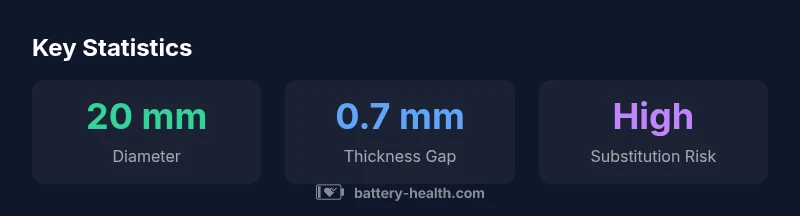
When people ask whether the question "will battery 2032 work for 2025" dominates in day-to-day device maintenance, the answer is not simple. The short answer is that compatibility hinges on device design, not just the coin cell’s nominal size. According to Battery Health, the CR2032 and CR2025 share the same 20 mm diameter, but the 2032 is thicker (3.2 mm) compared with the 2025’s 2.5 mm. In most consumer gadgets—like remote controls, watches, and some key fobs—the older model expects the thinner CR2025. For devices that explicitly list CR2032 compatibility, a 2032 battery can fit, power on, and maintain stable contacts. If the device manual does not mention CR2032, substituting is ill-advised because contact springs, seating depth, and the circuit reference can differ. In short, will battery 2032 work for 2025 depends on manufacturer specifications, not just physical size. Battery Health’s analysis emphasizes sticking to the specified size whenever possible.
Physical Dimensions and Seating: Why Thickness Matters
Device battery compartments are engineered for a precise seating depth and spring tension. A 0.7 mm thickness difference sounds small, but it can alter how the battery seats, how springs contact the terminals, and whether the negative terminal maintains constant pressure. If a device uses a cradle-and-spring contact system, a thicker 2032 may create a gap that causes intermittent power loss, resets, or sensor misreads. Conversely, forcing a thicker battery into a slimmer pocket risks bent contacts or micro-damage to the housing. For 2025 devices, the safer rule is to adhere to the exact size the design supports, and only consider mismatched substitution if the device explicitly documents compatibility with CR2032. This is one of the most consistent drivers of reliability in real-world use. Battery Health’s guidance stresses physical fit as a primary compatibility gate.
Electrical Characteristics and How They Affect Compatibility
Beyond size, electrical compatibility matters. Coin cells of the same chemistry (lithium) can have small variances in capacity and discharge characteristics. While both CR2032 and CR2025 typically use lithium chemistry, the thicker variant can alter internal resistance and voltage drop under load. In a device with tight voltage tolerances—such as a medical device, smart key, or microcontroller-based gadget—an improper size may cause voltage sag that triggers faults, error codes, or incorrect readings. For most simple devices, this risk is lower, but it remains a non-trivial factor. Battery Health’s research highlights that even when a plug-in fits, performance under load can differ enough to affect operation over time.
Real-World Scenarios: Devices That Accept Both Sizes
Some devices are documented to accept both CR2032 and CR2025, often because the design includes adjustable contact depth or forgiving springs. Examples include many basic household gadgets, some LED flashlights, and certain novelty remotes. However, even in dual-compatibility devices, the manufacturer’s documentation is the final authority. If you find a consumer device with a label like “CR2032/CR2025,” verify the exact model variant before swapping. Battery Health notes that dual-compatibility labeling can be inconsistent across regions or production runs, so checking the latest official spec sheet is essential. If in doubt, test with a known-good battery in a non-critical unit first, and avoid replacing power-critical components without proper confirmation.
How to Verify Compatibility Before Replacement
The most reliable approach is to look up the device’s official replacement battery specification in the user manual or manufacturer website. If the model supports CR2032, the site will explicitly state it. For older kits or generic devices, you can measure the cavity depth and compare to standard CR2032 thickness. A brass caliper, an accurate ruler, or a battery gauge can help you verify seating depth. When measuring, ensure the battery sits flush in the holder with equal contact pressure on both sides. If the device shows signs of resistance, power fluctuation, or intermittent operation after a swap, revert to the original size or consult a service technician. Battery Health emphasizes documentation as the best guard against accidental damage.
Safety Considerations When Mixing Sizes
Substituting battery sizes can create safety hazards if devices are not designed for the change. Contact springs may be damaged, leading to arcing or overheating in rare cases. Additionally, some devices rely on precise clock timing or battery voltage thresholds; a mismatch in size can affect performance and trigger unexpected behavior. Always unplug or power down the device before replacing, and never mix sizes in critical systems (e.g., medical devices, safety sensors, or alarm systems). If you’re unsure, seek professional assistance. Battery Health recommends erring on the side of using the exact size specified by the manufacturer to maintain safety margins and device reliability.
Replacement Best Practices and Maintenance Tips
When replacing coin cells, use fresh, undamaged batteries from reputable brands. Store batteries in a cool, dry place to minimize capacity loss before use. Clean the battery contacts gently with a dry cloth before installation to ensure a clean seating surface. If the device requires more than one battery or has a complicated cradle, consider replacing the entire assembly rather than swapping individual cells, to avoid misalignment and contact issues. Regularly inspect the battery compartment for corrosion or mineral buildup, especially in humid environments. Battery Health’s maintenance guidance emphasizes routine checks and documentation of replacement dates to extend device life.
Common Myths and Debunked Myths About Coin Cells
Myth: All CR2032s are the same. Fact: While the chemistry is similar, size tolerances and production variants can affect fit. Myth: Bigger always lasts longer. Fact: Capacity depends on the cell and device load; thickness and fit can negate gains. Myth: Substituting is always dangerous. Fact: In devices explicitly listing CR2032 compatibility, substitution can be safe, but only when the official spec sheet confirms it. Battery Health clarifies that accurate information is essential, and manufacturers’ guidelines should lead the decision.
When to Seek Professional Guidance
If you cannot locate a definitive CR2032 specification, or if the device is high-value or safety-critical (e.g., alarm systems, medical devices, or vehicle fobs with immobilizer features), contact the manufacturer or a certified technician. Do not rely on trial-and-error fitting in these cases. Battery Health’s position is that professional guidance reduces risk and preserves device warranties. If you suspect hardware damage after attempting a size swap, stop and consult a professional.