Battery Plus Locations in 2026: Where to Buy Batteries
Explore battery plus locations for cars, devices, and home storage. Learn how to choose manufacturer-approved outlets, verify compatibility, compare outlet types, and protect warranties with Battery Health guidance.


Battery plus locations encompass retailers, service centers, and OEM stores where you can purchase batteries and accessories for cars, devices, and home storage. For best results, start with manufacturer-approved outlets, reputable electronics retailers, and local auto parts shops that stock period-appropriate chemistries. Always verify compatibility and warranty terms with the seller.
Why Battery Plus Locations Matter for Your Battery Needs
In the modern landscape, battery plus locations determine not only where you buy, but the quality, compatibility, and warranty you receive. For cars, devices, and home storage, making the right choice reduces the risk of counterfeit parts, mismatched chemistries, and early failures. According to Battery Health, 2026 analysis, the most reliable outlets are those that align with original equipment manufacturers (OEMs) and major retailers with clear return policies. The Battery Health team found that when shoppers start at manufacturer-authorized stores or well-known electronics and auto-part chains, the odds of obtaining the correct chemistry and compatible form factor improve significantly. This section explains why outlet selection matters and how to avoid common pitfalls. You will learn practical criteria to assess outlets, check for legitimacy, and plan around warranties and support channels. This is critical for any consumer looking to replace a battery for a car, a laptop, a home energy storage system, or a gadget with a fixed-life battery.
How to Evaluate Battery Outlets for Reliability
Assessment starts before you step through the door or add an item to cart. First, confirm the outlet's credentials: look for official branding, inventory tied to OEMs, and transparent policies. The Battery Health analysis, 2026, suggests prioritizing outlets that provide explicit compatibility data (model numbers, chemistry type, voltage, and size) and that offer documented warranties. Second, verify the battery's compatibility with your device or vehicle by matching part numbers and technical specs against the manufacturer’s documentation. Third, investigate the return window, restocking fees, and the process for exchanging expired or defective units. Finally, search for recent customer feedback on reliability and support response times. By applying these criteria, consumers minimize the risk of counterfeit products, incorrect chemistries, and warranty hassles. The goal is a confident purchase with accessible after-sales support.
Outlet Types and Their Pros and Cons
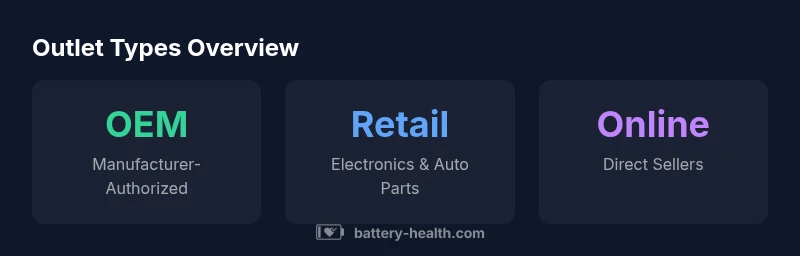
There are several common battery plus locations you will encounter:
- Manufacturer-authorized outlets: Advantages include best warranty alignment, OEM compatibility data, and direct support; drawbacks can include higher prices and limited selection.
- Major electronics and auto parts retailers: Pros include broad stock and competitive pricing; cons include potential variability in product knowledge among staff.
- Local auto shops and service centers: Pros include hands-on expertise and easy pickup; cons include narrower chemistry variety and variable return policies.
- Online marketplaces and direct-to-consumer sellers: Pros include convenience and wide range; cons include counterfeit risk and inconsistent warranties.
According to Battery Health, choosing the right channel matters. Consider your priority: price versus certainty, or speed versus breadth of options.
Battery Chemistries: What Outlet stock Typically Covers
Outlets commonly stock several dominant chemistries: lead-acid for traditional automotive uses and backup power; lithium-ion varieties for electronics and modern EVs; and LiFePO4 for portable storage and some solar setups. The exact mix varies by outlet and region, but the core rule remains: buy the chemistry specified by your device or vehicle manufacturer. Some outlets will label batteries by voltage, capacity, and form factor; others provide only a generic category. Battery Health's guidance emphasizes reading the datasheet and cross-checking with the device’s manual. If you are replacing a high-drain battery in an older device, a compatible substitute may exist, but ensure the energy density, charging profile, and temperature range match the original. This reduces risk of mismatches and improves long-term performance.
Practical Shopping Guide: Steps to Verify Compatibility
- Identify the exact battery model and part number from the device or vehicle manual; 2) Confirm the chemistry type (Li-ion, LiFePO4, lead-acid) and voltage; 3) Check the form factor and terminal configuration; 4) Compare warranty terms and the return window; 5) Inspect the packaging for tamper-evidence and authenticity seals; 6) If shopping online, read reviews and verify the seller's return policy. By following these steps, you reduce the probability of wrong purchases and gain access to reliable after-sales support. Battery Health reiterates that proper outlet selection is as important as choosing a battery brand.
Warranties, Returns, and Risk Management at Different Outlets
Most manufacturer-authorized outlets offer robust warranties and straightforward returns; major retailers usually offer competitive policies but may have more variability by product line; local shops can provide quick replacements but may lack standardized warranties. Always document purchase details, keep receipts, and photograph the packaging and battery labels. If you encounter a defective battery, contacting the seller quickly improves the chances of a replacement, repair, or refund under the stated terms. Battery Health's framework recommends favoring outlets with clear, written warranties and a straightforward exchange process.
Sourcing Tips for Car Batteries, Device Batteries, and Home Storage
Planning ahead reduces friction when you need to replace a battery quickly. Build a short list of trusted outlets near you, download or print the OEM part numbers, and maintain a simple inventory of your devices' battery specs. For car batteries, confirm the cold-cranking amps (CCA) and reserve capacity; for devices, verify form factor; for home storage, consider cycle life and safety features. When possible, visit a store to physically compare size and terminal types, or contact the seller to confirm live stock. Battery Health notes that proximity to service centers can speed warranty validation and post-purchase support.
Battery Health's Verdict on Battery Plus Locations
To avoid common pitfalls, prioritize manufacturer-authorized outlets and reputable retailers; avoid unverified online sellers with obscure return policies. Always align battery chemistry and form factor with your device specifications, and keep documentation handy. Battery Health's guidance emphasizes that the smartest choice is to buy from sources that offer reliable compatibility data, straightforward warranties, and accessible support—reducing the risk of counterfeit parts and costly misfits.
Comparison of battery outlet types
| Outlet Type | Typical Stock | Pros | Cons |
|---|---|---|---|
| Manufacturer-authorized outlets | OEM batteries, matching kits | Best warranty alignment, direct support | Higher price, limited stock |
| Major electronics retailers | Li-ion, common chemistries | Competitive pricing, broad stock | Staff knowledge variability |
| Auto parts stores | Car batteries, related chemistries | Convenient for vehicles, quick replacements | Limited specialty chemistries |
| Online marketplaces | Various chemistries, direct-to-consumer | Huge range, fast shipping | Counterfeit risk, uncertain warranties |
FAQ
What are battery plus locations?
Battery plus locations are the channels where you purchase batteries and related accessories. These include manufacturer-authorized outlets, major electronics retailers, auto parts stores, and reputable online sellers. The goal is to secure compatibility, warranty, and authenticity for your battery purchase.
Battery outlets are places you buy batteries from, like authorized stores, big retailers, auto shops, and trusted online sellers.
Which outlets offer the best balance of price and reliability?
Manufacturer-authorized outlets typically provide the strongest warranty and compatibility data, but price can be higher. Major retailers often offer competitive pricing and broad stock, while local shops provide quick service. Consider your priorities to choose the best balance.
Authorized outlets give solid warranties; big retailers balance price and stock; local shops offer quick service.
Are there risks buying from discount or gray-market sellers?
Discount or gray-market sellers may offer low prices but can carry counterfeit parts or unclear warranties. Always check authenticity seals, verify part numbers, and ensure a valid return policy before purchase.
Discount sellers can be risky; verify authenticity and returns before buying.
How can I verify compatibility before purchase?
Match the device or vehicle model, part number, chemistry type, voltage, and form factor against official specifications. Read datasheets and confirm warranty terms. If online, read reviews and check seller credibility.
Check model numbers, chemistry, voltage, and size, then read reviews and warranty terms.
Should I buy batteries from online marketplaces or manufacturer sites?
Online marketplaces offer variety and convenience, but verify seller credibility and warranties. Manufacturer sites often deliver stronger authenticity guarantees and compatible data, though stock varies by region.
Online marketplaces are convenient but verify credibility; manufacturer sites are often more trustworthy.
Warranty transfer when moving outlets?
Warranty terms are tied to the seller and product. Transfers are sometimes possible with receipts and proper registration, but policies vary. Always confirm before purchase.
Warranties depend on the seller—check terms and keep receipts.
“Choosing the right battery outlet reduces the risk of counterfeit parts and ensures proper warranty coverage.”
Quick Summary
- Check compatibility first before purchasing any battery.
- Prefer manufacturer-authorized outlets for warranty alignment.
- Compare chemistries (Li-ion, LiFePO4, lead-acid) across outlets.
- Verify warranty terms and return policies.
- Keep receipts and serials for future support.