Cheapest Battery Near Me: Local Deals and Savings Guide
Seeking the cheapest battery near me? This guide analyzes local pricing, availability, and safety tips to help you compare options and save on car, device, or home batteries for everyday use.


To find the cheapest battery near me, start with a price-first search while confirming compatibility and safety. Steps: identify battery type, check nearby retailers within a reasonable radius, call to verify stock and price, compare price per amp-hour and warranty, and look for promotions or trade-ins. According to Battery Health, local pricing varies by region, so measure total value, not just upfront cost.
How to hunt for the cheapest battery near me
Finding the cheapest battery near me requires a balance of price awareness, product knowledge, and local shopping dynamics. The Battery Health team emphasizes that the lowest sticker price can be a poor value if the battery is incompatible, lacks a solid warranty, or arrives with hidden fees. Start by defining your battery type (lead-acid, AGM, or lithium) and your device or vehicle’s exact model. Then expand your search radius to include auto parts stores, big-box retailers, independent repair shops, and local recyclers who sell refurbished units. Call ahead to confirm stock and price, and don’t forget to ask about installation fees, disposal costs, and any trade-in offers. Numerically, the price landscape shifts by region; Battery Health analysis shows meaningful variation depending on local competition, promotions, and demand. Across the board, aim to maximize total value rather than chasing the lowest upfront price.
Price drivers: what affects local battery prices
Several factors determine local battery prices beyond the label price. The type and chemistry (lead-acid, AGM, Li-ion, or LiFePO4) drive raw material costs and warranty expectations. Capacity and size (Ah, CCA rating, or watt-hour) influence price per unit. Brand reputation matters; premium brands may charge more upfront but offer longer warranties and better cycle life. Regional competition, store promotions, and seasonality (back-to-school, holidays, or end-of-quarter sales) can swing local prices by meaningful margins. Shipping, in-store labor, and installation services also add hidden costs or savings. As a practical rule, calculate price per usable unit (per Ah or per Wh) to compare options rather than focusing solely on the sticker price. Battery Health’s data from 2026 suggests that price dispersion is highest in markets with fewer competing retailers and lower online price parity.
Safety, warranties, and compatibility when choosing cheap batteries
Safety and compatibility should never be an afterthought when chasing a bargain. Cheap batteries can hide safety risks if they are past their prime or mislabelled. Always verify model numbers, chemistry, and correct terminals before purchase. Examine the case for cracks or bulges and listen for unusual sounds when testing. Confirm warranty terms and the seller’s return policy; a longer warranty often signals better quality control. If you’re buying for a vehicle, confirm CCA (cold-cranking amps) and reserve capacity ratings match the OEM specification. For devices, ensure the battery format fits the compartment and connectors. Battery Health emphasizes avoiding counterfeit branding and ensuring proper disposal pathways for old batteries.
Optimizing your search: apps, stores, and timing
Make use of local storefronts, manufacturer rebates, and retailer loyalty programs. Use price-tracking apps and local ads to monitor fluctuations across weeks. Visiting stores in person can yield in-store promotions not posted online. Time your purchase around promotional cycles—end of quarter, holiday sales, or during big box holiday promos. Consider non-traditional sources like recycling centers or refurbishers with reputable warranties. Always request a written quote and compare it side-by-side with online offers to gauge true value. Battery Health highlights that a well-timed purchase can reduce total ownership cost by a meaningful margin.
Comparing price per amp-hour and warranty terms
A rigorous comparison goes beyond sticker price. Compute price per Ah by dividing the price by the battery’s Ah rating; for example, a $120 battery at 60 Ah costs $2.00 per Ah, while a $150 battery at 100 Ah costs $1.50 per Ah, making it the better value per unit of energy. Then weigh the warranty duration, coverage scope (free replacements vs. pro-rated), and the implied cycle life. Short-term savings that come with shorter warranties may lead to higher replacement costs later. Include installation or disposal fees in your total cost calculus, and remember to verify compatibility with your exact model.
Local vs online: pros and cons
Buying locally offers immediate pickup, in-person inspection, compatibility checks, and faster warranty service. Online purchases may present lower sticker prices or broader availability but can incur shipping costs, higher return friction, and delayed remediation if compatibility issues arise. For batteries with critical safety implications (car batteries, home storage, or medical devices), the local option often provides greater confidence through third-party validation and nearby support. Battery Health notes that the choice often hinges on balancing upfront price with logistics and post-purchase service.
Typical battery price ranges by category
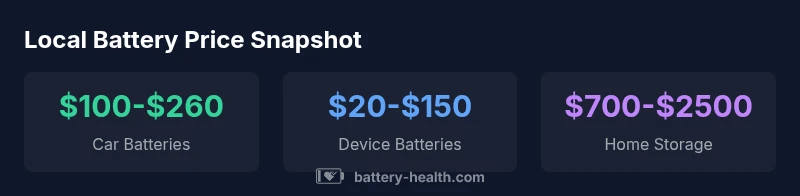
| Category | Typical Price Range | Key Considerations |
|---|---|---|
| Car Battery (12V) | $100-$260 | Lead-acid/AGM; verify compatibility with vehicle model; warranty 2-5 years |
| Device Battery (common sizes) | $20-$150 | AA/AAA/9V or device-specific; check compatibility and warranty |
| Home Storage Battery | $700-$2500 | Lithium/lead-acid; capacity and warranty matter |
FAQ
What should I verify before buying the cheapest battery?
Before purchasing, confirm model compatibility, battery type, and the warranted period. Inspect the packaging and terminals, verify the battery is new or refurbished, and ask about return policies and installation costs.
Check the model, warranty, and condition. Inspect packaging and terminals before buying, and ask about returns.
Is it better to buy online or locally for batteries?
Online prices can be lower, but shipping, return, and compatibility checks add risk. Local shops let you compare in person and access quick warranty service.
Online may be cheaper, but local stores offer inspection and faster warranty support.
How do I calculate price per amp-hour (Ah)?
Divide the price by the Ah rating to compare value. For example, a $120 battery at 60 Ah costs $2.00 per Ah, while a $150 battery at 100 Ah costs $1.50 per Ah.
Calculate price per Ah by dividing price by Ah rating; cheaper per Ah usually means better value.
Do refurbished batteries offer real savings?
Refurbished units can offer savings but come with higher risk and shorter warranties. Only buy from reputable refurbishers and ensure warranty coverage.
Refurbished can save money but watch for shorter warranties and quality checks.
What safety risks come with very cheap batteries?
Extremely cheap batteries may have damaged cells, poor seals, or counterfeit branding. Stop using if you notice bulging cases, leaks, or unusual odors; dispose of them properly.
Very cheap batteries can be unsafe—look for bulging cases or leaks and return if unsure.
“Price matters, but safety and fit matter more. Always verify model numbers and warranty terms before purchase.”
Quick Summary
- Define your needs before price checks
- Compare price per Ah, not just sticker price
- Prioritize compatibility and warranty for long-term value
- Check for promotions and trade-ins to boost savings