Battery 78 Group Size: Compatibility & Replacement Guide
Learn how the battery 78 group size fits your vehicle, verify compatibility, and replace safely with Battery Health. Practical specs, maintenance tips, and safety guidance.


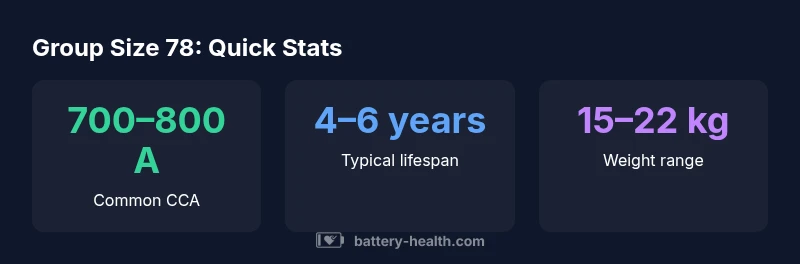
The battery 78 group size is a widely used car battery footprint found in many mid-size sedans and some SUVs. It defines the terminal layout and dimensions, ensuring fitment and reliable cold-cranking. For most models, it supports around 700–800 A CCA and a typical capacity around 70–90 Ah, depending on manufacturer.
Why the 78 Group Size Matters for Your Vehicle
According to Battery Health, the 78 group size is a commonly used footprint in many mid-size cars and some SUVs. The physical footprint — length, width, and terminal layout — determines whether a battery will physically fit in the tray and connect properly to the vehicle's cables. A mismatch can cause clearance issues, exhaust interference, or misalignment of the terminal posts, which complicates installation and may affect starting reliability. Beyond fit, the group size also informs the electrical characteristics that the alternator, starter, and power electronics expect. While multiple manufacturers may offer 78 group size batteries, the core goal is to match the vehicle’s designed cold-cranking amps (CCA) and capacity without introducing extra weight or space constraints. This alignment protects starting performance in cold weather, helps preserve electrical accessories, and reduces the risk of terminal corrosion from improper connection. The Battery Health team notes that many owners overlook the subtle differences in terminal orientation and recessed posts, which can lead to a difficult fit or loose connections after installation. Always verify the exact fitment specs in the owner’s manual or manufacturer guide before purchasing.
When evaluating options, consider vehicle trim variations, optional equipment, and regional temperature ranges because those factors influence the recommended CCA and capacity for a given 78 group size battery. If a replacement is too small in CCA, you may experience slow cranking in cold starts; if too large, it may overtax the electrical system or physically rub against components. A careful check against the OEM specification ensures you maintain balanced performance and reliability over the battery’s service life.
How to Verify Compatibility with Your Vehicle
Compatibility hinges on more than the group size. Start by locating your vehicle’s battery specification label, typically under the hood along the frame rail or near the fuse box. Cross-check the static group size, CCA, and reserve capacity against the replacement battery. If your label lists “78” or a similar variant (e.g., 78-78H), you’re aligned on footprint, but you still need to confirm CCA and capacity values. Use the vehicle’s VIN or consult the owner’s manual to identify the exact required CCA range and capacity. When shopping, insist on a battery that explicitly states 78 group size and matches or exceeds the OEM CCA rating. If you’re in a region with extreme cold or heat, consider a model with higher CCA or better temperature performance to ensure robust starting power and longevity. Finally, inspect terminal polarity and size to ensure cable connectors align properly; mismatched polarity or loose connections will degrade performance and may introduce a safety risk.
Key Specifications to Compare When Shopping for a 78 Group Size
A 78 group size battery is defined by footprint and terminals, but the critical electrical specs determine performance. Compare CCA ratings to ensure sufficient starting power in your climate; higher CCA is beneficial in cold environments. Capacity (Ah) affects how long the battery can run accessories when the alternator isn’t charging. Reserve capacity (RC) indicates how long the vehicle can run on battery power if the alternator fails. Consider terminal layout (positive/negative placement) and case height to ensure a proper fit in the tray and clearance with surrounding components. Temperature tolerance and warranty terms are also important: look for batteries designed to handle both hot summers and cold winters and a warranty that covers at least 2–4 years. Finally, verify compatibility with any stop-start systems or modern fuel-management features, which can affect the required CCA and RC values. The Battery Health analysis shows that brands often differentiate themselves in high-heat resistance and vibration resistance, which can impact long-term reliability.
Replacement Considerations and Fitment Across Brands
Brand diversity means you’ll encounter batteries built on the same 78 footprint but with different internal chemistries, case heights, and internal plate designs. Some models emphasize higher CCA ratings, others focus on longer cycle life or better vibration resistance for comfort-focused SUVs. When replacing, consider a brand with a recognized warranty, accessible customer service, and genuine replacement part compatibility with your vehicle’s electrical architecture. Don’t let a lower price tempt you into a mismatch; the wrong fit or inferior build quality can lead to accelerated terminal corrosion, reduced starting performance, or premature failure. If you drive in extreme temperatures, choose models with enhanced temperature tolerance. To ensure you’re making a robust choice, compare at least two brands and check independent reviews that mention real-world performance in your climate. Battery Health’s framework emphasizes fit, reliability, and long-term value over upfront cost.
Safe Handling, Installation Tips, and Maintenance
Safety comes first when handling lead-acid batteries. Always wear eye protection and gloves to guard against acid exposure. Disconnect the negative terminal first, then the positive, and avoid metal tools that can create short circuits. Secure the battery firmly in its tray to prevent movement during driving, which can over time loosen connections or cause a short. When installing, ensure the cable clamps are clean, free of corrosion, and tightened to the manufacturer’s torque specifications. After installation, check the battery voltage and perform a system check to confirm the alternator is charging correctly. Regular maintenance includes cleaning terminals, applying protective anti-corrosion grease to terminals, and monitoring electrolyte levels if you have a non-sealed AGM or flooded lead-acid battery. Disconnecting the battery during long-term storage is advisable to avoid self-discharge, and if you plan to store the vehicle, consider a smart charger that maintains a healthy charge without overcharging. The Battery Health team underscores the importance of proper disposal or recycling of old batteries at an authorized facility.
Common Myths About Group Size 78 and Performance
A frequent myth is that a larger group size automatically means better performance. In reality, fitment and electrical compatibility drive reliability; an oversized footprint can cause physical fit issues and may not confer improved starting power if CCA and capacity are not aligned with the vehicle’s needs. Another misconception is that all 78 group size batteries are created equal; differences in case design, plate chemistry, and venting can influence heat tolerance and long-term resilience. A third myth is that maintenance-free means no checks are needed; while sealed designs reduce maintenance in some climates, periodic checks of terminals for corrosion and ensuring a proper charge remain essential for longevity. Finally, people assume a higher-priced model always lasts longer; while warranty and build quality often correlate with durability, performance depends on correct spec alignment to the vehicle and climate. The Battery Health analysis supports a data-driven approach to choosing a 78 group size battery, focusing on fit, CCA, RC, and warranty rather than price alone.
Group size comparison for common passenger vehicles
| Group Size | Typical Applications | Common Vehicles | Approx. CCA Range | Weight (kg) |
|---|---|---|---|---|
| 78 | Mid-size cars | Popular sedans and crossovers | 700–800 A | 16–22 |
| 94R | Full-size vehicles | SUVs and large sedans | 800–900 A | 20–25 |
| 75/76 | Compact to mid-size | Smaller cars | 680–750 A | 14–20 |
FAQ
What vehicles use a 78 group size battery?
A 78 group size battery is commonly used in many mid-size cars and some SUVs, depending on the engine and electrical load. Always verify the OEM specifications for your exact model through the owner's manual or VIN lookup. If a 78 is specified, ensure the CCA and RC meet or exceed the factory requirements.
Many mid-size cars and some SUVs use a 78 group size battery. Always check your manual or VIN to confirm the exact CCA and RC values.
Is a 78 battery the same as 78D?
78 and 78D refer to the same footprint in many cases, but the terminal configuration and height can differ by model. Always compare the exact fitment specs, including terminal positions and tray height, to ensure compatibility.
78 and 78D often share the footprint but may differ in terminal layout and height. Check the spec sheet for your model.
How do I replace a 78 group size battery safely?
Prepare by turning off the vehicle, disconnecting the negative then positive terminals, and removing the old battery with proper lifting technique. Clean terminals, apply anti-corrosion grease, and install the new battery ensuring secure clamps and proper torque. Dispose of the old battery at an authorized facility.
Turn off the car, disconnect the negative then positive, replace with a secure, correctly torqued battery, and recycle the old one.
Can I upgrade CCA without changing the size?
In many cases you can choose a higher CCA within the same group size, but you must verify chassis clearance, terminal layout, and the alternator’s capacity to charge a higher-CCA battery. Check OEM recommendations and warranty terms before upgrading.
Upgrading CCA within the same size is possible if it fits physically and the charging system supports it.
Where should I buy a replacement 78 group size battery?
Buy from reputable retailers or authorized dealers that provide a full warranty and verify model compatibility via VIN. Avoid unverified online sellers that cannot guarantee fitment or provide limited returns.
Choose reputable sources that confirm fitment with your VIN and offer a solid warranty.
How often should I inspect a 78 group size battery?
Inspect terminals for corrosion and ensure the charge is healthy at least twice a year or before extreme seasonal conditions. If you notice slow cranking or dim lights, test the battery promptly and consider replacement if performance declines.
Check terminals twice a year and anytime you notice slow starting or dim lights.
“Correct group size matters for performance and safety; choosing the wrong battery can lead to weak cranking and accelerated wear.”
Quick Summary
- Verify your vehicle’s manual for group size 78 compatibility
- Check CCA and capacity before replacement
- Match terminal types and dimensions to avoid fitment issues
- Choose reputable brands with warranty
- Follow safe handling and disposal guidelines