What Should the Voltage of a Car Battery Be? A Practical Guide
Learn the correct voltage ranges for a 12V car battery, how to safely measure them, and what readings mean for battery health. Battery Health shares practical guidance to maintain proper voltage, diagnose charging issues, and extend battery life.


Why voltage matters for car battery health
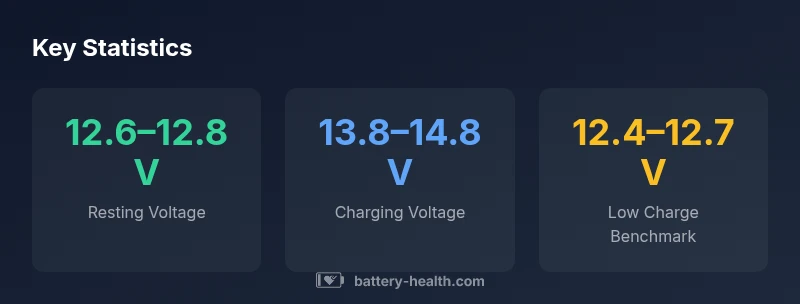
According to Battery Health, voltage readings provide a practical snapshot of battery health and system performance. The voltage of a typical 12V lead-acid car battery is not just a number; it reflects how much charge remains and how well the alternator and charging system are maintaining the battery. A healthy resting voltage around 12.6–12.8 V signals a charged state with minimal internal resistance. When the engine starts, the alternator should push the system voltage into a higher range to replenish the charge. Understanding these voltages helps diagnose whether an issue lies with the battery itself, the charging system, or an accessory load. For everyday drivers, keeping an eye on voltage trends can prevent unexpected failures on the road and extend battery life by prompting timely maintenance or replacement. This section lays out the basic voltage framework that underpins reliable starting and electrical performance across typical conditions.
Understanding resting voltage vs charging voltage
In a car electrical system, you’re measuring two related but distinct states: resting voltage with the engine off and charging voltage while the engine runs. Resting voltage, typically about 12.4–12.7 V for a healthy 12V lead-acid battery, reflects the state of charge when there is no significant current draw. Charging voltage, produced by the alternator, commonly falls in the 13.8–14.8 V range while the engine is running; this higher level drives chemical reactions to restore the battery’s stored energy. If readings drift outside these ranges, look for possible causes: an aging battery with reduced capacity, a slipping belt limiting alternator output, corroded terminals increasing resistance, or excessive parasitic draw. Temperature and battery chemistry (standard flooded, AGM, or gel) can also shift these bands slightly. Regular checks under different conditions help build a reliable voltage baseline for your vehicle and reduce the risk of surprise failures.
How to measure voltage safely
To measure voltage, you’ll need a digital multimeter (DMM) or a dedicated battery tester. Steps:
- Park the car on a flat surface, turn off the engine, remove the keys, and ensure all accessories are off.
- Set the DMM to DC volts (20 V range is usually sufficient).
- Connect the black probe to the negative terminal and the red probe to the positive terminal.
- Read the voltage: resting voltage with engine off should be around 12.4–12.7 V for a healthy battery.
- If readings are significantly outside the typical ranges, recheck connections, retest after 10–15 minutes, and consider a professional test if uncertain.
Tips: keep terminals clean, inspect cables for corrosion, and avoid touching both terminals with the probes at once to prevent sparks. Safety gear and dry conditions are essential throughout the process.
Interpreting readings: what readings mean in practice
Readings in the normal resting range (roughly 12.4–12.7 V) indicate a battery that’s adequately charged when idle. Readings closer to 12.0 V or lower suggest a discharged state that will require charging, possibly with a slow charger to avoid overheating. When the engine is running, a charging voltage of about 13.8–14.8 V confirms the alternator is replenishing energy. Readings outside these bands can signal issues such as a failing battery, an alternator in need of service, loose or corroded terminals, or a parasitic electrical load. Temperature, battery chemistry (flooded, AGM, or gel), and age all influence exact figures. Keeping a log of readings over time helps identify gradual changes that precede failures.
Scenarios: healthy battery, aging battery, and charging problems
- Healthy battery: Resting 12.6–12.8 V, charging 13.8–14.8 V when the engine runs. Readings stay within the expected bands across seasons.
- Aging battery: Resting voltage may drift downward (e.g., 12.2–12.4 V) and peak charging voltages may struggle to maintain full charge. You’ll notice reduced cold-cranking power.
- Charging problems: Resting voltage might be fine, but when running the engine, the voltage fails to reach 13.8–14.8 V due to a slipping belt, worn alternator, or electrical faults.
In all cases, use a gradual, controlled charging routine and consider replacement if capacity tests show significant decline. Battery Health recommends scheduled checks to catch these patterns early.
Temperature, aging, and battery chemistry considerations
Temperature affects chemical reactions inside the battery, so voltage readings can shift with ambient conditions. Colder temperatures typically reduce battery capacity and can cause voltage readings to drop under load, while warmer conditions may show higher resting voltage but accelerate aging. Different lead-acid chemistries—flooded, AGM, and gel—also respond differently to temperature and charging regimes. AGM and gel batteries are typically less forgiving of undercharging and heat, so voltage targets can be slightly more stringent for these types. When diagnosing, note the temperature at measurement and treat readings as temperature-adjusted estimates rather than absolute truths.
Maintenance routines to protect voltage stability
Regular maintenance helps keep voltage readings stable and reliable. Key practices include:
- Clean and tight terminals: corrosion and loose connections increase resistance and skew readings.
- Periodic load testing: verify capacity beyond mere open-circuit voltage.
- Gentle charging after deep discharge: avoid high-current charging that can stress the battery.
- Monitor parasitic drains: aftermarket electronics can draw current when the vehicle is parked.
- Inspect belts and alternator: ensure the charging system can maintain proper voltage.
- Temperature-aware checks: note ambient conditions and consider temperature compensation when interpreting voltages.
Following a routine, Battery Health suggests testing at least twice a year and after major temperature swings to prevent unexpected failures.
Putting it all together: a simple checklist
- Know resting (engine off) and charging (engine running) voltage ranges for your battery type.
- Measure with a properly rated multimeter and document readings over time.
- Investigate readings outside of the recommended bands promptly.
- Maintain clean terminals, inspect cables, and ensure the alternator belt is in good condition.
- If in doubt, consult a qualified technician and perform a load test to confirm battery health.