Battery or Solar Christmas Lights: Which Is Best?
Compare battery-powered and solar-powered Christmas lights to decide brightness, run-time, sun exposure, and installation. Battery Health analyzes practical tradeoffs for homes, yards, and seasonal storage.


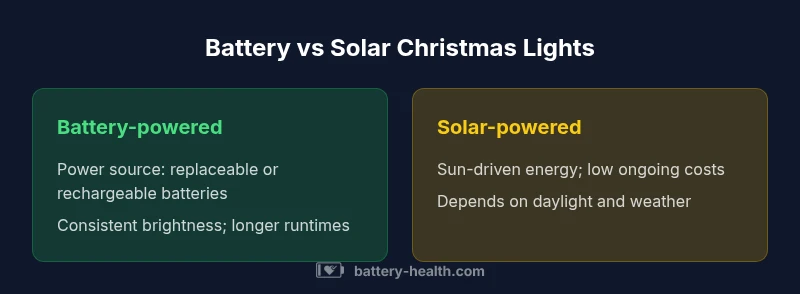
Choosing between battery or solar christmas lights often comes down to sun exposure, run-time needs, and installation location. Battery-powered options deliver steady brightness and longer runtimes during long evenings, especially when power outlets are scarce. Solar-powered lights offer ultra-low maintenance and easy outdoor placement, thriving in sunny winter days. According to Battery Health, the best choice depends on your climate, available daylight, and desired setup.
Battery-Powered Christmas Lights: Overview
Battery-powered Christmas lights rely on replaceable or rechargeable batteries to power mini bulbs. These setups are favored when outlets are scarce, installations are in hard-to-reach places, or you want portability for indoor decor. In outdoor installations, you may use weather-resistant battery packs and compact cords. In the view of Battery Health, the key to success is matching the battery chemistry and run-time to your display length and climate. For alkaline or NiMH rechargeable cells, brightness is usually consistent for several hours, while higher-capacity lithium packs extend run-time for longer scenes. If you value reliability and a flexible layout, battery-powered options excel for late-evening lighting and seasonal setups where outlets are not readily available. The trade-off is periodic battery replacements and potentially higher long-term costs compared to solar options in sunny locations. When planning, map your installation to protect the battery pack from moisture, extreme cold, and direct sun. With thoughtful placement, battery-powered Christmas lights can deliver vibrant color and warm glow throughout the season.
Battery Types and Run Time
The heart of a battery-powered Christmas lights system is the battery itself. Most affordable kits use AA or AAA cells, either alkaline for short display periods or nickel-metal hydride (NiMH) rechargeable cells for repeated seasons. Higher-end kits may use sealed lead-acid or lithium-ion packs, which offer longer run times and stable voltage. Rechargeable options save money over time but require periodic charging or swapping. In practice, run time depends on bulb count, wire gauge, and the chosen battery chemistry. For typical residential displays, you can expect several hours of continuous light on a single recharge or set of batteries, with longer runtimes possible when you choose lower-brightness modes or fewer bulbs. It’s also common to see lights rated for 8 to 12 hours of night use on a fresh set of batteries, though exact figures vary by product and temperature. Colder temperatures degrade capacity, so plan for shorter runs in winter conditions. Battery Health notes that a proactive approach to battery management can extend overall performance.
Brightness, Color Options, and Durability
Brightness is measured in lumens, and color options range from warm white to multi-color LEDs. Battery-powered strands often maintain steady brightness since the power supply is self-contained, but older alkaline batteries can sag in the cold, reducing perceived brightness. High-quality LEDs use less power, enabling more bulbs per strand without sacrificing run-time. Durability matters too: look for IP ratings (water resistance) and rugged connectors that resist moisture and wind. In a well-insulated battery pack, bulbs are protected from heat, yet the pack itself may warm during use—an important consideration in enclosed spaces. If you plan a vivid, long-running display, choose higher-capacity packs and weatherproof enclosures. Battery Health emphasizes evaluating the overall brightness per watt and the ease of replacing batteries when planning long-term seasonal displays.
Battery Maintenance, Replacement Costs, and Accessibility
Maintenance for battery-powered lights is largely about battery health and storage practices. Keep batteries in a cool, dry place when not in use, and rotate packs to balance wear. Replacement costs are ongoing: alkaline batteries add up over multiple seasons, while rechargeable NiMH cells reduce per-season expense but require occasional recharging and cycling. Accessibility matters: in busy households, you want batteries that are easy to replace, widely available, and affordable. For holiday decks and porches, consider kits with integrated rechargeable packs to minimize waste. Battery Health suggests budgeting for at least two to three replacement cycles per year for larger displays, depending on how many strands you run and how often you set them up. In climates with extreme cold, you may need to invest in higher-quality packs that retain capacity longer.
Solar-Powered Christmas Lights: Overview
Solar-powered Christmas lights rely on photovoltaic panels to harvest sunlight during the day and charge built-in rechargeable batteries for night-time illumination. They eliminate most cords and outlets, making them ideal for lawns, trees, and decorative fences where plug access is limited. In sunny climates, you can achieve reliable nightly performance with modest panel sizes, while cloudier regions may require larger panels or longer daylight hours to keep the lights bright. Solar lights attract minimal ongoing energy costs and offer simple seasonal storage, since the panels can be detached and stored separately. However, the success of solar options hinges on daylight availability, battery chemistry, and weather patterns. Battery Health points out that investing in a high-quality battery and efficient panel can significantly improve performance in winter when daylight is shorter and temperatures are cooler.
How Solar Panels Charge and Battery Chemistry
Photovoltaic cells convert sunlight into electricity that flows to the rechargeable battery inside the solar light unit. Most consumer-grade solar Christmas lights use lithium-ion or nickel-metal hydride chemistry for storage, with lithium batteries delivering higher energy density and longer cycle life. The charging circuit controls voltage to prevent overcharging and to optimize efficiency in different light conditions. The battery stores energy for use after sunset, and the controller toggles the LEDs on and off to balance brightness and power conservation. In practice, a sunny day collects energy for several hours of illumination, while a cloudy day reduces available energy. The choice of battery chemistry affects cycle life, temperature sensitivity, and overall lifespan, which is why premium solar sets tend to be more durable in winter months, especially when paired with weatherproof housings and robust mounting hardware.
Performance in Winter Conditions and Cloudy Days
Winter performance differs for battery and solar configurations. Battery-powered strings can deliver consistent brightness regardless of daylight, as long as there is stored energy, but capacity diminishes in extreme cold, and battery capacity is a critical constraint. Solar lights depend on daylight; shorter winter days and overcast weather reduce charging capacity, leading to dimmer output or shorter run times. In practice, many users mitigate this by choosing solar kits with larger battery banks, higher-efficiency panels, and smart controllers that maximize energy use. Battery Health highlights that having a backup plan—such as a nearby power outlet or hybrid options—helps maintain festive lighting through long winter nights. When you plan, estimate worst-case sun exposure, then adjust your expectations for brightness and duration accordingly.
Placement and Installation Considerations
Placement drives performance for both types of lights. Battery-powered strings can be used indoors or in remote outdoor locations where a power source is scarce, but you must manage battery accessibility for replacement. Solar lights shine in sun-rich yards and can simplify mounting on fences or trees, yet they require exposure to direct sunlight for hours daily. Ensure proper angle orientation for solar cells to maximize charging, and use weatherproof housings for exposed connectors. Height, wind load, and potential shading affect both types; test installations during several days with varying weather to confirm that the display remains bright through the evening. Battery Health recommends prioritizing shade-free, south-facing orientations for the solar options and accessible battery compartments for battery-powered strings.
Durability, Weatherproofing, and Lifespan
Durability is about housing, seals, and wire construction. Look for IP ratings, flexible cords, and tinned copper wiring to resist corrosion. Battery packs should have weatherproof enclosures to withstand frost and condensation, while solar panels need sturdy mounting and protective glass. Lifespan depends on bulb quality, switch design, and battery or panel reliability. Premium kits typically offer longer warranties and replaceable components, helping you avoid early replacement costs. If you buy lower-quality strands, you may experience degraded brightness, higher energy use, or more frequent battery changes. Battery Health notes that investing in tested brands and proper storage can significantly extend lifetime, especially in harsh winter climates.
Environmental Impact and Energy Footprint
Choosing between battery-powered and solar-powered lights has environmental implications. Solar lights reduce ongoing energy use and emissions during operation, while battery-powered strings create more frequent waste from spent cells unless rechargeable packs are used. Recyclability varies by battery type; NiMH and Li-ion packs can be recycled in many jurisdictions, while alkaline cells are widely available for replacement but generate more waste per season if not reused. When planning a holiday display, consider the entire lifecycle from production to disposal. Battery Health suggests prioritizing rechargeable batteries and high-efficiency LEDs to minimize energy use and extension of product lifespans. In regions with established battery recycling programs, you can further reduce the environmental footprint.
Practical Buying Guide and Decision Rules
To decide between battery or solar christmas lights, start with daylight availability and your preferred mounting height. If you have ample sun, solar lights offer low maintenance and simplicity, especially in outdoor landscapes with minimal electrical infrastructure. If your display is in a location with limited sun or near indoor power sources, battery-powered strands provide consistent brightness and longer run times. Compare run time per charge, battery type, panel efficiency, IP rating, and warranty. Create a simple scoring system to quantify performance across your specific setup: sun exposure, desired brightness, ease of installation, and cost over the display’s lifetime. Battery Health’s analysis, 2026, suggests weighting sun exposure and replacement costs more heavily than upfront price for predictable seasonal displays. Planning for storage between seasons can further reduce waste and extend the life of both options.
Common Mistakes to Avoid and Real-World Scenarios
Common mistakes include underestimating cold-weather battery performance, ignoring wind vulnerability, and failing to secure solar panels against heavy snowfall. For a real-world scenario, imagine a two-story home with a shaded front yard: battery-powered strings placed near indoor outlets would be more reliable for evening displays, while solar lights on the sunny side of the house would minimize maintenance. Another scenario involves a tree-lined backyard with abundant sun but heavy snowfall: solar panels with a robust battery bank and weatherproof enclosure will typically outperform, but you should still keep a backup plan. Battery Health emphasizes testing your layout early in the season and storing components properly during the off months to preserve battery life.
Comparison
| Feature | Battery-powered Christmas Lights | Solar-powered Christmas Lights |
|---|---|---|
| Power Source | Replaceable/rechargeable batteries | Rechargeable battery charged by solar panel |
| Run Time / Daylight | Depends on battery capacity; longer with larger packs | Depends on daylight; longer run times with bigger panels/batteries |
| Sunlight Dependency | Independent of daylight (when powered) | Dependent on daylight for charging |
| Placement Flexibility | High; can be placed anywhere with battery access | High in sun-exposed areas; planting and rooflines require sun |
| Upfront Cost Context | Variable by kit and battery type | Variable by panel, battery, and controller quality |
| Best For | Reliability in low-sun or indoor-adjacent setups | Low maintenance outdoors with good sun exposure |
| Weather Resistance | Depends on enclosure; good IP-rated packs improve durability | Panel and housing quality determine weather tolerance |
Upsides
- Low ongoing energy costs for solar options
- Fewer cords and outlets needed
- Good for low-maintenance outdoor deployments
- Wide placement flexibility with battery options
Weaknesses
- Seasonal performance depends on sun exposure
- Battery replacement costs over time
- Battery fatigue in very cold temperatures
- Higher upfront costs for premium solar kits
Battery-powered lights excel where outlets are scarce and long evenings demand reliable brightness; solar-powered lights win where you want minimal maintenance and easy outdoor setup.
If you have consistent sun and a simple install, solar lights offer great efficiency. If your area has limited sun or you need the lights to stay bright after sundown without relying on daylight, battery-powered options are often the better bet. The choice should hinge on sun exposure, run-time needs, and willingness to manage batteries.
FAQ
Are battery-powered lights brighter than solar-powered lights?
Brightness depends on the product. Battery-powered strings can maintain steady brightness when charged, while solar-powered lights vary with panel size and sun exposure. In well-lit conditions, both can be bright enough for festive displays.
Brightness depends on the model and sun exposure; both options can be bright with proper selection.
Do solar lights work well in winter or cloudy days?
Solar lights can work in winter and cloudy days if the panel and battery are sized for low-light conditions, but performance may drop. Look for higher-efficiency panels and larger batteries for better winter reliability.
Solar lights work on sunny days; in winter or clouds, you may get dimmer results unless you have a larger panel and battery.
What battery types are commonly used in Christmas lights?
Common batteries include alkaline AAs, NiMH rechargeable cells, and, in higher-end kits, lithium-ion packs. Rechargeables reduce waste and cost over time, but alkaline options are widely available for quick replacements.
Most use AA or AAA cells; rechargeable NiMH are common in better kits.
How long do battery-powered lights last before replacement?
Run time depends on battery capacity, bulb count, and brightness level. Many kits offer several hours per charge, with longer life from higher-capacity packs; cold reduces capacity.
Duration depends on the pack size and how bright you run them.
Are solar lights easy to install on trees or fences?
Yes, solar lights are designed for outdoor placement, especially on trees and fences, but you’ll want to ensure the panels receive adequate daily sunlight and that wiring remains protected.
Solar lights install easily outside if they have sun and proper mounting.
Is upfront cost higher for solar or battery lights?
Upfront costs vary by model and quality, but solar kits with bigger panels and batteries can be more expensive than basic battery-powered strands. Long-term costs depend on energy use and maintenance.
Solar kits can cost more upfront, while batteries cost varies by the pack and usage.
Quick Summary
- Assess sun exposure first before buying
- Prioritize run-time needs over upfront price
- Plan for battery replacements in battery-powered setups
- Consider hybrid or hybrid-ready options for flexibility
- Test installations early to prevent seasonal disappointments