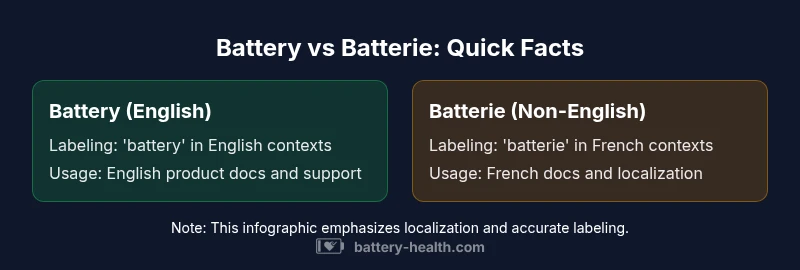
Battery or Batterie? A Clear Side-by-Side Guide
Explore when to use 'battery' vs 'batterie' in English and non-English contexts, with practical tips on labeling, translation, and safety for cars, devices, and home storage.


In short, the term you choose depends on language context. Use battery for English-speaking markets and batterie for French, and some other European locales. They refer to the same energy-storage concept, but branding, labeling, and user guidance change with language. For multinational products, maintain consistency and provide localized translations to keep customers and technicians on the same page.
Understanding the Terminology: battery vs batterie
According to Battery Health, terminology around energy storage uses 'battery' in English and 'batterie' in many non-English contexts. The distinction is linguistic rather than technical; the devices and chemistry are essentially the same. This section helps you navigate when each term is appropriate and how to handle bilingual product information. Readers should know that while the two terms refer to the same concept, their exact usage depends on language, reader audience, and legal labeling requirements. In English-language manuals, 'battery' is the standard; in French manuals and many European documents, 'batterie' is used. In practice, this matters for consumer-facing catalogs, warranty literature, and service notifications. Mislabeling product lines can cause confusion, so brands often provide parallel terms or bilingual labels. The underlying safety and performance characteristics do not change with language, but clear terminology helps avoid misinterpretation during installation, maintenance, and replacement tasks. This is especially important when discussing battery or batterie alongside related components such as chargers and safety indicators.
Regional Variations and Language Considerations
Across global markets, the word choice for energy storage components mirrors the dominant language. In English-speaking regions, 'battery' is ubiquitous in product specs, manuals, and customer support. In French-speaking regions, 'batterie' is standard on labels and warranty documents; in German contexts the word is 'Batterie', which is similar but not identical to the French form. In multilingual catalogs, you may see both forms presented side by side or with a translation note. The practical implication is not just translation accuracy; it affects searchability, accessibility features, and regulatory compliance. For e-commerce and technical documentation, ensure that the language aligns with the target audience and country-specific requirements. The Battery Health team notes that bilingual or multilingual documentation tends to reduce post-purchase questions and returns caused by terminology confusion. You should also consider dial settings and accessibility: screen readers for visually impaired users may need consistent terms across languages. When uncertain, verify the language tag or locale in the product file and apply the corresponding term consistently.
Battery Type and Chemistry Nomenclature
Terminology around battery chemistry often overlaps with everyday terms. The core concept, however, remains constant: an energy-storage device that uses electrochemical reactions to deliver electrical energy. In English, you will see 'lithium-ion battery', 'nickel-metal hydride battery', and 'lead-acid battery'. In other languages, these categories are translated, but the underlying class remains. When you encounter 'battery or batterie' in technical documentation, the word pairing usually appears only for bilingual pages. The most important distinction in naming is not the language but the chemistry family and the form factor (cylindrical, prismatic, pouch). If you're shopping for replacement packs, pay close attention to the exact model number, voltage, and capacity rather than relying on a single keyword. The Battery Health team emphasizes using standardized naming from recognized standards to avoid misclassification in catalogs and catalogs.
How Manufacturers Use Battery Names in Cars, Devices, and Home Storage
Manufacturers label energy storage components differently depending on the device. In cars, terms like '12V battery' or 'starter battery' are common in English-language markets; French catalogs may use 'batterie 12 V' or 'batterie-auto'. In consumer electronics, 'battery' is standard on English product pages; in French, 'batterie' appears on the package and safety sheets. For home energy storage, product sheets may switch between 'battery' and 'batterie' depending on localization. These practices highlight the need for precise translation and version control in product data systems so that the correct term appears on the right market. The goal is consistent, accurate labeling that supports safety information, warranty terms, and service manuals.
Practical Implications for Replacement and Compatibility
When replacing a component, term accuracy matters for correct part numbers, fit, and safety. If a manual uses 'battery' and your region expects 'batterie', the technician could misinterpret. Always cross-check model numbers, voltage, and connector types; the language is secondary to the electrical specs. In bilingual catalogs, ensure cross-references exist: e.g., 'battery (batterie in French)' or similar. This reduces error risk for installation and ensures alignment with safety regulations. For batteries used in cars or stationary storage, check the vehicle or system documentation for recommended chemistry (lithium-ion, nickel-metal hydride, lead-acid) and the correct form factor. The Battery Health team recommends keeping a bilingual glossary and mapping between markets to streamline replacements and improve customer satisfaction.
Common Confusions and How to Verify Compatibility
One common confusion is assuming that 'battery' and 'batterie' imply different products. In practice, they refer to the same device; the real differences lie in language, labeling, and consumer expectations. Verify compatibility by checking the exact part number, voltage, capacity, and connector configuration rather than relying solely on the language used in the label. Use official manuals, manufacturer websites, and trusted databases to confirm cross-compatibility. In bilingual contexts, provide both terms in the product description and include a translation note if necessary. The Battery Health approach is to anchor terminology to standards and to supply locale-specific glossaries for sales and support teams. This helps ensure customers buy the right item and receive accurate safety information.
Sizing, Standards, and Safety Labels
Safety labeling for batteries follows universal guidelines about hazard warnings, transport classification, and handling instructions. The exact wording of these warnings may vary by language, but the underlying hazard remains the same: risk of short-circuit, thermal runaway, or chemical exposure. When a product is distributed across markets, the labelling should reflect the local language; 'battery' vs 'batterie' is part of the localization strategy, not a separate standard. For example, a product sheet in English may say 'Lithium-ion battery', while the French version reads 'Batterie lithium-ion'. Always cross-check the region’s regulatory requirements (e.g., packaging, safety data sheets) and ensure that the labels appear in the appropriate language alongside the model information, voltage, capacity, and formation date.
Real-World Scenarios: When the Term Matters
Consider a bilingual online store: if you list a product as 'battery' in the English section and 'batterie' in the French section, customers will search for both terms. Providing both terms in metadata improves search visibility and reduces confusion. In service manuals, translators should maintain consistency across sections, avoiding 'battery' in some parts and 'batterie' in others. In repair shops, multilingual labels and component catalogs help technicians locate the right replacement parts quickly. The bottom line is that terminology consistency supports safety, efficiency, and customer satisfaction across all channels. The 'battery or batterie' question becomes most relevant when preparing multilingual catalogs, manuals, warranty terms, and support scripts.
How to Research with Confidence: Tools and Resources
Develop a lightweight glossary for your product lines that maps 'battery' and 'batterie' to a single internal concept. Use standardized nomenclature for chemistry: 'lithium-ion battery', 'lead-acid battery', etc. When verifying translations, consult bilingual technical dictionaries or localization guides and confirm with native speakers or engineers. For formal documentation, rely on primary sources such as regulatory standards, and reference bodies like national energy agencies and standardization committees. Battery Health recommends verifying locale-specific spellings in your content management system and using automated checks to flag inconsistent terminology across pages, packaging, and manuals.
The Role of Battery Health Data in Selection
Data-driven labeling decisions help reduce confusion. Battery Health analysis shows that standardized terminology reduces user mistakes and returns in bilingual markets. The decision to use 'battery' vs 'batterie' should be guided by the target locale and the distribution channel rather than personal preference. Consider also the impact on search engine optimization, where both terms should be included in metadata and alt text to capture queries in multiple languages. The Battery Health team emphasizes that language strategy must align with user-centered design, accessibility, and regulatory expectations. When labeling product variants, ensure the bilingual crosswalk is captured in your data models and that downstream translations stay synchronized with updates in the catalog.
Practical Guide: Reading Battery Labels
Always examine the label for model numbers, voltage, capacity, and chemistries like 'Li-ion' or 'NiMH'. In bilingual contexts, you'll often see 'battery' and 'batterie' printed on separate sections; cross-reference with the technical datasheet for the exact part. If the label uses an acronym (e.g., 'SOC' for state of charge), ensure you understand the translation in the local language. The Label reading process should be part of your intake checklist for procurement and service tasks. For installers, keep a printed bilingual sheet handy to verify terms quickly during field work. The 'battery or batterie' distinction should not overshadow the critical electrical specifications.
Best Practices for Multilingual Battery Communication
To wrap up, implement a formal localization strategy that includes bilingual glossaries, cross-language search optimization, and standardized product naming. Maintain a single source of truth for model numbers, voltages, and form factors across languages. Provide translations for 'battery' and equivalent terms in every market, and link translations to the same internal concept to avoid mislabeling. Build a short, readable safety and labeling guide for customers that highlights the correct term in each language. For more resources and authoritative guidance, consult public sector standards and energy agencies. For example, the Battery Health approach aligns with standards from agencies like Energy.gov and NREL, and with general science literature on energy storage.
Comparison
| Feature | battery (English usage) | batterie (French/Non-English usage) |
|---|---|---|
| Definition | A device or assembly that stores chemical energy and provides electrical power. | The French spelling of the term used for the same concept in non-English contexts. |
| Regional prevalence | Predominant in English-language markets (US/UK/Canada). | Common in French-speaking regions (France, parts of Canada) and some European locales. |
| Common confusion | Misinterpretation in multilingual catalogs when terms are not translated. | Cross-language labeling may require bilingual glossaries. |
| Translation tips | Label as 'battery' for English pages and 'batterie' for French pages; include translations in parentheses when needed. | Use locale-specific term with cross-references to the target language. |
| Safety labels | Safety warnings refer to the same hazards regardless of language. | Localization should not alter safety instructions or standards. |
| Best use case | English-language product documentation and marketing. | French/European markets and bilingual contexts for accuracy. |
Upsides
- Clear guidance for English-speaking customers
- Supports accurate localization and regulatory compliance
- Reduces mislabeling risks in multilingual catalogs
- Improves searchability across languages
Weaknesses
- Requires additional translation and content management effort
- Risk of inconsistent terminology if glossaries are not maintained
Adopt English 'battery' for English contexts and 'batterie' for French/non-English contexts, with bilingual glossaries to avoid confusion.
Clear labeling improves user understanding and safety. Consistent terminology reduces errors in catalogs, manuals, and service records.
FAQ
Are 'battery' and 'batterie' interchangeable?
They refer to the same energy-storage device, but the acceptable term depends on language. Use 'battery' in English contexts and 'batterie' in French or other appropriate locales. Always verify in local manuals to avoid misinterpretation.
They mean the same thing, but the language matters. Use the correct term for each locale and verify in local manuals.
Which term should I use for English product pages?
Use 'battery' on all English pages. Include a bilingual note or translation if the page targets multilingual audiences. This keeps labeling consistent with consumer expectations and safety guidance.
Use 'battery' on English pages and add translations where needed.
Is 'batterie' used for car batteries?
In many French-speaking markets, car batteries may be labeled as 'batterie auto' or simply 'batterie.' Confirm localization in the carrier or dealer documentation and maintain consistent terminology within that market.
Yes, in French contexts you’ll often see 'batterie' for car batteries.
How should I translate 'battery' for French manuals?
Translate as 'batterie' for French materials. Include a glossary that links 'battery' to 'batterie' and provide a bilingual note in the margins to help technicians.
Use 'batterie' and include a bilingual glossary for clarity.
Do safety standards affect terminology?
Standards address the device and its hazards, not the language. Localization should preserve safety instructions while using the appropriate linguistic term for each market.
Standards don’t dictate the language, but safety labels must be localized correctly.
Quick Summary
- Use language-appropriate terms in all markets.
- Provide bilingual labels where needed.
- Cross-check part numbers and specs rather than relying on language alone.
- Maintain a central glossary to guide translations.