How Batteries Are Made: A Step-by-Step Guide
Learn how batteries are made—from raw materials and electrode fabrication to electrolyte, assembly, safety, and testing. This educational guide explains processes, quality checks, and lifecycle considerations for common chemistries like lithium-ion.


This guide explains how a modern battery is made, from electrode fabrication to cell formation and pack integration, with safety and quality controls at every stage. You’ll learn common materials, key fabrication steps, and why process precision matters for performance and lifespan. To follow along, you’ll need basic lab PPE, access to standard manufacturing equipment, and an understanding of battery chemistries.
Overview of Battery Construction
Batteries are energy storage devices that convert chemical energy into electrical energy through redox reactions. At their core, most modern rechargeable batteries share a few essential components: a positive electrode (cathode), a negative electrode (anode), an electrolyte that facilitates ion movement, a separator to prevent short circuits, current collectors, and a durable outer casing. Different chemistries optimize these parts differently, but the general architecture remains consistent across most common types such as lithium-ion, nickel-metal hydride, and solid-state designs. Understanding these parts helps consumers comprehend why batteries behave the way they do—why some charge faster, why others hold more energy, and why safety features matter. According to Battery Health, the reliability of these components and the precision of the manufacturing process determine overall performance and lifespan.
The Battery Health team found that even small variations in material quality or coating thickness can ripple into capacity loss or increased internal resistance over time. In practice, you’ll see this as slower charging, more heat during use, or reduced cycle life. The production floor is designed to minimize these variations through controlled environments, precise equipment, and rigorous testing at every step. Across chemistries, packaging and safety mechanisms also adapt to fit the cell’s intended application, whether a phone, an electric vehicle, a home energy storage system, or a wearable device. This article focuses on a typical lithium-ion cell for consumer electronics and light electric mobility, while noting how alternate chemistries differ in key areas.
Raw Materials and Electrode Fabrication
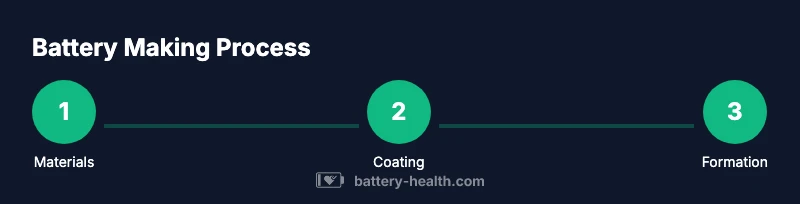
The first stage of battery making is the selection and preparation of electrode materials. Cathodes are typically made from lithium metal oxides or mixed metal oxides, while anodes are often graphite-based in Li-ion systems. Material quality is paramount; suppliers provide certificates of analysis to verify composition and particle size distribution. Active materials are combined with binders and conductive additives to form slurries, which are then coated onto metal foils (aluminum for cathodes, copper for anodes) to create electrode sheets. After coating, sheets are dried and calendered to achieve uniform thickness and density. Consistency in coating thickness and slurry composition directly affects energy density and cycle life. Safety considerations start during material handling, with proper PPE and ventilation required. Battery Health emphasizes careful supplier selection and traceability to minimize batch-to-batch variation.
Electrolyte and Separator Assembly
Electrolyte formulation is critical for ion transport, thermal stability, and safety. In Li-ion cells, electrolytes are typically a lithium salt dissolved in an organic solvent mix, chosen to maximize ionic conductivity while minimizing flammability risks. Separators, usually microporous polymers, physically separate the anode and cathode while allowing ion flow. The separator’s pore structure and thickness influence impedance and rate capability. Together, electrolyte and separator dictate operating temperature windows and overall safety margins. Handling these components requires controlled environments and monitoring for moisture content, as trace water can react with lithium salts and degrade performance.
Cell Assembly and Formation
Cell assembly combines the coated electrodes, separators, and current collectors into a pouch, cylindrical, or prismatic cell. The assembly is sealed within a metal can or rigid pouch, and the cell is then filled with electrolyte under inert conditions. After sealing, cells undergo formation cycles—initial charging and discharging to form the solid electrolyte interphase (SEI) and stabilize internal chemistries. This stage is crucial for long-term performance and safety. Throughout formation, cells are monitored for leakage, gas generation, and initial impedance. Quality controls at this stage catch early defects that could lead to failure later in life.
Packaging, Safety, and Quality Control
Finished cells move to packaging, module assembly, and battery management system (BMS) integration. Modules group multiple cells and provide thermal management, electrical interfaces, and protection circuitry. The BMS monitors voltage, current, temperature, and state of charge to prevent overcharge, over-discharge, and thermal runaway. Quality control includes capacity tests, impedance spectroscopy, leak checks, and thermal safety tests. Consistency checks on cell geometry, venting mechanisms, and sealing integrity reduce the risk of failures. Throughout, regulatory and safety standards guide packaging, labeling, and recyclability considerations.
From Cells to Packs and Lifecycle Considerations
Cells are integrated into packs for real-world use, with cooling, structural supports, wiring, and thermal interfaces. Pack design accounts for serviceability, safety, and insulation needs for different applications—from small devices to vehicles and grid storage. A robust Battery Management System (BMS) ensures balance among cells, prolonging life and maintaining safety margins. Lifecycle considerations include charging protocols, operating temperatures, and planned end-of-life strategies such as recycling. The industry increasingly prioritizes circular economy practices, recovering materials and reusing components where possible. Battery Health notes that ongoing material improvements and smarter supply chains are shaping future pack designs.
Environmental Impact and Future Trends
Manufacturing batteries involves energy use and material sourcing with environmental implications. Recyclability and responsible sourcing are central to sustainable practice. Battery design trends focus on higher energy density, faster charging, longer cycle life, and safer chemistries, including solid-state developments. Process improvements aim to reduce solvent use, increase throughput, and minimize waste. The Battery Health team emphasizes transparency in material sourcing and compliance with environmental standards to reduce the ecological footprint of battery production.
Tools & Materials
- PPE: safety goggles, gloves, lab coat(Chemical-resistant gloves; eye protection mandatory; lab coat with sleeves.)
- Respirator or fume hood access(Used during solvent handling and coating operations.)
- Coating equipment (doctor blade or slot-die)(Controls electrode film thickness.)
- Drying oven or vacuum oven(For drying electrode sheets and slurries.)
- Calendering station(Achieves desired film density and thickness.)
- Glovebox or inert atmosphere glovebox(Helpful for moisture-sensitive steps.)
- Analytical balance and moisture analyzer(Monitors material quality and solvent content.)
- Cell tester or battery cycler(Performs formation and capacity testing.)
Steps
Estimated time: 8-12 hours
- 1
Define chemistry and targets
Choose a battery chemistry appropriate for the application (e.g., Li-ion) and set target specs for energy density, cycle life, and safety. Align these goals with the intended device or vehicle, regulatory requirements, and environmental considerations.
Tip: Document all specs and approvals early to guide material choices and process flow. - 2
Prepare electrode materials
Source cathode and anode materials and mix with binders and conductive additives to form slurries. Ensure material quality, particle size distribution, and storage conditions minimize contamination.
Tip: Verify supplier certificates and maintain traceability for each batch. - 3
Coat and dry electrodes
Coat slurries onto aluminum or copper foils to form electrode sheets. Dry the coated foils under controlled temperature and humidity to achieve uniform film thickness.
Tip: Calibrate coating weight to meet target energy density and impedance goals. - 4
Assemble electrode stacks
Assemble the coated electrodes with separators into a stack or wound configuration. Attach current collectors and verify alignment to prevent short circuits.
Tip: Inspect for air gaps and ensure clean environment during assembly. - 5
Fill electrolyte and seal
Inject electrolyte under controlled conditions in a sealed environment, then seal the cell to minimize moisture ingress. Conduct initial leak checks and verify seal integrity.
Tip: Use inert atmosphere when handling sensitive solvents and monitor for gas generation. - 6
Forming and conditioning
Charge/discharge through initial cycles to form SEI and stabilize the cell’s electrochemistry. Record baseline voltage, resistance, and temperature profiles.
Tip: Document formation curves to set quality baselines for production lots. - 7
Module/pack assembly and QC
Group cells into modules, install BMS and cooling, and enclosure hardware. Run capacity, impedance, leakage, and thermal tests to confirm meeting specs.
Tip: Automate inline tests where possible to reduce human error.
FAQ
What are the main components of a battery?
A battery typically comprises anode, cathode, electrolyte, separator, and packaging. Additional parts include current collectors and a Battery Management System (BMS) for safety and monitoring.
A battery has an anode, cathode, electrolyte, separator, and packaging, plus often a battery management system.
Why is the electrolyte important?
The electrolyte enables ion transport between electrodes and influences ionic conductivity, thermal stability, and overall safety.
The electrolyte lets ions move between the electrodes and is crucial for performance and safety.
What is a Battery Management System (BMS)?
A BMS monitors voltage, current, and temperature to prevent overcharge, over-discharge, and overheating, and it helps balance cells.
A BMS watches voltage, current, and temperature to keep the cell safe and balanced.
Are all batteries made the same?
No. Manufacturing varies by chemistry, packaging, and application; processes are tailored to safety and performance.
Not all batteries are made the same—chemistry and use case change the process.
How is quality checked during production?
Manufacturing uses in-line inspection, material QC, and performance tests such as capacity, impedance, and leakage tests.
Quality checks run continuously and include capacity and impedance tests.
How long do batteries last?
Lifespan depends on chemistry, cycling, and usage. Proper charging and moderate temperatures extend life.
Batteries last longer with proper charging and cooler operating conditions.
Watch Video
Quick Summary
- Identify core components and the general cell architecture.
- Quality control begins with materials and coating consistency.
- Formation cycles establish the baseline performance.
- Pack integration with BMS and cooling is essential for safety.
- Plan end-of-life recycling and sustainability.