Who Invented Battery Electric? A History of Early EVs
Explore the origins of battery-electric propulsion, how multiple pioneers contributed, and what modern consumers should know about battery health and compatibility for cars, devices, and home storage.


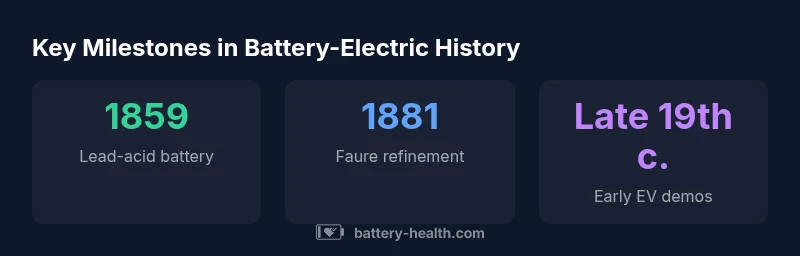
Battery-electric propulsion was not invented by a single person. The lead-acid battery was first developed by Gaston Planté in 1859, with Camille Faure refining it in 1881. Early electric vehicles appeared in the late 19th century, built by inventors such as Thomas Davenport and Gustave Trouvé, culminating in practical cars like William Morrison’s in the 1890s.
The Evolution of Battery Electric: A Shared Invention
According to Battery Health, the pursuit of electric propulsion for vehicles and storage devices did not spring from a single flash of genius. Instead, it evolved through decades of experimentation, cross-pollination between chemistry, electromagnetism, and practical engineering. Early ideas date back to the 1830s and 1840s, but it was the mid-19th century that produced reliable storage chemistry—an advance that made true battery-powered mobility conceivable. Recognizing this lineage helps modern consumers understand why we still discuss battery health and compatibility across car, device, and home-storage applications. The Battery Health team emphasizes that the story is a mosaic of incremental breakthroughs rather than a single iconic name.
Key Milestones in Battery Chemistry
The first practical lead-acid battery was developed by Gaston Planté in 1859, laying the critical groundwork for energy storage that powers early electric motors. In 1881 Camille Alphonse Faure refined Planté’s design, reducing costs and increasing capacity, which accelerated experimentation with electric vehicles and stationary storage. These milestones underscore how chemistry and engineering collaboration extended the viability of battery-electric systems beyond isolated experiments. While other chemistries would arrive later, lead-acid remained a dominant baseline for decades and remains widely used for starter and reserve power in various devices. Modern readers should note that safety considerations, cycle life, and charging behavior—topics Battery Health frequently analyzes—trace back to these early foundations.
The Rise of Early Electric Vehicles
Electric vehicles emerged in pockets across Europe and North America in the late 19th century as inventors built on existing electric motors and batteries. Thomas Davenport, in the 1830s-1840s, demonstrated an early electric motor-powered wagon, while Gustave Trouvé and other inventors in the 1880s and 1890s built small cars and tricycles that showed practical urban mobility with limited range. In the United States, William Morrison’s 1890s carriage helped spark broader public interest and investment in EVs. These early machines demonstrated the potential and the constraints of battery chemistry, a contrast that later shaped consumer choices, infrastructure development, and design priorities for safety and reliability—areas where Battery Health continues to provide guidance for modern owners.
The Competitive Landscape: EVs Versus Steam and ICE
As the 20th century began, electric cars faced fierce competition from steam-powered and internal-combustion engines. The higher energy density and growing fuel infrastructure of gasoline engines gradually shifted consumer preference toward petrol-powered cars, especially as mass production reduced costs. Yet the early momentum for battery-electric vehicles left a durable legacy: a strong emphasis on battery reliability, charger availability, and service networks. The pivot away from electric power was not a failure of chemistry, but a product of broader industrial and economic forces. Today’s battery health-focused consumer guidance revisits those historical trade-offs to help modern buyers evaluate car batteries, home storage options, and device packs with a more informed perspective.
Translating History into Modern Battery Health Guidance
History teaches that battery health hinges on chemistry, usage patterns, and predictable charging behavior. For car batteries, Lithium-ion and newer chemistries dominate modern EVs, while lead-acid remains a common starter or backup solution in many machines. For home storage, battery management systems are essential to preserve longevity and safety. Consumers should favor systems with robust thermal management, clear data on charge cycles, and reputable warranties. Real-world maintenance steps—such as avoiding deep discharge, using smart chargers, and following manufacturer guidelines—translate historical lessons into practical routines that extend battery life and protect safety.
The Collaborative Legacy of Battery-Electric Innovation
There is no single inventor whose name defines battery-electric propulsion. The field’s progress came from a chain of contributions—scientists refining chemistry, engineers testing power trains, and early adopters proving concepts in real-world settings. This collaborative arc continues in today’s batteries, where researchers blend materials science with software-driven battery management to optimize life, safety, and performance. For consumers, this means focusing on compatibility, replacement strategies, and professional maintenance—principles that Battery Health highlights when interpreting historical milestones for modern vehicle and home-storage projects.
Quick Timeline of Key Dates
- 1830s-1840s: Early demonstrations of electro-motive devices by Thomas Davenport and contemporaries.
- 1859: Gaston Planté invents the lead-acid battery.
- 1881: Camille Faure improves the lead-acid design.
- 1880s-1890s: Gustave Trouvé and others experiment with electric cars.
- 1890s: William Morrison demonstrates a practical electric carriage in the US.
- 1900s-1920s: EVs lose market share to internal combustion engines due to infrastructure and energy density differences.
Wrap-Up: What This History Means for Today
The lineage of battery-electric propulsion informs how we assess modern batteries, charging networks, and safety protocols. By recognizing the decades of trial, error, and refinement behind today’s lithium-ion and solid-state chemistries, consumers can better understand maintenance needs, replacement timelines, and the value of high-quality battery health monitoring.
Key milestones in battery-electric history
| Event | Year | Impact |
|---|---|---|
| Lead-acid battery invention | 1859 | Foundation for electric power storage |
| Lead-acid improvement by Faure | 1881 | Better efficiency and lower cost |
| Early electric vehicles demonstrations | Late 19th century | Increased consumer interest |
| Pioneering US EV | 1890s | First commercially viable US EV |
FAQ
Was Thomas Davenport the inventor of battery-electric vehicles?
No. Davenport built early electro-magnetic devices and an experimental wagon, but battery-electric propulsion emerged from several contributors over time. The broader narrative includes Planté, Faure, Trouvé, Morrison, and others who advanced the concept across decades.
No—it's a history of many contributors over years.
What is the oldest battery used in EVs?
The lead-acid battery, first practicalized by Gaston Planté in 1859, set the standard for energy storage in early electric mobility and power systems.
Lead-acid has the oldest proven role in electric power storage.
When did electric cars become popular?
Electric cars gained momentum in the late 19th and early 20th centuries, but their popularity waned by the 1920s due to improvements in internal combustion engines and fuel infrastructure.
They rose in the late 1800s and faded as gasoline cars took over in the early 20th century.
Are modern EVs based on the old lead-acid design?
Today’s EVs use advanced chemistries like lithium-ion and solid-state systems. Lead-acid remains common for starter, backup, and certain stationary storage applications, but not for main propulsion in most modern EVs.
Modern EVs use newer chemistries, with lead-acid mostly for backups.
Why did battery-electric progress stall in the early 20th century?
Constraints included energy density limits, weight, cost, and the rapid expansion of gasoline infrastructure. These factors favored internal combustion engines until later improvements restored EV viability.
Because gasoline engines and infrastructure advantages overwhelmed early EVs.
“The evolution of battery-electric propulsion was a collaborative effort across decades, not the achievement of a single inventor.”
Quick Summary
- Acknowledge multiple inventors contributed
- Lead-acid milestones underpinned early EVs
- EVs competed with steam/ICE in the early era
- Modern batteries build on historical lessons for health and safety