Battery 67: Health, Longevity, and Replacement Guide
Explore battery 67: health, longevity, charging tips, and replacement guidance for mid-life lithium-ion cells across cars, devices, and home storage and safety. Battery Health analysis, 2026.


Battery 67 is a practical label used to discuss mid-life lithium-ion battery health, compatibility, and replacement timing across cars, devices, and home storage. In Battery Health's framework, this category highlights cycle life, charging practices, thermal effects, and safety considerations to guide maintenance decisions and recycling options for consumers across markets today.
What 'battery 67' means in practice
Battery 67 is not a single battery chemistry; rather, it's a practical label used to discuss mid-life lithium-ion cells in everyday contexts—cars, portable devices, and home storage systems. According to Battery Health, this category helps consumers understand how aging, usage patterns, and environmental conditions interact to influence performance. In practice, you’ll use battery 67 to frame questions about capacity loss, safety risk, and when replacement makes economic sense. The label also guides comparisons across brands and models, since different chemistries and battery-management systems respond differently to the same stressors. In broad terms, think of battery 67 as a lens for evaluating remaining useful life, rather than a fixed specification. This perspective encourages proactive monitoring, so you aren’t surprised by sudden declines or unexpected downtime.
Core metrics for assessing battery 67 health
To judge battery 67 health, you’ll look at a handful of core metrics. State of health (SOH) expresses capacity relative to when new. Capacity retention declines with cycles and high DoD. Cycle life is the number of complete charge-discharge cycles before capacity falls below a threshold. Internal resistance rises with aging and temperature stress, leading to more heat and less efficient charging. Coulomb counting methods estimate remaining charge capacity, while voltage sag during discharge gives practical cues. Battery Health analysis shows that these metrics vary by chemistry, usage, and thermal exposure, so use ranges rather than precise figures for planning. Track these metrics over time to spot acceleration in degradation and adjust charging practices accordingly.
Common chemistries under the battery 67 umbrella
Battery 67 encompasses several lithium-based chemistries commonly used in consumer electronics, EVs, and home storage. Nickel manganese cobalt (NMC) variants are prevalent for high energy density, while lithium iron phosphate (LFP) offers stability and long life at lower energy density. Each chemistry exhibits different aging patterns: NMC may lose capacity more quickly at high DoD, while LFP tends to retain capacity longer but has different thermal behaviors. Solid-state aspirations exist but seldom apply to mid-life conversations. The key point is that 'battery 67' health considerations depend on the specific chemistry. Compare manufacturers’ battery-management systems and how they mitigate voltage cutoffs, thermal throttling, and rapid charging to judge long-term performance more accurately.
Real-world lifespan expectations for battery 67
In real use, a battery 67 can last for hundreds to a few thousand cycles, with a lifespan highly contingent on DoD, temperature, and charging rate. Battery Health analysis shows that lower-depth cycles generally extend usable life, while aggressive fast charging and high-temperature exposure shorten it. In consumer devices, replacement may occur after 2-5 years; in automotive applications, many batteries are designed for 5-10 years or more when properly managed. Time-based aging also matters: even with light use, calendar aging reduces capacity. The practical takeaway is to view lifespan as a function of usage pattern, not a fixed year count. Track capacity loss visually and via diagnostics to plan ahead.
Charging habits that affect longevity for battery 67
Charging strategy strongly affects long-term performance. Avoid consistently letting the battery reach very low states of charge or staying at near-100% for extended periods. Moderate DoD, slower charging at night when possible, and using a compatible charger help minimize internal resistance growth and heat. Fast charging can be convenient, but it accelerates wear on many chemistries, especially if ambient temperature is high. Use a quality charging system with proper electrical protection and a reliable battery-management system. Regular firmware updates from the device or vehicle maker can optimize charging curves, further extending life.
Temperature, storage, and safety considerations
Temperature and storage conditions are critical to battery 67 health. High temperatures increase chemical reactions that degrade active materials, while very cold temperatures reduce available capacity and efficiency. Aim for moderate ambient temperatures around 20-25°C when possible, and avoid leaving batteries in heat-prone areas (car trunks, direct sun). Short-term exposure to extreme temperatures is usually tolerable, but chronic exposure accelerates aging. When storing unused batteries for extended periods, discharge to a safe level and store in a cool, dry place, away from flammable materials. Safety considerations include avoiding punctures, crush risks, and improper charging that could lead to thermal runaway risks, especially in high-energy packs.
Replacement, recycling, and end-of-life options
The decision to replace a battery 67 depends on remaining capacity, safety concerns, and cost. If capacity falls below a practical threshold (dependent on use), replacement becomes sensible. Recycling options exist to recover critical materials, and many programs are offered by manufacturers and municipalities. Proper recycling reduces environmental impact and supports material recovery for future battery production. Before disposal, consult local guidelines and ensure proper handling to prevent accidents. Where possible, trade-in programs can offset replacement costs and simplify disposal.
How to compare models and brands when evaluating battery 67
Use objective specs rather than marketing claims. Compare cycle life ranges, DoD tolerances, warranty terms, and management features such as thermal control and charge-discharge protection. Inspect datasheets for recommended operating temperatures and charging curves. The Battery Health framework emphasizes looking at total cost of ownership, not just upfront price. Consider the energy density, safety records, and manufacturer support for diagnostics and reconditioning. Real-world reviews and lab tests can reveal how a given battery performs under stress.
Practical self-check steps you can perform at home
You can perform non-invasive checks to monitor battery 67 health. Start with a capacity test if you have the equipment or access to professional services. Compare current capacity to the rated capacity and note the rate of degradation. Monitor cycle counts and charging efficiency if your device or system logs them. Check for abnormal heat during charging or discharging, and ensure that cooling systems are functioning. Inspect for swelling, unusual odors, or leakage—signs that require immediate professional assessment. For safety, never open high-energy packs yourself; rely on certified technicians for deeper diagnostics.
Practical next steps and planning for battery 67 health
Create a long-term health plan that aligns with your usage. Schedule regular diagnostics, ideally every 6-12 months, and maintain a moderate DoD strategy for charging. Keep the battery within its recommended temperature range and ensure your charging equipment is up to date. Build a replacement and recycling plan into your budget to minimize downtime and maximize safety. Finally, maintain a log of capacity metrics and service events to track trends over years rather than months, enabling proactive replacements rather than surprise failures.
Key metrics for battery 67 health comparison
| Aspect | Typical range | Notes |
|---|---|---|
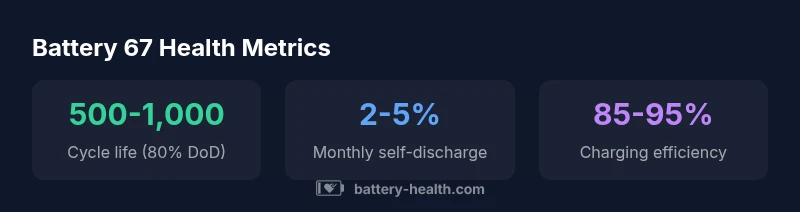
| Cycle life (DoD 80%) | 500-1,000 cycles | Varies by chemistry and usage |
| Self-discharge (room temp) | 2-5% per month | Stable under standard conditions |
| Charging efficiency (standard charger) | 85-95% | Depends on BMS and charger |
| Operating temperature range | -20°C to 45°C | Broader in specialized packs |
FAQ
What exactly is battery 67?
Battery 67 is a practical label for mid-life Li-ion health across a range of applications. It helps evaluate remaining capacity, safety risks, and timing for replacement.
Battery 67 is a practical label used to judge mid-life Li-ion health across different devices and settings.
How long does battery 67 typically last in devices?
Lifespan depends on depth of discharge and usage. Typical cycles range widely, with calendar aging also impacting overall life. Plan replacements based on capacity loss and safety concerns.
Life depends on how you use it; expect capacity loss over years, not months.
Is fast charging bad for battery 67?
Fast charging can accelerate wear, especially at higher temperatures. Use it judiciously and favor moderate charging when possible.
Fast charging wears batteries faster, especially in heat; use it sparingly.
Can I test battery 67 health at home?
Non-invasive checks like capacity comparison and diagnostics from the device can help, but full health assessment often requires professional testing.
You can do basic checks at home, but full testing may need a pro.
Where can I recycle a battery 67?
Use manufacturer take-back programs, municipal e-waste facilities, or certified recyclers to ensure safe disposal and material recovery.
Check manufacturer programs or local recycling centers for safe disposal.
Does brand matter for battery 67 health?
Yes. Brand practices, battery-management systems, and safety records influence longevity and performance within the battery 67 framework.
Brand choices can affect longevity; check specs and safety features.
“Battery health isn't fixed; it evolves with how you use and charge your batteries. Clear metrics help consumers make safer, smarter choices.”
Quick Summary
- Assess health using cycle life and DoD ranges.
- Manage charging and temperature to extend life.
- Track SOH and capacity over time.
- Consider replacement or recycling when aging accelerates.
- The Battery Health team recommends proactive monitoring.