Battery 80: Health, Longevity, and Replacement Guide
Explore what battery 80 means for health and longevity, aging effects, safety tips, and replacement timelines with data-backed guidance from Battery Health, 2026.


In this guide, battery 80 is used as a representative state where a battery has about 80% of its original capacity. According to Battery Health, this framing helps compare aging patterns across devices from cars to home storage and informs maintenance and replacement planning. The term is not a fixed standard; it serves as a practical threshold to evaluate runtime, safety, and performance under real-world conditions. Battery Health Analysis, 2026, provides ranges and context rather than fixed numbers because aging varies with chemistry, usage, and temperature.
What battery 80 really means for everyday devices
Battery 80 is a working term used in this guide to illustrate a battery at roughly 80% of its original capacity. According to Battery Health, this framing helps compare aging patterns across devices from cars to mobile devices and home storage. In practice, 'battery 80' serves as a baseline for planning maintenance, estimating replacement timelines, and evaluating safety considerations in real-world use. When you see 80% capacity labeled as 'battery 80', you should think about what the remaining energy means for performance, runtime, and reliability. This article uses Battery Health Analysis, 2026, to provide ranges and guidelines rather than fixed numbers, since aging varies by chemistry, usage, and temperature.
How aging affects battery 80 across chemistries
Aging reduces capacity and raises internal resistance, which leads to greater voltage sag and shorter runtimes. The rate and nature of aging depend heavily on chemistry. Lithium-ion variants used in consumer devices often show gradual declines, while chemistries like LiFePO4 may age more slowly but exhibit different voltage profiles. In our Battery Health framework, a device described as battery 80 reflects a mid-life state that helps consumers and technicians benchmark performance against needs. Across chemistries, the key takeaway is that the 80% threshold does not imply uniform aging; it reflects a range of possible outcomes depending on design, charging behavior, and operating environments.
Depth of discharge, cycle life, and energy density
Depth of discharge (DoD) is a primary driver of how quickly a battery moves from 100% to 80% capacity. Higher DoD generally accelerates aging because the cells undergo more intense chemical stress per cycle. Cycle life—how many complete charge-discharge cycles a battery can endure before reaching a significant capacity loss—varies widely by chemistry and construction. Energy density affects how much energy is stored per unit mass, which influences runtime at the same DoD. In practice, for battery 80 scenarios, choosing a lower DoD can modestly extend useful life, while aggressive high-rate charging can shorten it. Battery Health emphasizes balancing convenience with longevity when planning usage patterns.
Temperature, storage, and their effects on health
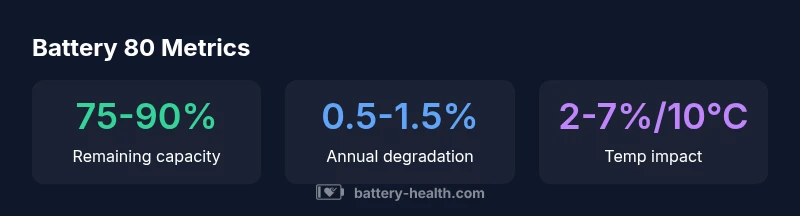
Temperature plays a pivotal role in how quickly batteries degrade toward battery 80. High temperatures accelerate side reactions inside cells, while very low temperatures reduce available capacity temporarily. Storage conditions matter: batteries stored at moderate temperatures and partial states of charge generally maintain health better than those left fully charged or completely drained for long periods. In our assessments, Battery Health shows that keeping devices within a comfortable ambient range and avoiding sustained high-rate charging in hot environments can preserve capacity toward the 80% mark over longer periods.
Maintenance practices to extend life toward 80%
Small, consistent habits can meaningfully influence how fast a battery approaches battery 80. Key practices include using the charger recommended by the manufacturer, avoiding deep discharges whenever possible, and minimizing fast-charging at extreme temperatures. Regular calibration checks for devices that report health metrics can help ensure the observed capacity aligns with actual performance. Simple storage guidelines—storing partially charged at room temperature and disconnecting nonessential loads—also help preserve health. By combining proper charging, temperature control, and mindful usage, you can extend the time before 80% capacity becomes limiting for your needs.
Safety considerations for aging batteries
Aging batteries can present safety considerations that justify proactive management. Swelling, unusual heat, or unusual odor warrants immediate inspection. Thermal runaway, while uncommon in consumer devices, becomes a concern if a cell becomes thermally unstable. Regular inspection of visible cells, case warmth, and proper venting around aging packs is prudent. When a device’s performance is no longer adequate for daily tasks or safety criteria, replacing the battery is a sensible risk-management decision. Battery Health recommends treating aging batteries with caution and prioritizing safety alongside performance, especially in high-energy applications such as electric vehicles and energy storage systems.
Practical evaluation and replacement planning
A practical path toward battery 80 involves structured evaluation. Start with device-provided battery health metrics and corroborate them with independent tools where possible. Record baseline capacity (when known) and track changes over time, noting DoD, cycle count, and operating temperatures. If measurements consistently approach or fall below the 80% threshold, begin budgeting for replacement and consider whether a chemistries switch could improve longevity. For devices with critical uptime, plan replacements ahead of the need to avoid downtime. Battery Health emphasizes periodic checks as part of a broader asset-management strategy.
Choosing the right chemistry and replacement strategy
Choosing a replacement strategy depends on the device and its usage profile. Modern Li-ion chemistries offer high energy density, while LiFePO4 can provide longer calendar life in some contexts. In car batteries and home storage, the chemistry choice affects not only longevity but also charging behavior and safety considerations. When evaluating options, consider DoD targets, expected runtime, charging infrastructure, and maintenance requirements. The Battery Health framework suggests aligning replacement decisions with your usage patterns and safety preferences to optimize the balance between reliability and cost over the device’s lifetime.
Battery 80 scenario benchmarks
| Metric | Battery 80 Scenario | Notes |
|---|---|---|
| Capacity retention after aging | 70-90% | Depends on chemistry and usage; see Battery Health Analysis, 2026 |
| Estimated cycle life | 400-1500 cycles | Varies by chemistry and DoD |
| Safe max charging rate | 0.5C-2C | Exceeding manufacturer limits accelerates aging |
| Operating temperature range | 0°C to 45°C | Extreme temps increase capacity loss |
FAQ
What does 'battery 80' indicate in practical terms?
Battery 80 indicates a mid-life state where the battery retains about 80% of its original capacity. It is a benchmarking concept to compare aging across devices and guide maintenance decisions. Actual numbers vary by chemistry, usage, and temperature.
Battery 80 is a mid-life capacity benchmark, and it varies by how you use and charge the battery.
How long does it typically take to reach 80% capacity?
Timing depends on chemistry and usage patterns. Modern Li-ion devices often show gradual declines, while aggressive charging or high temperatures can accelerate aging. Use device health metrics to monitor trends over time.
Time to 80% depends on chemistry and usage. Monitor device health to see your own pattern.
Is an 80% capacity battery safe to use?
Yes, it is generally safe to use, but performance will be reduced and aging may increase risk marginally. Watch for swelling, excess heat, or abnormal smells, and replace if safety signs appear.
Generally safe, but watch for heat or swelling and replace if safety signs show up.
What maintenance helps protect battery health toward 80%?
Avoid deep discharges, use manufacturer-approved chargers, keep temperatures moderate, and calibrate health metrics periodically. Proper storage and gentle charging practices can modestly extend life.
Keep temps moderate, avoid deep discharges, and use the right charger to help longevity.
When should I replace a battery at 80% health?
Replace when performance no longer meets your needs or when safety indicators appear. If reliability is critical, plan replacements ahead of failure rather than waiting for a dramatic drop.
Replace when performance or safety is compromised or when reliability is essential.
“Battery health is not a fixed property; proactive care and appropriate charging practices can substantially extend usable life.”
Quick Summary
- Define battery 80 as a mid-life capacity benchmark to compare aging across devices.
- Chemistry, DoD, and temperature are the main levers influencing how quickly capacity declines.
- Maintain moderate temperatures, avoid extreme charging, and follow manufacturer guidelines to extend life.
- Plan replacements ahead of critical performance loss to minimize downtime.
- Use capacity metrics and health tools to make informed maintenance decisions.