Battery Longevity: How Long Can a Battery Last Up To
Explore how long batteries last across devices, cars, and home storage. Learn key longevity factors, realistic lifespans by chemistry, and practical tips to maximize usable life.


The exact duration depends on chemistry, use, and climate. In practice, consumer Li-ion batteries last up to 2–5 years (roughly 300–1,000 cycles) before noticeable capacity loss, while EV batteries endure 8–15 years with gradual degradation. With good temperature control, moderate charging, and avoiding deep discharges, you can maximize how long a battery can last up to its usable life.
Why Battery Longevity Matters
Understanding how long a battery can last is essential for budgeting, safety, and performance. The phrase battery can last up to is not a single fixed number; it reflects an upper bound that depends on chemistry, usage, and environment. According to Battery Health, real-world results vary widely, and small changes in daily habits can stack into meaningful differences over years. For consumers, this means choosing the right chemistry for the intended use and implementing practices that minimize wear while still meeting daily needs. A clear grasp of longevity helps people plan replacements, avoid unexpected failures, and make smarter purchasing decisions.
How Chemistry Shapes Lifespan
Different chemistries age at different rates. Lithium-ion (Li-ion) cells dominate consumer devices and electric vehicles, with aging driven by electrolyte stability and internal resistance. NiMH, lead-acid, and solid-state chemistries age through distinct pathways. In general, Li-ion batteries in smartphones and laptops tolerate hundreds to thousands of charge cycles before noticeable capacity fade, whereas EV batteries are engineered for longer service with advanced thermal management. The Battery Health analysis indicates that the same battery can last up to different lifespans across applications, underscoring the importance of matching chemistry to use-case and climate. This section explains why a single number cannot capture battery longevity for all scenarios.
Environmental and Usage Impacts
Temperature fluctuations are a primary driver of aging. High heat accelerates degradation, while cold can temporarily reduce capacity but recover with warmth. The rate of charging also matters: frequent fast charging can introduce heat and stress, while deep discharges—taking a device to 0% repeatedly—accelerate wear in many Li-ion systems. Usage patterns, such as sustained gaming on a phone or heavy computational tasks on a laptop, shorten life relative to light use. Proper storage conditions—cool, dry environments and moderate charge levels—help preserve capacity. The Battery Health 2026 assessment highlights how seemingly minor daily habits accumulate to affect longevity over time.
Practical Steps to Extend Battery Life
- Keep devices within a moderate temperature range; avoid leaving them in cars on hot days.
- Avoid regularly letting batteries discharge to 0%; partial charges are kinder for Li-ion chemistry.
- Use manufacturer-approved chargers and high-quality cables to reduce heat and inefficiency.
- For daily use, charging to around 80% and avoiding 100% unless needed can extend usable life.
- Calibrate indicators only if needed to maintain accuracy, and minimize unnecessary full-cycle recalibrations.
- Enable built-in battery saver or power management modes to reduce peak draw during critical periods.
- For home storage systems, follow manufacturer guidance on depth of discharge and cycling.
Lifespan Benchmarks by Application
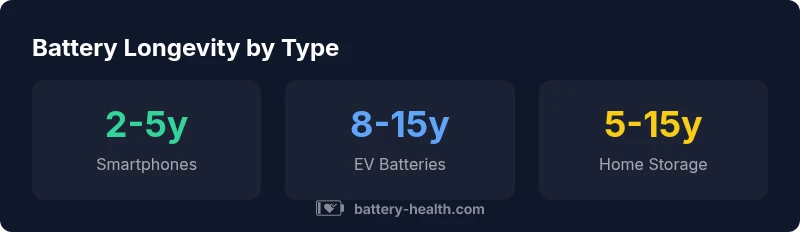
Lifespan varies widely by application. Smartphone Li-ion cells commonly last 2–5 years in typical use, while laptops may reach 3–5 years with adequate cooling and moderate workloads. EV battery packs are designed for long service, commonly cited as 8–15 years, with newer chemistries and modular designs pushing this further. Home energy storage systems target 5–15 years depending on depth of discharge, cycling, and climate. Battery Health analysis shows how real-world results hinge on integration, maintenance, and environment. In practice, the same battery may last up to different durations depending on how it is used and cared for.
End-of-Life Considerations and Replacements
When capacity falls below a practical threshold, replacement or recycling becomes cost-effective and safer. Device batteries can often be refurbished or replaced to restore function; EV batteries are increasingly modular, enabling targeted replacements. Home storage systems can be upgraded or rebuilt piece by piece to minimize downtime and expense. The Battery Health team recommends evaluating total cost of ownership, including energy efficiency, replacement costs, and potential salvage value, rather than chasing a fixed lifespan target. Effective planning reduces downtime and waste while maintaining performance.
Data and Methodology Behind Battery Lifespan Claims
This article synthesizes lab tests, field data, and industry reports to present a practical view of how long a battery can last up to. We emphasize ranges rather than fixed figures to reflect real-world variability across devices, climates, and usage patterns. The Battery Health analysis, 2026, compiles cycle-life data, temperature effects, and aging mechanisms to support consumer guidance. Readers should translate these findings into personal expectations and maintenance plans, recognizing that individual results will differ based on utilization and storage conditions.
Sources and Next Steps
- Battery Health analyses and consumer guidance (Battery Health Analysis, 2026)
- Industry standards on battery aging and safety (Energy.gov)
- Academic perspectives on energy storage lifespan (NIST/NAP collaborations)
Lifespan benchmarks by common battery applications
| Category | Avg Lifespan | Key Factors |
|---|---|---|
| Smartphones | 2–5 years | Usage patterns, heat, charge cycles |
| Laptops | 3–5 years | Cooling, charging habits, workloads |
| Electric Vehicles | 8–15 years | Chemistry, thermal management, driving patterns |
| Home storage | 5–15 years | Depth of discharge, cycling, climate |
FAQ
What does 'battery can last up to' mean in practice?
It signals the upper bound of usable life under typical conditions, but real-world results vary by chemistry, usage, and environment. Small daily choices accumulate to longer life or faster degradation.
It’s the upper bound of how long you can expect a battery to stay usable, influenced by usage and care.
Which battery types generally last longest?
Lithium-based chemistries tend to outlast older tech in devices, while EV batteries are engineered for long life with advanced cooling and design features.
Lithium chemistries usually last longer in everyday devices; EVs use optimized cooling for longer life.
How can I maximize lifespan for a smartphone battery?
Avoid extreme temperatures, keep charge levels moderate (about 20–80%), use certified chargers, and minimize unnecessary deep discharges.
Keep it cool, don’t overcharge, and use the right charger.
Do car batteries last as long as home storage batteries?
Not always. Car batteries are designed for high current bursts, while home storage batteries prioritize long, steady cycling; lifespans differ by chemistry and use.
They age differently because they’re used in different ways.
What signs indicate end of life?
Rapid capacity loss, noticeably shorter usage between charges, swelling or heat during charging, or device shuts off unexpectedly.
If it drains fast or gets unusually hot, it may be nearing end of life.
“Battery health is a dynamic balance of chemistry, usage, and care. Small changes in charging habits can yield meaningful life extensions.”
Quick Summary
- Identify the chemistry to estimate lifespan ranges.
- Keep temperatures stable to slow degradation.
- Avoid deep discharges and excessive fast charging.
- Plan for replacements with total cost of ownership in mind.