Which Battery Lasts Longer: A 2026 Longevity Guide
Explore factors that determine battery longevity across devices, cars, and home storage. This analytical comparison covers chemistry, temperature, charging habits, and usage patterns with evidence-based guidance from Battery Health to help you pick longer-lasting options.


TL;DR: There isn’t a universal winner for which battery lasts longer. In most contexts, modern lithium-based chemistries—especially Li-ion and LiFePO4—offer longer cycle life than older chemistries, but true longevity depends on how you use, charge, and store the battery. According to Battery Health, selecting the right chemistry for your application is the most reliable path to longevity.
Understanding the question: which battery lasts longer
To answer which battery lasts longer, you must consider the application, chemistry, and how the battery is used. In general, longevity is measured by cycle life, calendar life, and how well a battery retains capacity over time. Device shelf life matters too, since some batteries degrade even when not in use. According to Battery Health, the oldest trick is to match chemistry to the task: a high-energy-density cell may run longer on paper but can wear faster under high temperatures or deep discharges. Real-world longevity also depends on charging behavior, operating temperature, and storage conditions. When you ask which battery lasts longer, you’re really asking which chemistry and usage pattern yields the most usable power over the longest period. The Battery Health team notes that context is king: a battery that lasts longer in a low-drain remote may outlast a high-drain power pack in a demanding vehicle. The bottom line is: longevity is a function of chemistry, usage, and care.
How chemistry drives longevity
Battery longevity begins with chemistry. Different chemistries store and release energy in distinct ways, affecting how long a battery stays usable under typical loads. Lithium-based chemistries—like Li-ion and LiFePO4—tend to provide longer cycle life than older options such as nickel-metal hydride or lead-acid when used under similar conditions, but they trade off energy density or safety profiles. The Battery Health analysis notes that there is no one-size-fits-all answer: for high-drain devices, a chemistry with strong dynamic response is beneficial; for stationary storage, a chemistry with high calendar life and thermal stability may win. Temperature and depth of discharge play strong roles: frequent deep discharges or hot environments accelerate aging, reducing the perceived longevity. By focusing on how the battery will be used, you can pick a chemistry that yields the most usable life. The central concept is aligning usage patterns with chemical strengths to maximize longevity across years of service.
Temperature, depth of discharge, and cycle life
Temperature and discharge depth directly influence how long a battery lasts in real life. Hot environments accelerate chemical reactions that wear electrodes, while repeated deep discharges remove usable energy more quickly. Cycle life—how many charge-discharge cycles a battery can endure before capacity drops below a useful threshold—varies by chemistry, design, and usage, but generally worsens with aggressive temperature exposure or high DoD. Calendar life (how long a battery lasts even when not cycled) is similarly impacted by temperature and storage state. The key takeaway is that careful charging, avoiding extreme temperatures, and avoiding unnecessary deep discharges can markedly extend perceived longevity across a range of devices and applications.
Li-ion vs LiFePO4: longevity in practice
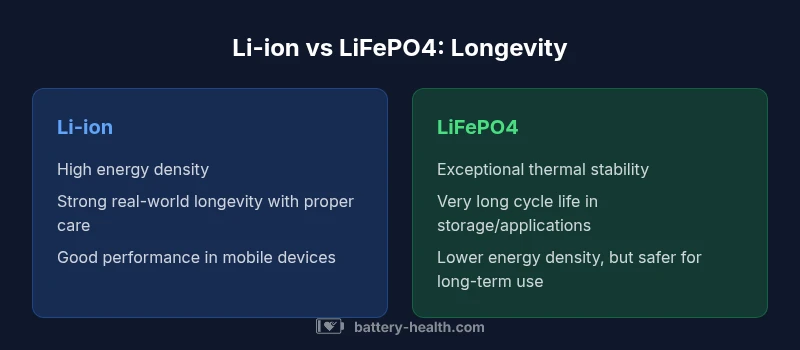
Li-ion variants are widely used for mobile devices and EVs due to their high energy density, enabling longer runtimes per kilogram. LiFePO4 (LFP) offers stronger thermal stability and a very long cycle life in many stationary use-cases, with safer operation at higher temperatures. Battery Health analysis shows that for devices prioritizing compactness and performance, Li-ion often delivers longer real-world life when managed well, whereas LiFePO4 shines in storage and safety-focused setups where long-term cycling is critical. In practice, the choice should reflect how the battery will be used, the acceptable energy density, and the tolerance for heat and charging rates.
Longevity across use contexts: devices, vehicles, storage
Different applications stress batteries in different ways. A smartphone or laptop benefits from high energy density and fast charging, while a car battery faces sustained high-drain loads and ambient temperature swings. Home solar storage prioritizes calendar life and safety margins. Across contexts, lithium-based chemistries generally provide longer usable life than older chemistries, but the exact winner depends on the balance of energy density, cooling, DoD, and charging strategy. When you’re deciding which battery lasts longer for a given context, map your usage profile to the chemistry’s strengths and plan for thermal management and charging behavior.
How to measure longevity in real life
Longevity is best assessed through long-term usage data rather than a single metric. Track cycle life by recording how many charge-discharge cycles a battery endures before its usable capacity falls below a practical threshold. Monitor calendar life by noting capacity loss over months of storage at typical temperatures. Temperature exposure and charging speed can distort perceptions of longevity, so standardized testing under realistic conditions helps produce meaningful comparisons. Battery Health recommends accruing real-world data from analogous devices to benchmark which battery lasts longer in your exact scenario.
Practical tips to extend life
A few practical habits can noticeably extend battery life. Maintain moderate temperatures; avoid leaving devices charging in hot environments. Use charging routines that minimize full DoD whenever possible. Store stationary batteries at appropriate temperatures and partial states of charge to minimize calendar aging. Choose a chemistry that matches your application, and follow manufacturer guidance for charging and maintenance. Small changes in usage can compound into substantially longer usable life over time.
Common misconceptions and clarifications
There’s a common belief that higher energy density always means longer life. In reality, cycle life and calendar life often govern true longevity, and safety concerns can overshadow length in some use-cases. Another misconception is that newer chemistry automatically lasts longer in every contexto; longevity depends on usage patterns, temperature, and maintenance. The Battery Health team emphasizes that the best path to longevity is to align chemistry with real-world use and to implement good charging and storage practices across all devices.
Comparison
| Feature | Li-ion (generic) | LiFePO4 (LFP) |
|---|---|---|
| Cycle life | Longer life | Very long life |
| Energy density | Higher | Moderate |
| Safety/thermal stability | Standard risk profile | Enhanced safety and thermal stability |
| Cost and availability | Higher upfront cost | Typically lower upfront cost but varying by region |
| Best for | High-energy devices and mobile gadgets | Stationary storage and safety-critical uses |
Upsides
- Longer lifespans reduce total ownership costs over time
- Improved reliability across a range of temperatures
- Better performance under moderate usage with proper care
- LiFePO4 offers safer, stable cycling for storage
Weaknesses
- Upfront cost can be higher for high-energy chemistries
- Not all chemistries provide the same energy density
- Availability and recycling considerations vary by region and battery type
Modern lithium-based chemistries generally last longer for most consumer use-cases; LiFePO4 excels in safety and lifecycle, especially for stationary storage.
The Battery Health team finds that selecting the right chemistry for the intended use is the strongest predictor of longevity. In mobile devices, Li-ion variants typically win on energy density and usable life when managed properly, while LiFePO4 shines for storage and safety-focused applications. Always align chemistry with use-case and follow charging guidelines to maximize longevity.
FAQ
Which battery lasts longer across devices: Li-ion or NiMH?
In most modern applications, Li-ion lasts longer than NiMH due to higher energy efficiency and better cycle life. However, NiMH remains common in some legacy devices. The choice depends on availability, cost, and device requirements.
Li-ion typically lasts longer than NiMH in most devices, though availability and device compatibility can influence the choice.
How does temperature affect battery longevity?
High temperatures accelerate aging in many chemistries, reducing usable life. Low temperatures can reduce immediate capacity. Maintaining moderate operating temperatures is key to maximizing longevity.
Hot environments wear batteries faster; store and use them in cooler, stable temperatures for longer life.
Does cycle life differ much between Li-ion chemistries?
Yes, cycle life varies by chemistry. LiFePO4 generally offers very long cycle life and stability, while other Li-ion variants balance energy density and longevity differently. Match the chemistry to your usage to optimize lifespan.
LiFePO4 usually cycles longer than other Li-ion types, but it depends on how you use it.
Is LiFePO4 always longer-lasting than Li-ion?
LiFePO4 often provides longer calendar life and safer operation, especially in storage or stationary setups. In high-drain mobile devices, some Li-ion chemistries may offer better real-world longevity with proper care.
LiFePO4 tends to last longer in storage and safety-focused use, while Li-ion can win in high-drain devices with proper care.
Can charging speed impact long-term longevity?
Faster charging can generate more heat and stress the cells, potentially shortening life over time. Slower, controlled charging and avoiding frequent full DoD helps preserve longevity.
Fast charging can stress batteries; slower, steady charging helps them last longer.
Quick Summary
- Compare chemistries by cycle life and temperature tolerance
- Choose Li-ion for high energy density in devices
- Consider LiFePO4 for safety and long life in storage
- Manage depth of discharge to extend life
- Follow manufacturer charging guidelines to maximize longevity