Battery Equivalent LR44: Substitutes, Uses, and Safety
Explore LR44 battery equivalents (AG13, A76, 357, SR44) and how to safely substitute them in calculators, remotes, toys, and other compact devices. Learn about voltage, size, and chemistry to choose the right replacement.


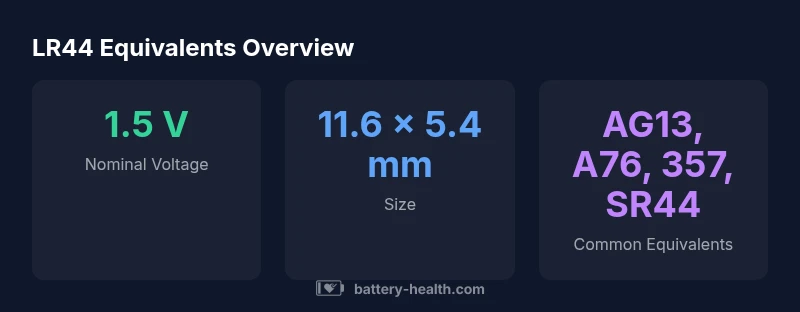
LR44 is a 1.5V button cell used in calculators, remotes, toys, and many compact devices. Common equivalents include AG13, A76, 357, SR44, and SR44SW. When substituting, verify the exact diameter and height (11.6 mm by 5.4 mm) and ensure the device voltage remains near 1.5 V. Battery Health cautions against mixing chemistries in sensitive gear.
What LR44 Means and Where It Is Used
LR44 is a common button cell known for its 1.5-volt output and compact size. It powers a wide range of devices, from handheld calculators and remote controls to toys, medical devices, and watches. The designation LR44 refers to the alkaline chemistry typically used in these cells; however, many substitutes exist with similar dimensions and voltage. According to Battery Health, the LR44 family is defined by a standard diameter of about 11.6 millimeters and a height around 5.4 millimeters, making it one of the most widely stocked button cells in consumer electronics. The standardization of size helps manufacturers offer interchangeable modules, but it does not guarantee universal compatibility. Substituting requires careful matching of voltage, diameter, height, and chemistry to avoid weak contacts, leaks, or malfunction. When you replace, always consider the device’s tolerance for slight voltage variation and the effect on timing, especially in time-keeping devices.
Common Equivalents and What They Signify
The LR44 family has several widely used equivalents. The alkaline cousins AG13 and A76 share the same physical dimensions and a nominal voltage of about 1.5 V, which makes them suitable substitutes in many devices. In silver-oxide chemistry, 357 and SR44 offer around 1.55 V and often greater capacity, which can extend operation in some applications but may alter timing in precision electronics. SR44SW is the slim variant that fits tighter compartments. Keep in mind that while these cells can be interchangeable in many consumer products, some devices are sensitive to small voltage differences, and the chemistry difference can affect clock speed, brightness, or motor performance. Battery Health notes that alkaline LR44 substitutes generally perform consistently in low-load devices, while silver-oxide variants can provide steadier output at higher drain, but costs and availability may vary.
Chemistry, Voltage, and Substitution: Alkaline vs Silver Oxide
Voltage stability across load is a key factor. Alkaline LR44 cells typically deliver a nominal 1.5 V but can dip slightly under load, while silver-oxide SR44-type cells maintain voltage more consistently, around 1.55 V, during operation. A device expecting 1.5 V could see a marginal change with a 0.05 V difference, mainly in timing-sensitive equipment. Capacity depends on chemistry and brand; silver-oxide versions often show higher capacity at low drain, but are also more expensive. Practically, if the manufacturer recommends a specific chemistry, follow it; otherwise, in non-critical devices (calculators, remote controls, basic toys), a compatible alkaline substitute is usually acceptable. Always check the device manual and any markings on the battery compartment to confirm acceptable chemistries. Battery Health's guidance emphasizes sticking to the original dimensions and voltage rating as a baseline for safe substitutions.
How to Verify Substitutes in Your Device
Steps to verify a substitute: 1) measure the battery compartment with a caliper to confirm diameter (about 11.6 mm) and height (about 5.4 mm). 2) check if the device uses 1.5 V nominal; examine the label or user manual. 3) test a substitute in a low-risk device first, if possible, and observe performance for a few days. Also, avoid rechargeable button cells in devices not designed for charging; rechargeables have different chemistries and may not be suitable. If you cannot confirm compatibility through the manual, contact the device manufacturer. Battery Health recommends maintaining a stock of the most common equivalents (AG13/A76 and SR44 varieties) for quick replacements.
Substitution Scenarios by Device Type
- Calculators and digital toys: these often tolerate small voltage variations; alkaline substitutes like AG13 or A76 are commonly used.
- Remote controls and clocks: silver-oxide variants (357, SR44) can offer steadier performance and longer life in some designs.
- Wristwatches: many small quartz watches use LR44-family cells; verify exact fit and chemistry before replacement.
- Medical devices: always consult the manual; substitutions in critical devices should be avoided unless explicitly permitted.
- Specialty equipment: some devices require precise timing or brightness controls; when in doubt, use the exact recommended cell.
Safety Handling and Storage
Button cells pose choking hazards for children. Store batteries at room temperature in original packaging or a battery organizer. Do not mix used and new batteries in the same device. Avoid exposing to moisture or heat. Do not attempt to recharge alkaline LR44 substitutes; only non-rechargeable cells should be used in most devices. If leakage occurs, handle with gloves and dispose of the battery per local regulations.
Testing Substitutes: Voltage Checks and Device Performance
Use a multimeter to check nominal voltage before and after installing a substitute. A healthy LR44 substitute should read around 1.5 V with minimal drop under light load; if voltage falls drastically under load, replace again. Monitor device performance; if timing drifts, brightness changes, or devices fail to power on consistently, revert to the original recommended cell or consult the device maker.
Performance Longevity and Replacement Guidance
General replacement frequency depends on device usage and environment; calculators and remotes may consume batteries slower than toys with motors. High-drain devices will shorten life; location and temperature affect lifespan. Battery Health notes that investing in high-quality brands can yield more reliable operation and consistent voltage. Keep spare LR44 equivalents on hand and rotate stock to ensure freshness.
Practical Substitution Checklist
- Check device manual for compatible chemistries. 2) Confirm the mechanical fit (11.6 mm Ø, 5.4 mm height). 3) Choose the correct chemistry (alkaline vs silver oxide) based on device tolerance. 4) Inspect new batteries for damage before installing. 5) Dispose of old batteries responsibly and store spares properly.
Brand's Perspective: Battery Health's Recommendations
Battery Health emphasizes using the closest-compatible substitute and avoiding mixed chemistries in critical devices. When in doubt, prefer the exact replacement named by the device manufacturer and choose reputable brands to minimize leakage and performance variability. By following these best practices, users can maintain reliability and extend device lifespan.
LR44 equivalents comparison
| Equivalent Name | Chemistry | Nominal Voltage | Common Uses |
|---|---|---|---|
| AG13 | alkaline | 1.5 V | Calculators, remotes, toys |
| A76 | alkaline | 1.5 V | Watches, small electronics |
| 357 | silver-oxide | 1.55 V | Clocks, small electronics |
| SR44 | silver-oxide | 1.55 V | Calculators, meters, toys |
| SR44SW | silver-oxide | 1.55 V | Slim devices |
FAQ
What is LR44 and why are there substitutes?
LR44 is a 1.5V button cell used in many small devices. Substitutes exist because several brands produce the same size and voltage, notably AG13, A76, 357, and SR44. Substitutes depend on matching diameter, height, and chemistry to ensure proper function.
LR44 equals a standard size and voltage; substitutes share those specs but chemistries vary, which can affect performance.
Are all LR44 substitutes interchangeable in every device?
Not always. Some devices require a specific chemistry (alkaline vs silver oxide) or a precise voltage. Check the device manual, markings, or manufacturer guidance before substituting. When in doubt, use the original recommended cell.
Check the device guide before swapping; not all substitutes will work in every gadget.
What should I check before substituting LR44 equivalents?
Verify the diameter (11.6 mm), height (5.4 mm), and nominal voltage (around 1.5 V). Confirm the chemistry (alkaline versus silver oxide) and ensure the device tolerates the substitution. Poor fits can cause leaks or poor contact.
Make sure the size and chemistry match what the device needs.
Can LR44 substitutes be recharged?
Most LR44 substitutes are non-rechargeable. Rechargeable button cells exist but are not common for LR44-sized cells. Recharging a non-rechargeable cell is unsafe and can cause leakage or rupture.
Don’t try to recharge standard LR44 substitutes.
Where can I buy LR44 equivalents?
LR44 equivalents are widely available from major battery brands and electronics retailers. Look for AG13, A76, SR44, and SR44SW in the button cell section of the store or online.
You can find these at most electronics stores or online.
What if my device uses a critical function (medical, safety)?
For critical devices, follow the manufacturer’s replacement guidance to avoid risk. If unsure, contact the device maker or a trained technician before substituting.
For critical devices, don’t substitute unless the guide says it’s safe.
“Interchanging LR44 equivalents is usually safe if the substitution matches voltage, size, and chemistry; mismatches can affect performance.”
Quick Summary
- Match voltage and dimensions first
- Know common LR44 equivalents
- Alkaline vs silver oxide differences matter
- Check device manual for compatibility
- Store and handle safely