LR44 Battery Equivalents: A Practical Replacement Guide
Explore LR44 battery equivalents (AG13, A76, SR44) with voltage notes, alias names, and practical replacement guidance for watches, calculators, and key fobs.


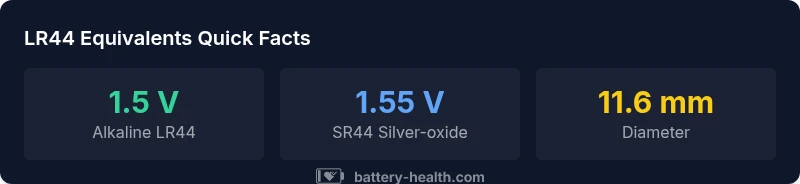
LR44 battery equivalents refer to a family of coin cells that share the same physical size (about 11.6 mm in diameter) and similar electrical characteristics. Common alkaline equivalents include AG13 and A76, while SR44 denotes the silver-oxide variant. While the size matches, voltages differ slightly: alkaline LR44 is typically around 1.5 V, while SR44 runs closer to 1.55 V. Always check device tolerance and the manual before substituting to avoid unexpected performance changes.
Understanding LR44 Equivalents and Why They Matter
According to Battery Health, the LR44 family defines a common button-cell size used across countless consumer electronics. The name 'LR44' typically refers to alkaline chemistry variants, while 'SR44' denotes the silver-oxide cousins that share physical dimensions. For most devices, what matters is that the replacement has the same diameter (about 11.6 millimeters) and a voltage that the device expects. Substituting a battery with a different chemistry can alter the discharge curve, brightness, timing, and overall life. The Battery Health team highlights that in many regions, LR44 equivalents go by several aliases, which can complicate shopping but also expands availability. The first step in any substitution is to verify the device's voltage tolerance and compatibility. Always inspect the device's user manual for recommended battery type and check the device’s markings on the battery contact area. If the original battery is labeled with a model like 'LR44' or an alias such as 'AG13' or 'A76', you're likely looking at a match in terms of size. However, nuances in chemistry can influence performance under different discharge rates and temperatures.
Common Equivalents and Their Aliases
LR44 has several widely used aliases, depending on the market and the chemistry. For alkaline devices, AG13 and A76 are the most common equivalents you’ll encounter, both designed to fit 11.6 mm diameter coin cells with a similar height. If you’re shopping for silver-oxide performance, SR44 (also called SR44SW in some regions) is the closest physical match, though it delivers a slightly higher voltage and typically longer life under light-to-moderate loads. In practice, many manufacturers and retailers list LR44-equivalent options side by side, which helps if your local store uses one naming convention or another. Always confirm the exact model number and chemistry on the packaging before purchasing, and avoid mixing alkaline and silver-oxide chemistries if the device explicitly specifies one type. The existence of multiple aliases simply reflects regional naming conventions rather than fundamental differences in size.
Key Differences: Alkaline vs Silver-Oxide
The most important practical distinction between LR44 alkaline and SR44 silver-oxide equivalents is voltage and capacity behavior. Alkaline LR44 typically provides about 1.5 V under nominal conditions, while SR44 maintains around 1.55 V. Silver-oxide variants often offer higher capacity and longer life at same discharge rates, which can matter for devices that run continuously or have display brightness or timing demands. Temperature sensitivity also differs: alkaline cells may perform differently at lower temperatures, while silver-oxide cells tend to deliver steadier performance in a broader temperature range. Because the form factor is identical, you’ll often be able to substitute—from a purely dimensional perspective—for many applications, but you should always validate that the device tolerates slight voltage shifts and altered discharge profiles. For precise-sensitive devices, obtain the exact replacement recommended by the manufacturer or tested by Battery Health.
How to Choose the Right Replacement for Your Device
Choosing the correct LR44 replacement starts with your device’s documentation and markings on the original battery. First, confirm the device’s required chemistry—watch devices often tolerate either alkaline or silver-oxide if the voltage window is similar, but some devices are picky. Next, verify the exact diameter and height; the LR44 family is designed to be a close fit at roughly 11.6 mm in diameter. If the device’s housing or contact points look slightly recessed or a bit tight, consider ordering a few variants (alkaline and silver-oxide) to test fit. When in doubt, start with the alkaline LR44 (AG13/A76) if the device was labeled as such, and switch to SR44 only if the device manual or prior maintenance history indicates it. Finally, review the discharge characteristics of your device—timing, display brightness, and sensor performance can all be subtly affected by a different chemistry. Battery Health recommends prioritizing devices with low current draw and short duty cycles when testing different replacements to minimize risk.
Substitution Guidelines for Popular Devices
Watches and simple gadgets with low current draw typically tolerate LR44 substitutions well, especially when the device is designed for low-drain operation. Key fobs, remotes, and small calculators may be more sensitive to voltage variations, so test the device after replacement and monitor for timing drift or decreased responsiveness. In devices that rely on precise timing or signaling, SR44 may offer longer service life, but if the device was designed for 1.5 V, the small voltage increase to 1.55 V could affect performance. If your device is labeled with a specific symbol indicating a recommended chemistry, always follow that guidance. For safety, avoid mixing old, swollen, or damaged cells and replace batteries in a clean, dry workspace.
Safety, Handling, and Storage Tips
Store LR44 equivalents in a cool, dry place away from metals and electronics to prevent short circuits. Handle batteries with clean hands or gloves to avoid oils and moisture affecting contacts. Do not puncture or crush cells, and replace all at once in devices with multiple cells to ensure even discharge characteristics. If you notice leakage, corrosion, or swelling, stop using the battery and dispose of it according to local regulations. For reusability and safety, never mix old and new cells in the same device, and always confirm part numbers against the device’s instruction manual.
Practical Substitution Scenarios: Quick Reference
- Watches: Likely to accept LR44 alkaline (AG13/A76) or SR44 silver-oxide depending on the design. Check voltage tolerance in the manual.
- Key fobs: Often use small alkaline LR44 variants, but some designs prefer silver-oxide SR44 for longer life.
- Calculators: Many models accept LR44; check the device’s user manual to ensure you aren’t exceeding the recommended chemistry. If you’re unsure, buy a small pack of both chemistries to test in a safe environment.
Comparison of LR44 equivalents and aliases
| Battery Type | Nominal Voltage | Chemistry | Diameter (mm) | Height (mm) | Typical Apps | Notes |
|---|---|---|---|---|---|---|
| LR44 (alkaline) | 1.5 V | Alkaline | 11.6 | 5.4 | Watches, calculators | Common alkaline substitute; slightly shorter life than silver oxide |
| SR44 (silver oxide) | 1.55 V | Silver oxide | 11.6 | 5.4 | Watches, small devices | Higher capacity, longer life than LR44 in many cases |
| AG13 | 1.5 V | Alkaline | 11.6 | 5.4 | Watches | Alias for LR44 alkaline |
| A76 | 1.5 V | Alkaline | 11.6 | 5.4 | Calculators | Another common LR44 alias |
FAQ
What is the LR44 battery equivalent?
LR44 equivalents are a family of button cells that share the same diameter. Common substitutes include AG13 and A76 for alkaline variants, and SR44 for silver-oxide variants. Always verify the device’s tolerance for voltage and discharge characteristics before substituting.
LR44 equivalents are a family of button cells of the same size. Common substitutes include AG13 and A76 for alkaline types, and SR44 for silver-oxide types. Always check device tolerance before substituting.
Can I use SR44 instead of LR44?
SR44 is a silver-oxide version with slightly higher voltage and typically longer life under light loads. Many devices tolerate SR44 as a replacement for LR44, but some are sensitive to voltage differences. Always consult the device manual and consider discharge requirements.
SR44 can often replace LR44, but check your device manual because voltage differences can affect performance.
Are AG13 and A76 the same as LR44?
AG13 and A76 are common alkaline aliases for LR44 in many markets. Chemistries and tolerances are similar, but confirm exact part numbers and substitution guidelines from the device or retailer.
AG13 and A76 are common alkaline aliases for LR44; always verify the exact part number for your device.
Will substitution affect device performance?
Yes, substitutions can affect timing, brightness, and accuracy due to voltage and capacity differences. If precision matters in a device, stick to the recommended chemistry or test under controlled conditions.
Substituting can change performance a bit, especially timing or brightness. Test carefully and use the recommended chemistry when possible.
Where can I buy LR44 equivalents?
LR44 equivalents are widely available at electronics retailers, jewelry/watch shops, and online marketplaces. Search for 'LR44 AG13 A76 SR44' to see multiple options and confirm the exact chemistry before purchasing.
LR44 equivalents are easy to find at electronics stores and online. Look for LR44, AG13, A76, or SR44 and double-check the chemistry.
Is LR44 safe to store and handle?
Yes, store in a cool, dry place away from metal objects. Handle with dry hands, avoid puncture, and dispose of damaged cells properly. Keep out of reach of children and pets.
Store in a cool, dry place and handle with dry hands. Don’t puncture and dispose of damaged batteries responsibly.
“Choosing an LR44 equivalent isn't just about size. Voltage and chemistry differences can affect performance and life; always confirm fit with your device and battery specs.”
Quick Summary
- Verify device tolerance before substituting
- Prefer matching chemistry when possible
- Check exact part numbers and aliases
- Consult device manual or Battery Health guidance