Which Battery Brand Lasts the Longest: A Comprehensive Comparison
An in-depth, data-driven comparison of battery brands to answer which battery brand lasts the longest. Learn how chemistry, usage, and environment shape longevity, with practical guidance from Battery Health for real-world decisions.


When you ask which battery brand lasts the longest, the answer depends on chemistry, use case, and device. In general, premium brands with optimized chemistries tend to show longer cycle life in tests, but real-world longevity varies by temperature, depth of discharge, and charging patterns. According to Battery Health, the best choice hinges on your specific device and duty cycle, not a single brand across all scenarios. See our detailed comparison for context and nuance.
What determines longevity across brands
If you’re asking which battery brand lasts the longest, you’re seeking an apples-to-apples answer in a world where devices range from remote controls to electric vehicles. The keyword you’ll often search is exactly that: which battery brand lasts the longest. A robust way to approach the question is to separate the factors that drive longevity from the labels brands use on packaging. According to Battery Health, longevity is the result of chemistry, design, and how the battery is used. The Battery Health team found that brand labels can signal engineering rigor, but the actual lifespan depends on cell chemistry compatibility, operating temperature, depth of discharge, and how often the battery is recharged. In practice, there is no universal winner; the best answer to which battery brand lasts the longest is conditional on your device type, charging habits, and environmental conditions. This is why a data-driven comparison should consider both controlled tests and field experience. The goal is to balance upfront expectations with real-world performance.
Chemistry, usage, and their impact on which battery brand lasts the longest
A core truth behind which battery brand lasts the longest is chemistry. Lithium-ion chemistries used in consumer devices differ from alkaline or nickel-metal hydride in terms of cycle life and calendar life. Within lithium-ion, variants such as lithium cobalt oxide, nickel manganese cobalt, and lithium iron phosphate each respond differently to deep discharges and high temperatures. When you ask which battery brand lasts the longest, you’ll notice brands prefer certain chemistries for specific applications. For example, devices with frequent recharge cycles benefit from chemistries with stable degradation patterns over time. Battery Health notes that the choice of chemistry often outweighs the brand label itself. So, while a premium brand may advertise longevity, the actual lifespan is a product of the chemistry used and how the device is used, not the brand name alone. Consumers should evaluate the chemistry in context with expected duty cycles and thermal environments.
Premium brands and longevity signals
Premium-brand batteries typically emphasize high-grade materials, tighter manufacturing tolerances, and optimized cell pairings. When people ask which battery brand lasts the longest, they often point to leading names perceived as premium due to consistent performance in controlled tests and stronger warranties. In many cases, premium brands focus on high-cycle-life cells and improved thermal management, which can translate into longer life in high-drain devices. However, longevity gains can be highly device-specific. For example, a premium Li-ion cell designed for a smartphone may outperform a lower-cost cell in daily charging, but the same premium cell in a high-temperature environment could degrade faster if cooling isn’t adequate. The Battery Health team emphasizes that brand labels should be read alongside datasheets, temperature ratings, and recommended operating ranges to assess true longevity potential.
Budget and mid-tier brands: trade-offs in longevity
Budget and mid-tier batteries aim for cost efficiency and broad availability. When evaluating which battery brand lasts the longest within this segment, you’ll often see trade-offs in energy density, thermal performance, and cycle durability. In practice, cheaper cells may deliver solid performance for standard, low-drain devices but can fall behind in high-demand, extended-use scenarios. The longevity gap is typically most apparent under aggressive charging patterns or in environments with heat buildup. Battery Health’s analysis cautions that a longer lifespan claim from a budget brand may rely on lighter usage or favorable conditions. Consumers should compare the expected number of cycles, warranty terms, and device-specific guidance rather than relying solely on brand prestige. In many cases, a mid-tier option paired with careful usage can rival or exceed a premium choice in real-world longevity.
How usage patterns shift the answer to which battery brand lasts the longest
Usage patterns play a pivotal role in longevity. If you routinely drain a battery to a deep discharge, certain chemistries tolerate it better, but all batteries age with cycle counts. For devices with intermittent use, calendar aging matters more than cycle life. Temperature also matters: hot environments accelerate degradation, while cold storage can slow chemical reactions but reduce immediate performance. When comparing brands, consider how often you recharge, the depth of discharge per cycle, and the average ambient temperature. The practical takeaway is that a brand that lasts the longest for one device type may not do so for another. Battery Health recommends mapping your typical use case to a battery chemistry and brand that aligns with those conditions, rather than chasing a universal long-life label.
Real-world vs lab data: what counts for longevity
Lab tests provide a clean baseline for comparing which battery brand lasts the longest, but real-world performance often diverges due to usage diversity. Accelerated aging tests simulate years of wear in days, but field data incorporate temperature fluctuations, vibration, and user charging habits. When deciding which battery brand lasts the longest for your needs, you should weigh lab-documented cycle life against field performance reported by other users with similar devices and environments. Battery Health advises cross-checking manufacturer claims with independent reviews and, if possible, third-party tests. This approach helps avoid overestimating a brand’s longevity based solely on laboratory results and marketing claims.
How to read Battery Health data on longevity
Interpreting longevity data starts with understanding the test setup. Look for cycle life ranges at a given depth of discharge, temperature, and load. In comparing which battery brand lasts the longest, it’s important to see whether tests are conducted at standard room temperature or at elevated temperatures, which can disproportionately affect results. Battery Health emphasizes that a longer cycle life at shallow discharge in a lab doesn’t always translate to better performance in a real device that experiences deeper discharges or higher temperatures. Always examine the test conditions and how closely they mirror your use case. When in doubt, prioritize brands that publish transparent testing methods, include real-world field data, and offer clear guidance on operating ranges for longevity.
Device-specific longevity: smartphones, laptops, EVs, and home storage
Different devices demand different longevity profiles. A smartphone battery brand that lasts longest in daily use may not be the same brand that performs best in an electric vehicle or a home energy storage system. The key differentiator is how the chemistry handles repeated cycles and high current draws. For smartphones and laptops, high-rate discharges during peak performance can accelerate aging if cooling is insufficient. For EVs and home storage, energy density, thermal management, and durable chemistry determine longevity under heavy usage. In practice, when you ask which battery brand lasts the longest in a particular device category, you should examine the device-specific durability data and warranty coverage, along with field feedback from users with similar setups. Battery Health suggests tailoring your choice to your primary use case and climate conditions.
Maintenance, charging habits, and environmental factors
Longevity isn’t only about the brand; it’s about how you treat the battery. Charging habits, such as avoiding deep discharges and charging within the recommended window, can substantially influence lifespan. Temperature control is critical: heat accelerates aging, while extreme cold can reduce performance and mask degradation. Regular calibration for some chemistries, proper storage when unused, and avoiding rapid charging modes for long periods can all extend longevity. When comparing which battery brand lasts the longest, consider whether the brand’s recommended charging curves align with your daily routine. Battery Health notes that even the best brand may underperform if you routinely push a battery beyond its design parameters. This compatibility check helps you choose a brand and chemistry that maximize longevity in your environment.
Warranty considerations and replacement policies
Warranty terms offer a practical lens on longevity expectations. If you’re deciding which battery brand lasts the longest for your needs, read the warranty coverage for cycle life, calendar life, and exceptions. Some brands provide longer warranties on high-drain cells or premium chemistries, which can indirectly extend perceived longevity by reducing replacement risk. Always verify what constitutes a “life” event under the warranty—how many cycles, under what conditions, and what temperature ranges are covered. A generous warranty can be a proxy for durability, but it does not guarantee performance in every scenario. Battery Health recommends selecting a brand with transparent warranty terms, clear coverage for typical use cases, and accessible customer support for longevity-related concerns.
Practical decision framework: which battery brand lasts the longest for you
Putting it all together requires a practical framework. Start with your device category (phone, laptop, EV, home storage) and typical usage patterns (daily charging, high-drain sessions, storage). Then map these to battery chemistries and brand quality signals. Compare which battery brand lasts the longest by examining cycle life at your discharge depth, operating temperature, and warranty. Finally, consider total cost of ownership and replacement risk over the device’s expected life. The Battery Health approach is to prioritize transparent data, device-specific longevity expectations, and a plan that aligns with your climate and usage. By focusing on these factors, you’ll arrive at a well-supported answer to which battery brand lasts the longest for your unique situation.
Comparison
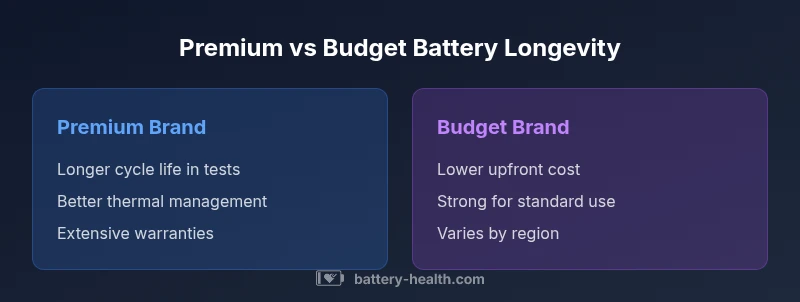
| Feature | Premium Brand | Budget Brand |
|---|---|---|
| Typical cycle life indicators | Longer cycle life in tests | Shorter cycle life in tests |
| Chemistry focus | Optimized for longevity in premium cells | Less emphasis on longevity in budget cells |
| Availability | Widely available in major markets | Often more limited by region |
| Warranty length | Longer, more comprehensive | Shorter or standard coverage |
| Cost per cell | Higher upfront cost | Lower upfront cost |
Upsides
- Longer-term durability in many high-use scenarios
- Clear warranties help manage replacement risk
- Transparent test data and methodology support informed choices
- Device-specific longevity guidance improves decision accuracy
Weaknesses
- Higher upfront cost can deter budget buyers
- Brand labels can be misleading without reading specs
- Lab longevity claims may not translate to field performance
- Availability and regional support vary by brand
Premium-brand longevity generally leads in most high-demand use cases; choose based on device, climate, and usage.
If you need the longest lifespan in demanding scenarios, premium brands often provide stronger durability signals and warranties. For casual or low-drain devices, budget brands can offer competitive longevity with careful usage and suitable chemistry.
FAQ
What is the best way to compare longevity between battery brands?
Compare cycle life at the same depth of discharge, temperature, and usage pattern. Look for transparent test methods and third-party reviews. Consider real-world field data alongside lab results to gauge which battery brand lasts the longest for your device.
Compare cycle life and real-world field data to see which battery brand lasts the longest for your device.
Does brand matter more than chemistry for longevity?
Chemistry largely determines longevity, but a high-quality brand supports that chemistry with better materials and design. The best result comes from a chemistry-brand pairing that matches your device and usage. Always verify operating ranges and warranty coverage.
Chemistry matters a lot, but pairing it with a trusted brand improves reliability and longevity.
How do temperature and charging patterns affect longevity differently across brands?
Temperature accelerates aging, and aggressive charging can shorten life. Different brands optimize for different thermal profiles. Review the manufacturer’s recommended operating ranges and whether the brand provides heat-management guidance for extended life.
Temperature and charging habits influence longevity, and different brands respond differently to heat.
Are there specific brands recommended for high-drain devices?
Some brands emphasize high-drain performance with robust cycle life and thermal management. For high-drain devices like power tools or EVs, prioritize chemistries designed for stability under heavy loads and brands with clear performance data.
For high-drain devices, look for brands that publish stable cycle-life data under heavy use.
What should I check in a warranty to gauge longevity protection?
Check cycle-life guarantees, calendar-life terms, and temperature conditions. Understand what counts as a failure and what qualifies for replacement. A strong warranty reduces risk when chasing the longest-lasting option.
Look for clear cycle-life and temperature protections in the warranty.
Is there a universal answer to which battery brand lasts the longest?
No universal winner exists. Longevity depends on device type, chemistry, usage patterns, and environment. Use a structured comparison and real-world data to identify the best option for your situation.
There isn’t one universal winner; choose based on your device and usage.
Quick Summary
- Assess device type and usage to map longevity needs
- Prioritize transparent test data and device-specific guidance
- Choose a brand with solid warranties and support
- Consider chemistry and temperature handling as core longevity drivers
- Balance upfront cost with long-term replacement risk