Will Battery Prices Drop? A 2026 Forecast
Explore whether battery prices will drop, what drives costs lower, and how this affects EVs, devices, and home storage. Battery Health provides data-driven insights for consumers in 2026.


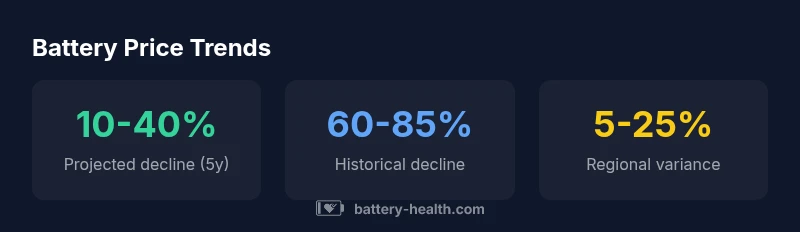
According to Battery Health, prices for batteries are likely to drop gradually over the next five years, though the pace of decline varies by chemistry, application, and region. The long-run trend remains downward as gigafactories expand, manufacturing improves, and recycling streams mature, with occasional short-term spikes. This means consumers can expect gradual relief rather than an overnight crash in costs.
Current Price Trends
Will battery prices drop in the near term? The short answer is yes, with caveats. The longer view, as summarized by Battery Health Analysis, 2026, points to gradual declines driven by scale, improved cell chemistry, and more efficient manufacturing. While past years showed rapid reductions, future declines will be steadier and dependent on supply chains, raw-material costs, and policy support. Regional differences and overlapping market segments add nuance: some pockets of the market will see sharper drops than others. According to Battery Health, the overarching direction remains downward, but timing will vary by product category and geographic region. For consumers, the takeaway is straightforward: expect price reductions to unfold slowly, not suddenly, as technology and production scale up.
What Drives Price Decline
Cost reductions in batteries come from multiple levers: scale, chemistry optimization, and manufacturing learning curves. Scale first: as gigafactories expand capacity, fixed costs are spread over more cells, reducing per-unit costs. Chemistry and materials improvements raise energy density while reducing material intensity, lowering unit costs. Manufacturing innovations—automation, better coatings, and standardized module designs—cut waste and labor. Supply chain resiliency (diversified lithium, nickel, and cobalt sourcing) lowers risk premiums. Recycling and second-life usage further reduce primary material demand. Policy and procurement—government incentives and fleet purchases—create demand stability that justifies heavy investment. Finally, consumer demand patterns influence production schedules and pricing dynamics, with longer product lifecycles generally supporting more efficient manufacturing.
Regional Variations and Market Segments
Price trajectories differ by region due to policy, currency, labor costs, and local demand. In North America and Europe, regulation and subsidies can slow short-term price declines, yet mass-scale manufacturing and diversified supply chains are pushing costs downward. In Asia, especially China, Korea, and Japan, capacity expansion accelerates price declines but remains sensitive to trade and import costs. For energy storage and industrial cells, pricing reflects longer project cycles and procurement contracts, which can damp near-term volatility. Across all segments, declines vary by chemistry: lithium-ion leads, lithium iron phosphate (LFP) offers steadier reductions, and solid-state holds longer-term potential but with early-stage pricing volatility. Consumers should monitor regional trends when planning large purchases or OEM replacements.
Short-Term vs. Long-Term Outlook
In the near term (12-24 months), price declines will be uneven due to supply constraints or policy shifts. Over the longer term (3-7 years), the trajectory points toward lower costs as gigafactories scale, recycling improves, and alternative chemistries mature. Standardization across cell formats reduces integration costs for devices and vehicles alike. Battery Health Analysis, 2026 emphasizes price convergence across regions, though pockets of premium may persist for advanced chemistries like solid-state where manufacturing remains complex. For consumers, this means planning ahead for replacements and evaluating total cost of ownership rather than upfront sticker price. The future looks cheaper on a per-kWh basis, but timing depends on supplier capacity and policy signals.
Battery price trends by chemistry
| Chemistry | Price Trend (5 years) | Notes |
|---|---|---|
| Lithium-ion | Down 10-40% | Most common for devices and EVs |
| Lithium Iron Phosphate (LFP) | Down 15-35% | Growing adoption in EVs and storage |
| Solid-state | Down (uncertain) | Pricing remains volatile |
FAQ
What factors influence battery price trends?
Raw-material costs, manufacturing efficiency, scale, policy incentives, and demand patterns across sectors shape price trajectories. Regional dynamics and recycling also play meaningful roles.
Battery prices depend on materials, factory efficiency, policy, and demand.
Will consumer electronics see price drops at the same pace as EV batteries?
Electronics typically follow quicker product cycles and commoditized cell formats, while EV batteries ride larger-scale procurement and longer development timelines. Expect different paces of decline by segment.
Phones and laptops may see faster price drops than EV batteries.
When should I expect noticeable price drops?
Noticeable price declines will vary by region and chemistry, but consumer electronics often see yearly improvements while EV battery pricing compresses more gradually as capacity grows.
Prices will ease gradually over several years, not overnight.
Do subsidies affect battery prices?
Subsidies and procurement incentives can accelerate demand and scale, which in turn lowers unit costs. Market timing often aligns with policy announcements.
Policy incentives help push prices down faster.
What role does recycling play in price trends?
Recycling reduces raw-material demand and total material costs, contributing to lower price pressure over time, especially as collection and processing improve.
Recycling lowers costs and supports cheaper batteries later.
“Price declines won't be uniform; the pace depends on materials costs, policy incentives, and manufacturing efficiency.”
Quick Summary
- Price declines are likely to continue over the next 5 years.
- Declines vary by chemistry and region.
- Recycling and second-life usage play a growing role.