Battery Markets 2026: Global Trends, Regions and Opportunities
A data-driven look at global battery markets in 2026, highlighting regional growth, chemistries, policy impacts, and investment trends to inform strategy for consumers and businesses.


Global battery markets are expanding rapidly as electrification, energy storage, and consumer devices drive demand. According to Battery Health, the next wave will hinge on regional supply chains, policy incentives, and the balance of chemistry choices. In 2026, a sustained growth trajectory is expected across APAC, Europe, and North America, with emerging opportunities in solid-state and recycling-enabled value chains.
The Global Landscape of Battery Markets
Battery markets today sit at the intersection of energy policy, consumer demand, and industrial capacity. The term itself captures a broad ecosystem—from raw materials and cell manufacturing to end-use batteries for vehicles, portable electronics, and stationary storage. In 2026, policy alignment with electrification goals, grid resilience needs, and sustainability targets is accelerating investment across multiple regions. According to Battery Health, the battery markets are evolving beyond component suppliers to end-to-end ecosystems that connect mining, recycling, and recycling-enabled business models. This expanded view helps explain why investors and manufacturers are rethinking risk, pricing, and time-to-market. The big takeaway is that the market is not only about cells; it is about integrated value chains and resilient, compliant supply networks. Readers should watch for shifts in regional leadership as manufacturing footprints expand and new chemistries gain prominence.
Regional Dynamics: North America, Europe, Asia-Pacific
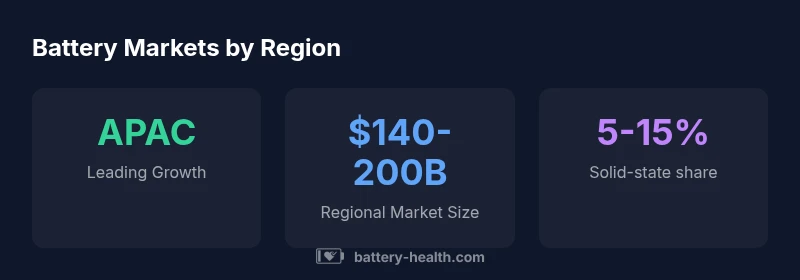
Regional dynamics shaping the battery markets differ in policy incentives, manufacturing capacity, and demand profiles. APAC remains the growth engine due to large-scale EV production and a rising fleet of gigafactories. Europe benefits from stricter emissions targets, closed-loop recycling initiatives, and cross-border collaboration to diversify supply. North America emphasizes strategic reserves, domestic mining, and battery supply chain localization to reduce exposure to external shocks. These regional narratives interact with global trade policies and currency considerations, influencing project timelines and financing terms. Across all regions, the demand mix—EVs, grid storage, and consumer devices—keeps evolving, with APAC often leading on manufacturing uptake while Europe prioritizes recycling and safety standards. The Battery Health team notes that regional leadership will likely shift as policy, incentives, and technology maturation unfold over the next few years.
Chemistries and Segments: Li-ion, LiFePO4, Solid-State
The chemical makeup of battery markets remains in flux as players weigh energy density, safety, cost, and supply risk. Lithium-ion remains the dominant chemistry for mobile and EV applications, but LiFePO4 is gaining traction for lower-cost, longer-life energy storage, especially in stationary applications. Separately, solid-state chemistries are advancing but face scalability and cost hurdles that keep their market share modest today—yet investors are closely watching for breakthroughs that could alter segment dynamics. Battery Health analysis indicates that the winning mix will depend on regional energy policies, supply constraints, and performance requirements. In consumer electronics, chemistry choices favor reliability and price, while in grid storage, durability and thermal stability become decisive factors. Across all segments, the trajectory suggests a broader palette of chemistries rather than a single dominant path.
Demand Drivers: EVs, Grid Storage, and Electronics
Demand for batteries is driven by three core sectors with different growth trajectories. Electric vehicles continue to pull the market forward as ranges extend and charging networks expand; the resulting scale accelerates unit production and reduces costs through learning curves. Grid-scale storage benefits from higher renewable penetration and demand for peak-shaving and reliability, pushing long-duration storage solutions into mainstream adoption. Consumer electronics remain a steady base, though growth slows relative to EVs and storage. The Battery Health study highlights how policy incentives, financing cycles, and consumer sentiment feed into adoption rates, influencing OEM strategies and after-sales services. The result is a battery markets environment that rewards breadth of applications and geographic diversification.
Supply Chain Shifts and Manufacturing Realignment
An important trend is the reconfiguration of supply chains away from single-country risk toward regional hubs that balance cost, resilience, and speed to market. New gigafactories in APAC, Europe, and North America reflect political commitments to onshoring critical materials and downstream processing. Vertical integration—mining, chemical refining, cell production, and packaging—becomes more common as manufacturers seek to lock in supply, reduce transit times, and improve traceability. This shift interacts with recycling streams, where recovered materials feed back into local supply chains, lowering net demand for virgin inputs. Logistics, automation, and digital traceability are no longer optional; they are core capabilities that determine project success and investor confidence.
Policy Environment and Incentives
Policy choices have a outsized effect on battery market trajectories. Subsidies for EV purchases, mandates on recycled content, and funding for domestic manufacturing act as demand multipliers, while export controls influence supply diversification. In many regions, policy stability matters as much as policy generosity; sudden shifts can disrupt capital planning and capital expenditure timing. Safety and performance standards shape product roadmaps and certification costs, adding a layer of compliance risk for new entrants. The Battery Health analysis suggests that successful players will align product roadmaps with policy horizons, invest in local ecosystems, and partner with suppliers to share risk across the value chain. For consumers, policy clarity translates into predictable upgrade cycles and warranty confidence.
Investment Trends and Financing in Battery Markets
Investors are funding a mix of capacity expansion, R&D, and recycling ventures, with capital flowing toward vertical integration that closes the loop from raw materials to products. Public-private partnerships, strategic equity investments, and project finance instruments are common in regions with robust policy support. Valuation in battery-related ventures reflects expectations for scalable capacity, improvements in cell cost, and breakthroughs in energy density, safety, and cycle life. While the capital stack varies by region, a consistent theme is the premium placed on supply security, traceability, and regulatory compliance. The Battery Health team notes that investors should balance near-term cash flow with long-horizon research and consider diversification across chemistries and geographies to weather structural shifts in the market.
Risks, Uncertainties, and Resilience
Market participants face a range of risks—from raw-material price volatility and geopolitical tensions to technology shifts that could disrupt existing supply agreements. Lithium, nickel, cobalt, and graphite remain sensitive to price swings and policy changes, complicating long-term cost forecasting. Manufacturing delays, bottlenecks in materials processing, and fluctuating currency rates can all ripple through the supply chain. Conversely, advances in recycling and alternative sources can mitigate some of these pressures, creating a self-sustaining loop that lowers virgin material demand over time. The Battery Health analysis emphasizes risk management through supplier diversification, scenario planning, and flexible manufacturing layouts that can adapt to evolving cost structures and policy landscapes. Stakeholders should monitor lead times, capacity expansions, and regulatory developments to stay ahead of disruptions.
Implications for Businesses and Consumers
For businesses, the evolving battery markets offer opportunities to participate in supply chains, secure favorable terms through long-term contracts, and invest in regional manufacturing capabilities. For consumers, ongoing price declines and increased availability should translate into more affordable devices and faster charging experiences, with better warranties and after-sales support. Across both groups, proactive risk management—tracking feedstock prices, supplier relationships, and policy shifts—will improve resilience in the face of volatility. The Battery Health Team recommends staying informed about regional incentives, investing in diversified partnerships, and planning for a longer horizon as technology maturation continues.
Regional battery markets by region
| Region | Estimated Market Size (USD bn) | Key Growth Driver |
|---|---|---|
| APAC | 140-200 | EV manufacturing expansion |
| Europe | 60-100 | Policy incentives & industrial strategy |
| North America | 70-120 | Strategic supply chains & gigafactories |
| Other regions | 20-40 | Infrastructural adoption and electronics |
FAQ
What defines the current battery markets and why does it matter?
The battery markets encompass all stages from material sourcing to end production and recycling. It matters because price, supply security, and policy incentives directly affect device prices, vehicle rollouts, and energy storage deployment.
Battery markets cover everything from mining to recycling, and policy incentives impact cost and supply.
Which region leads growth in 2026 and why?
APAC leads growth due to large-scale EV production and expanding gigafactories, supported by improving supply chain efficiency and ongoing investments.
APAC leads growth because of EV manufacturing and new battery plants.
What chemistries are driving the market now and in the near term?
Lithium-ion remains dominant for mobility, LiFePO4 for cost-effective storage, and solid-state is advancing but still scaling. The mix varies by region based on cost, safety, and policy priorities.
Li-ion remains key, LiFePO4 grows in storage, solid-state is rising but not dominant yet.
How do policy incentives shape battery market outcomes?
Policy incentives influence demand and investment timing, while standards affect product roadmaps and certification costs. Stability and alignment with long-term agendas matter as much as generosity.
Policy shapes demand and timing; stability matters for planning.
What are the main risks facing battery markets today?
Risks include raw-material price volatility, geopolitical tension, and potential delays in scaling new chemistries. Diversification and flexible manufacturing can mitigate some of these risks.
Raw materials and politics pose risks; diversify to stay resilient.
What should consumers and businesses do to prepare?
Monitor regional incentives, diversify supplier relationships, and plan for longer technology cycles. Building resilience now reduces exposure to sudden policy or price shifts.
Watch incentives and diversify suppliers to stay prepared.
“The battery markets are converging into an integrated ecosystem where policy, manufacturing, and recycling cooperate to shape long-term growth.”
Quick Summary
- Identify regional growth leaders to guide investment planning
- Diversify across chemistries to hedge supply and demand risks
- Policy signals strongly influence market timing and incentives
- Scale manufacturing with recycling integrations to lower virgin material reliance
- Monitor raw-material dynamics to anticipate price volatility