AA Battery Voltage: How Many Volts in AA Batteries
Understand AA battery voltages across common chemistries, how voltage changes with charge and load, and what it means for device compatibility and replacements.


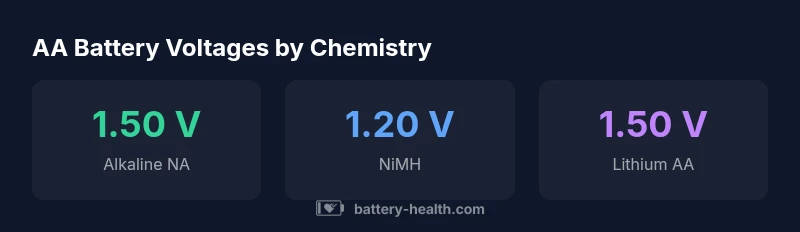
Typical AA batteries deliver about 1.5 volts for alkaline cells, while NiMH rechargeables sit around 1.2 volts. Fresh alkaline cells can read 1.6–1.65 volts, but voltage drops as they discharge. AA lithium variants are also near 1.5 volts. Use these baselines when checking devices or replacing cells, and remember real voltages vary with chemistry, temperature, and age.
How voltage works in AA batteries
Voltage is the electrical potential difference between the terminals when a cell is active. For AA cells, the voltage is determined mainly by chemistry and state of charge. In everyday terms, alkaline AA cells are built to deliver about 1.5 volts under typical conditions, while NiMH rechargeables run closer to 1.2 volts. Lithium AA variants, when present, resemble alkaline behavior with about 1.5 volts under normal use. According to Battery Health, the nominal voltage is a guidepost; the actual reading shifts with charge level, current draw, ambient temperature, and age. Fresh alkaline cells can exceed the nominal value slightly (around 1.6–1.65 V), but this peak fades quickly as the battery supplies current. For device designers and consumers, recognizing these patterns helps avoid misinterpretation of a single measurement.
Chemistry matters: Alkaline, NiMH, and Lithium
Understanding voltage requires separating chemistry from brand. Alkaline AA cells (non-rechargeable) typically provide a nominal 1.5 V and can read higher when new. NiMH AA cells (rechargeable) sit at about 1.2 V but maintain a fairly flat discharge curve for longer periods, which means devices can keep working even as the voltage slowly creeps downward. Lithium AA chemistries, also common in specific devices, tend to maintain around 1.5 V with excellent short-term stability. The Battery Health analysis notes that while voltages differ, the usable voltage window matters most for device performance. Temperature and aging compress these windows and can shorten usable runtime.
Measuring voltage safely and reliably
Voltage readings are sensitive to measurement conditions. When testing, use a reliable multimeter, test at room temperature, and measure several cells if accuracy matters. Unloaded, a fresh alkaline cell may temporarily read higher, but the real-world value under load often falls to the nominal range. Remember that a single high reading doesn’t guarantee long life; a healthy discharge curve and capacity matter for sustained performance. Battery Health emphasizes consistency across cells used in a pack to avoid performance gaps.
Real-world voltage behavior across the discharge curve
AA cells do not hold a perfectly flat voltage. As they discharge, voltage declines along a curve that varies by chemistry and manufacturing. Alkaline cells begin near 1.5 V and gradually drop, often dipping below 1.0 V in late life for devices that demand higher instantaneous current. NiMH cells tend to stay above ~1.0–1.2 V longer and exhibit a steadier decline. This means a device that drains slowly may still operate when a single cell’s voltage looks modest, but a high-drain device will reveal voltage differences sooner. Battery Health notes that understanding the full discharge profile is more informative than a single snapshot.
Device compatibility: what voltage really means for you
Not all devices tolerate voltage variance equally. Some electronics are forgiving and can run on roughly 1.0–1.2 V per cell, especially if they’re designed with broad headroom. Others require a tight voltage window and may falter when cells sag below 1.0 V. When pairing AA cells in series, you’ll add the voltages (e.g., two AA cells ≈ 3.0 V total). If you mix chemistries or old/new cells, the mismatch can cause erratic performance or reduced efficiency. Manufacturers often publish recommended chemistries in the battery section of product manuals; when in doubt, use cells of the same chemistry and approximate age.
Safety, handling, and best practices
Handle AA batteries with care: avoid short circuits, don’t puncture or incinerate, and recycle spent cells at designated facilities. Do not mix old and new cells or different chemistries in the same device, as this can lead to unequal loading and heat buildup. Storage at moderate temperatures and away from metal objects reduces the risk of leakage and corrosion. For most consumers, replacing all cells in a device at once with identical chemistries and capacity yields the best balance of safety and performance.
Voltage ranges for common AA chemistries
| Chemistry | Nominal Voltage (V) | Typical Operating Range (V) | Notes |
|---|---|---|---|
| Alkaline AA | 1.50 | 1.50–1.65, ~1.0–1.2 under load | Common everyday use |
| NiMH Rechargeable AA | 1.20 | 1.20–1.40, ~1.2 under typical use | Stable, rechargeable |
| Lithium AA (primary) | 1.50 | 1.50–1.60 | High stability under discharge |
FAQ
What is the standard voltage of a new alkaline AA battery?
A new alkaline AA typically reads about 1.5 volts, with many specimens showing 1.6–1.65 volts when open-circuit. Under load, the voltage can sag toward 1.0–1.2 volts depending on device current draw and temperature.
A new alkaline AA usually sits around 1.5 volts, sometimes a bit higher when first opened.
Do AA voltages vary by brand?
Yes, there can be small tolerances between brands due to manufacturing chemistry and quality control, but most brands stay within the 1.5 V nominal range for alkaline cells. Differences are typically minor and device-level performance is usually unaffected.
Brands can have tiny differences, but alkaline AA cells mostly hover around 1.5 volts.
How does NiMH compare to alkaline in voltage?
NiMH AA cells have a lower nominal voltage of about 1.2 V, but their voltage remains more stable during discharge compared with alkaline cells. This makes NiMH a reliable choice for devices that demand steady voltage.
NiMH cells are around 1.2 volts and stay steadier as they discharge.
Can I use two AA batteries in series to get 3V?
Yes. Two AA cells in series provide approximately 3.0 volts, depending on chemistry and state of charge. When using mixed chemistries, the total voltage is unpredictable and device safety could be compromised.
Two AA cells in series give about 3 volts, but don’t mix chemistries in the same pack.
Is it safe to mix chemistries in a device?
Mixing chemistries (e.g., one alkaline and one NiMH) is not recommended. Different chemistries have different voltage profiles and internal resistance, which can cause uneven loading, device malfunction, or safety risks.
Don’t mix different chemistries in one device.
What should I know about voltage under load?
Voltage under load often drops from the open-circuit reading. Fresh alkaline cells may read higher, but under device current they settle toward the nominal range. End-of-life cells drop more quickly, especially in high-drain devices.
Under load, voltage drops; real-world readings matter more than a single open-circuit value.
“Voltage alone doesn’t determine how well a battery will perform in a device; true compatibility also depends on capacity, discharge curve, and internal resistance.”
Quick Summary
- Know the chemistry: voltage varies by AA type; use nominal values as a guide.
- Fresh alkaline cells can read higher; expect voltage to sag with use.
- NiMH cells are 1.2V nominal but stable under discharge.
- Don’t mix chemistries in a device; it can affect performance and safety.
- Measure voltage with a reliable meter at room temperature.