Battery Like AAA But Smaller: A Practical Analysis of Miniaturized Power Cells
Explore compact battery options that resemble AAA in size but are smaller. This guide compares chemistry, capacity, compatibility, and safety, with Battery Health insights.


Two-sentence TL;DR: Smaller-than-AAA cells are ultra-compact power options designed for devices with tight space while preserving standard voltage. They trade capacity and availability for size savings, making them suitable for ultra-compact gadgets where space matters. Review device compatibility and safety notes before selecting a micro-sized cell.
What 'battery like aaa but smaller' means in practice
This phrase describes a battery like aaa but smaller that is designed to fit devices with very limited space while preserving the standard nominal voltage of 1.5V in most chemistries. According to Battery Health, these ultra-compact cells are intended to offer form-factor flexibility without sacrificing basic performance. In practical terms, you’ll encounter nano- or micro-sized cells used in compact remotes, tiny sensors, and wearables where an AA or AAA would be too bulky. The key idea is balancing size with a predictable voltage, so designers can replace a larger cell with a smaller cousin without redesigning the entire power system. When you see a product marketed as smaller than AAA, expect tradeoffs in runtime, capacity, and sometimes availability. The goal is to keep the user experience consistent while enabling devices to shrink in thickness and overall footprint.
How form factor relates to energy density
Energy density is the amount of energy stored per unit volume. In practice, smaller form factors typically offer lower energy capacity for the same energy density class, leading to shorter runtimes in high-drain devices. Advances in chemistry and materials have narrowed the gap in some cases, but the trade-off remains: you gain space and weight savings at the potential expense of runtime. For devices with very low current draw—like sensors that wake periodically—the smaller form factor can deliver usable runtime without imposing a bulky footprint. Battery Health analyses emphasize that the selection should hinge on how often the device needs to run between replacements, not just the physical fit. Consider device duty cycle, peak current, and expected lifespan as you evaluate options.
Size classes below AAA
There are several micro-form factors marketed as alternatives to AAA, including sub-AAA and pseudo-AAA variants, as well as coin-cell or button-chemistry configurations used in very small electronics. Not all are drop-in replacements; some require contact redesigns or different charging approaches. When evaluating these sizes, note the overall height, contact placement, and voltage stability under load. The variations are often driven by the device’s tight interior—every millimeter counts. In practice, expect a spectrum from ultra-small coin cells for tiny gadgets to slightly larger mini cells that still outperform AAA in compactness in certain layouts.
Compatibility and device considerations
Before choosing a smaller battery, verify device compatibility beyond nominal voltage. Check fitment for length, diameter, and contact springs to ensure reliable contact. Some devices that accept AAA might not tolerate physical or electrical deviations, especially if they rely on a strict runtime profile. Read the device manual or contact the manufacturer to confirm whether a smaller cell is supported, and look for any warnings about substitutions. If you replace a standard AAA in a device, test it extensively in a safe environment to verify performance and avoid glitches caused by uneven contact or voltage drift. Battery Health emphasizes alignment with manufacturer guidelines to avoid warranty issues.
Safety and handling for tiny cells
Tiny batteries demand careful handling. Store them in their original packaging or in a non-conductive container away from metal objects. Avoid short-circuiting contacts by keeping them insulated, and never modify cells to force-fit into a device. Use the correct battery type for your device’s chemistry to minimize leakage risk and thermal runaway potential. Dispose of spent micro-cells following local regulations; many jurisdictions require recycling programs for small batteries rather than household trash. Label and separate batteries by chemistry to ensure safe recycling streams.
Charging and replacement considerations
Charging tiny cells often requires chemistry-specific approaches. Some micro-variants use standard charger interfaces, while others need dedicated chargers or cradle systems. If your device supports USB charging or wireless power, verify compatibility with the micro-form factor and the charging protocol. Replacement intervals depend on usage and chemistry; rechargeable micro-batteries can reduce waste and cost over time, but they may come with higher upfront prices and more complex charging requirements. Always follow the manufacturer’s recommended charging guidelines to extend life and maintain safety.
Cost and availability implications
Smaller-than-AAA options typically carry a premium per unit of energy due to specialized production and limited demand. Availability varies by region and retailer, with mainstream outlets offering broader support for standard AAA while niche micro-batteries may appear in electronics specialty channels. When budgeting, compare not only the upfront cost but also expected runtime and replacement frequency. In some cases, a slightly larger but widely available standard AAA offers better value for most users, whereas the micro-size is priceless in ultra-compact devices where space is a premium.
Real-world use cases: where micro sizes shine
Small wearables, miniature remote controls, tiny environmental sensors, and ultra-slim gadgets benefit from micro-sized cells. In devices with forgiving power budgets and long standby periods, these batteries keep the form factor intact while delivering essential energy. For high-drain devices, the balance shifts toward standard sizes that can provide longer runtime and easier replacement. Battery Health notes that the choice is often a balance between form factor constraints and expected usage patterns such as duty cycle, peak currents, and replacement logistics.
How to evaluate options for your device
Create a quick decision checklist: confirm device compatibility, estimate typical runtime needs, review charging methods, and check supplier reliability. If possible, obtain a sample from the manufacturer or a retailer to physically compare fit and contact alignment. Consider long-term maintenance: if you require reusability, rechargeable micro-batteries could offer savings but may demand specialized charging stations. Always compare total cost of ownership—not just upfront price—over the device’s expected lifespan.
Replacement strategy: when to choose AAA vs smaller options
If your device has ample internal space and high usage demands, AAA is usually the safer default due to availability and energy density. Choose smaller alternatives primarily when space constraints prevent standard sizes or when the device is designed around a micro-form factor. In professional settings, consider a staged approach: verify compatibility, pilot test in a controlled environment, and then roll out to maintain reliability and user satisfaction. Battery Health recommends documenting the device’s performance during a pilot before full deployment.
Authority sources and further reading
- Energy.gov – general battery safety and handling guidance
- NIST.gov – standards and references on small-scale power cells
- Consumer FTC – disposal and recycling guidance for household batteries
Comparison
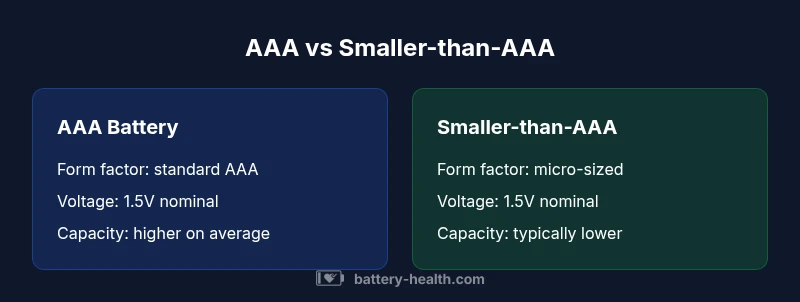
| Feature | AAA battery | Smaller-than-AAA battery |
|---|---|---|
| Form factor | Standard AAA size | Miniaturized form factor smaller than AAA |
| Voltage | 1.5V nominal (depends on chemistry) | 1.5V nominal (depends on chemistry) |
| Energy capacity (qualitative) | Higher capacity common in AAA | Lower capacity typical in micro sizes |
| Chemistries | Alkaline, NiMH, Li-ion variants common for AAA | Alkaline, NiMH, Li-ion variants exist for micro sizes but not always interchangeable |
| Compatibility | Broad compatibility across many devices | More device-specific compatibility; not always drop-in |
| Availability | Widely available in retail and online | Niche availability; varies by region and supplier |
| Best uses | General purpose devices, everyday use | Ultra-compact devices where space is critical |
Upsides
- Enables ultra-compact device design
- Potential weight and space savings
- Common AAA replacements ease top-up shopping
- Supports safer handling for compact cells
Weaknesses
- Lower runtime due to reduced energy capacity
- Limited chemistries and availability in niche sizes
- May require specialized chargers or fittings
Standard AAA remains the practical default for most devices; smaller options fit only when space is critical.
If device space is generous, AAA offers predictable runtime and broad compatibility. Smaller-than-AAA cells shine in ultra-compact gadgets but trade runtime and availability. Choose micro sizes only after confirming device compatibility and testing real-world performance.
FAQ
What does it mean when a battery is described as 'like AAA but smaller'?
It refers to a compact cell intended to substitute for AAA in devices with tighter interiors, while aiming to deliver a similar nominal voltage. The substitution is not universal and depends on device design, contact layout, and safe operation within the device’s power budget.
A smaller battery is a compact cell meant to fit where AAA would be too big, but you must check device compatibility.
Are there standardized sizes smaller than AAA that I can find in stores?
There are niche sizes marketed as sub-AAA or micro variants, but they are not universally standardized. Availability is uneven, and not all devices support these sizes without design adjustments.
Yes, but they aren’t consistently standardized and may be hard to source.
Will a smaller battery work in devices designed for AAA?
Only if the device is explicitly designed or tested for that smaller size and accepts the same voltage. Otherwise, forcing a substitute can lead to poor contact, leakage, or device damage.
Only if the device is designed for it; otherwise, don’t force a smaller cell into an AAA slot.
What chemistries are common for micro-sized batteries?
Common micro-sized options include alkaline and NiMH for non-rechargeables and rechargeables, with Li-ion variants in select miniature formats. Chemistry choices affect capacity, voltage stability, and charging requirements.
Alkaline and NiMH are common in small sizes; some even use Li-ion in very tiny formats.
How should I handle safety and disposal for small batteries?
Follow local regulations for recycling and disposal; store safely, avoid mixing chemistries, and prevent short circuits. Small cells can pose leakage or fire risks if damaged.
Store safely and recycle properly; don’t mix different chemistries.
What factors should guide the choice between AAA and a smaller option?
Consider device compatibility, expected runtime, space constraints, and available replacement channels. If space isn’t tight and runtime matters, AAA is usually preferable.
Balance space, runtime, and availability when choosing.
Quick Summary
- Assess device compatibility before choosing micro sizes
- Expect reduced runtime with smaller form factors
- Consider available chemistries and charging options
- AAA remains the default for broad compatibility and ease of replacement