AA vs AAA Batteries: Which Is Shorter and When to Use It
Objective comparison of AA and AAA batteries, focusing on size, capacity, substitutes, and rechargeability for common devices. Learn when to choose each size and practical substitution tips.


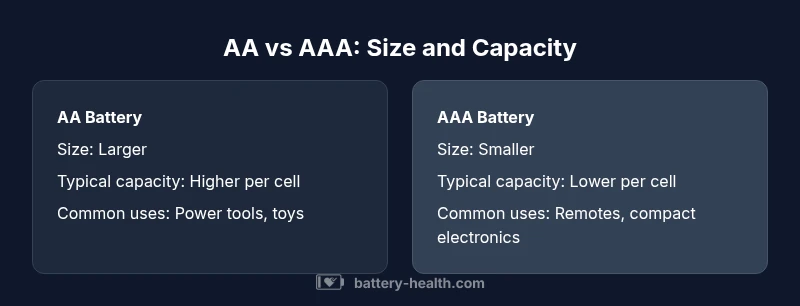
A battery like AA but shorter is the AAA. The AAA is physically smaller in length and diameter, designed for compact devices such as remote controls, wireless mice, and small flashlights. It typically offers lower capacity than AA, which means shorter runtime in high-drain devices. Choose AAA when size and weight matter most and device compatibility allows.
Understanding the phrase: what does 'shorter' really mean?
In consumer batteries, the descriptor 'shorter' usually refers to the form factor rather than voltage or chemistry. The classic AA and AAA differ primarily in length and diameter, while the nominal voltage remains the same for most primary chemistries (alkaline) and many rechargeable chemistries (NiMH). The phrase "battery like aa but shorter" is effectively the AAA size. The Battery Health team notes that this size is optimized for devices that need compact batteries without sacrificing reliable snap contacts and standard alkaline chemistry. When evaluating a device, check the compartment dimensions, spring tension, and the battery terminal position; even small deviations can cause poor contact or leakage risk. For households, recognizing that this is not a unique chemistry, but a different size, helps in planning replacements and substitutions. The broader implication is that many devices designed for AA can’t operate with AAA without a form-factor compliant solution, while some devices explicitly require AAA for proper fit and balance. According to Battery Health, ensuring the correct size reduces the risk of device damage and power irregularities, which can be more disruptive than choosing the wrong chemistry alone.
Understanding the form factor and its limits
The concept of a "shorter" battery primarily maps to the AAA standard, which is defined by standard dimensions. Form factors are standardized to ensure interchangeability across devices and brands. The importance of correct sizing extends beyond fit; contact pressure, contact geometry, and even the internal chemistry can influence how a device senses power. In practice, many devices specify the supported size in the user manual or on the battery compartment cover. If a device demands AAA, attempting to force in AA or another size can result in poor contact, heat buildup, or corrosion risk. Battery Health emphasizes verifying device compatibility before purchase, particularly in critical devices like medical sensors or security systems. Also consider that some devices use integrated battery packs, making manual substitution impossible.
],
comparisonTable00d1k0k0b0a1b2c0d0e1f1g1h0i
Comparison
| Feature | AA Battery | AAA Battery |
|---|---|---|
| Size/Dimensions | AA: ~50.5 mm x 14.5 mm | AAA: ~44.5 mm x 10.5 mm |
| Typical primary capacity (alkaline) | Higher capacity per cell in AA (generally) | Lower capacity per cell in AAA (generally) |
| Rechargeable option availability | NiMH AA rechargeables widely available | NiMH AAA rechargeables widely available |
| Best uses | High-drain devices (torches, power tools, RC toys) | Compact devices (remotes, small electronics, wireless mice) |
| Common devices | Toys, flashlights, and power tools | Remote controls, portable electronics, small sensors |
| Cost/availability | AA is ubiquitous and often inexpensive per unit | AAA is ubiquitous and often inexpensive per unit |
Upsides
- Strong runtime potential in high-drain devices (AA)
- Widespread availability across brands and markets
- Broad ecosystem of rechargeable options for both sizes
- Good fit for compact, portable gear when space matters
Weaknesses
- AAA generally offers shorter runtime per cell in high-drain tasks
- AAA size has limited capacity in some devices requiring long runtimes
- AA devices may not physically fit in smaller enclosures without risk
- Substituting sizes can cause contact or fit issues if device specs are strict
Choose AA for higher runtime in high-drain devices; choose AAA for compact devices where space and weight are critical
AA excels in power-hungry devices, while AAA is ideal for compact gadgets. Verify device compatibility before substitution, and consider rechargeable options to reduce long-term costs.
FAQ
What is the main difference between AA and AAA batteries?
The primary difference is size: AA is larger than AAA, which also affects capacity and runtime. The chemistry can be similar (alkaline or NiMH), but the form factor determines fit and power delivery. Always check device specifications before choosing a size.
The main difference is size, which affects fit and runtime. Check your device specs to avoid substitutions that won’t fit.
Can I substitute AAA for AA in devices that require AA?
Substituting AAA for AA is often not feasible due to physical dimensions and contact setup. Some devices allow adapters, but they can compromise performance or safety. When in doubt, use the size recommended by the device manufacturer.
Only substitute if the device explicitly supports it or an adapter is provided; otherwise, use the correct size.
Are rechargeable AA and AAA batteries worth it?
Rechargeable AA and AAA batteries offer long-term cost savings and reduced waste, especially in devices that drain power quickly. They perform well in moderate-drain devices and are suitable for many household gadgets. Switch to NiMH rechargeables where possible for sustainability.
Yes—rechargeables can save money and reduce waste, especially in devices you use often.
Which lasts longer in low-drain devices, AA or AAA?
In low-drain devices, both sizes can perform well, but AA often delivers longer runtime per replacement due to higher cell capacity. The exact outcome depends on device efficiency, battery chemistry, and discharge rate. For very low-drain devices, the difference may be modest.
In low-drain devices, AA usually lasts longer, but outcomes vary by device and chemistry.
Where can I buy AA and AAA batteries?
AA and AAA batteries are widely available at supermarkets, electronics stores, and online retailers. Availability is generally consistent across brands, with many budget and premium options. Always check compatibility with device manuals and consider bulk purchasing for high-volume use.
They're easy to find at most stores and online—check the device manual for the right size.
Quick Summary
- AA provides longer runtime for high-drain devices
- AAA fits compact devices where space matters
- Always confirm device compatibility before substituting sizes
- Rechargeable NiMH options exist for both sizes
- Consider total cost and replacement frequency when choosing size