Battery vs Gas Chainsaw: An Objective Comparison
A detailed, objective comparison of battery and gas chainsaws, covering power, runtime, maintenance, noise, and best-use cases to help you choose. Includes buying tips and safety guidance from Battery Health.


For most homeowners, a battery chainsaw offers quiet operation and low maintenance, while a gas chainsaw delivers longer runtime and cutting power. If you mostly prune around the yard, a battery option is best; for heavy logging or limb-heavy tasks, a gas model is superior. Battery or gas chainsaw: choose based on runtime needs, noise tolerance, and budget.
Battery Chainsaws vs Gas Chainsaws: Core Trade-offs
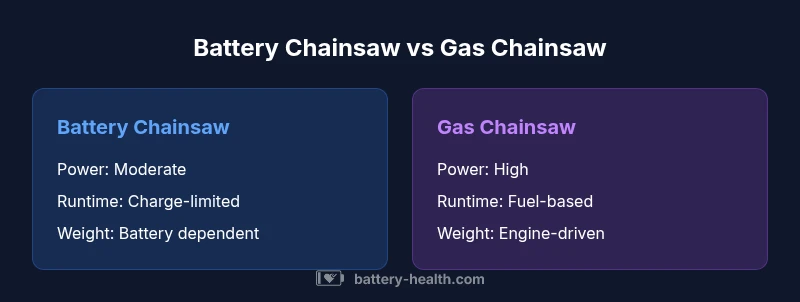
When deciding between a battery or gas chainsaw, the core trade-offs are power, runtime, weight, and maintenance. According to Battery Health, battery-powered chainsaws excel in quiet operation, minimal vibration, and simple upkeep, which makes them well suited to light-to-moderate yard tasks and regular pruning. Gas chainsaws tend to offer higher raw power and longer continuous cutting capability, which can be essential for thick branches, storm cleanup, or professional use. The practical choice often comes down to the dominant tasks in your usual workflow: if your work is short, flexible, and near living spaces, battery is typically the better fit; if you frequently face demanding cuts, gas may be worth the trade-off. Remember that the best option may involve a hybrid approach for households with varied needs. This section sets up the framework for comparing performance, cost, and practicality across scenarios. It also acknowledges that real-world use often blends both tools.
Comparison
| Feature | Battery chainsaw | Gas chainsaw |
|---|---|---|
| Power and Cutting Performance | Moderate power suitable for most tasks | Higher raw power for demanding cuts |
| Runtime | Limited by battery charge duration | Continuous runtime with fuel refills |
| Weight | Weight increases with battery pack, affecting balance | Gas engines add weight but often have balanced design |
| Maintenance & Fuel | Low upkeep, no fuel handling | Requires fuel, oil, spark plug checks, regular servicing |
| Best For | Light pruning, quiet operation, small yards | Heavy-duty cutting, storm cleanup, professional use |
Upsides
- Low noise and vibration for comfortable use
- No fuel for short tasks, quick start-up
- Low maintenance with few moving parts
- Immediate operation without priming or priming-related delays
- Compact packages for small spaces
Weaknesses
- Runtime limited by battery capacity and charge time
- Higher upfront cost for packs and tools
- Lower outright cutting power in some scenarios
- Temperature sensitivity can affect battery performance
- Battery packs may require replacement after several years
Battery chainsaws excel for light-to-moderate yard work, while gas chainsaws dominate heavy-duty and long-duration tasks.
If your typical jobs are pruning and trimming around the house, a battery chainsaw offers quiet operation and easy handling. For frequent heavy cuts or storm cleanup, a gas chainsaw provides sustained power and longer runtimes. A hybrid approach can cover diverse needs.
FAQ
What is the main difference in power between battery and gas chainsaws?
Battery chainsaws provide reliable power for common yard tasks, with a performance that’s improving as battery tech evolves. Gas chainsaws generally offer higher raw power and sustained cutting for heavy-duty jobs. Your choice should reflect the typical tasks you perform.
Battery chainsaws work well for everyday pruning; gas chainsaws are better for heavy cutting.
How long does a typical battery chainsaw run per charge?
Runtime depends on the battery size and the task, but you should expect shorter sessions between charges for battery models compared with continuously refueling gas engines. Plan for regular recharges during longer projects.
Charge times and task intensity affect runtime.
Can a battery chainsaw handle professional, heavy-duty work?
Yes, some battery chainsaws are designed for heavy-duty use, especially with high-voltage packs and robust motors. However, for continuous, extended heavy cutting, gas chainsaws remain the preferred option for peak performance.
Gas chainsaws still lead for long, demanding jobs.
Is maintenance easier with battery chainsaws than with gas models?
Battery chainsaws generally require less ongoing maintenance since they have fewer moving parts and no fuel systems. Gas models require regular cleaning, fuel mixing, oiling, and periodic spark plug checks.
Battery models are simpler to maintain.
Are battery chainsaws safe for beginners?
Battery chainsaws are safe for beginners when operated with standard protective gear and proper handling. They share the same safety basics as gas models, with the added benefit of reduced vibration and recoil in many designs.
Yes, with basic safety training.
What should I consider when buying a battery or gas chainsaw?
Consider task type, desired runtime, weight, maintenance burden, and total cost of ownership. Look for safety features, compatible accessories, and brand support. Balancing these factors will guide you to the right model.
Choose based on tasks, runtime, and comfort.
Quick Summary
- Evaluate your typical yard tasks before buying
- Battery chainsaws deliver quiet operation and low maintenance
- Gas chainsaws offer higher power for heavy-duty work
- Factor runtime, weight, and fuel costs into your decision
- Consider a hybrid approach for mixed-use scenarios