Battery vs Gas Chainsaw: Performance, Cost, and Safety
Compare battery-powered and gas-powered chainsaws to determine the best fit for your yard, safety, and budget. This Battery Health guide covers runtimes, maintenance, emissions, and total cost of ownership for home and professional use.


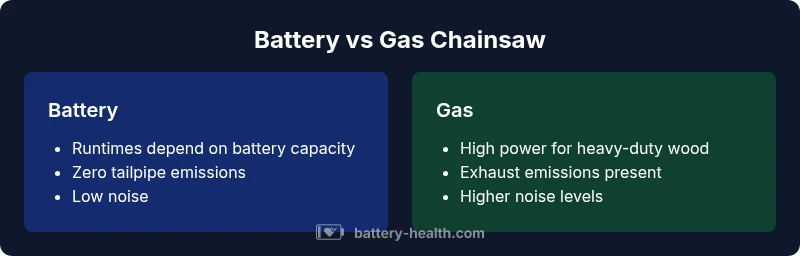
According to Battery Health, the Battery vs Gas Chainsaw comparison reveals that battery-powered models excel in quiet operation, minimal maintenance, and zero emissions, while gas models offer longer runtimes and higher cutting power for heavy-duty tasks. For most homeowners performing light to moderate cutting, a battery chainsaw often delivers the best balance of convenience and performance.
Performance Landscape: Battery vs Gas Chainsaws
In the broader market for cutting tools, battery-powered chainsaws and gas-powered chainsaws occupy distinct segments. Battery models are increasingly capable for light to mid-duty jobs, particularly where noise, fumes, and daily maintenance are concerns. Gas models, by contrast, remain the go-to choice for heavy-duty work, prolonged use, or locations without easy charging access. According to Battery Health, the Battery vs Gas Chainsaw comparison helps homeowners weigh quiet operation and emissions against raw power and runtime. The decision tends to hinge on how much wood you cut, where you work, and how you store and charge accessories. Beyond performance, consider lifecycle factors such as manufacturing, end-of-life disposal, and the environmental footprint associated with each option.
This section sets the stage for a practical decision: choose the tool that best aligns with your typical tasks, yard size, and work environment. It also frames the trade-offs between convenience and capability, as well as the implications for maintenance routines and tool longevity.
How They Work: Batteries vs Gas Engines
Battery-powered chainsaws rely on rechargeable cells—commonly lithium-ion—paired with a controller that optimizes torque and speed. Gas chainsaws use a small internal combustion engine that drives the chain through a clutch system. Battery chainsaws start with a press of a button and require charging between tasks, while gas models typically start via pull cord or electric start on some modern engines. Battery health and battery chemistry influence runtime, peak power, and cycle life, whereas the fuel system, air filter, and spark plug affect the longevity and reliability of gas engines. Understanding these basics helps buyers anticipate maintenance needs, charging cycles, and potential downtime between work sessions.
The Battery Health team emphasizes that the reliability of either option depends on tool design, battery capacity, and how you use the saw. If you cut irregularly or in small bursts, a battery model often provides smooth, predictable performance with minimal downtime.
Key Performance Differences
Real-World Scenarios: When to Choose Each
Weight, Ergonomics, and Handling
Maintenance, Durability, and Reliability
Emissions, Noise, and Environmental Impact
Cost of Ownership and Long-Term Value
Practical Buying Guide: What to Look For
Comparison
| Feature | Battery-powered chainsaw | Gas-powered chainsaw |
|---|---|---|
| Runtimes | Depends on battery capacity and charge level; charging time varies | Fuel capacity enables longer uninterrupted use |
| Power/Cutting Speed | Balanced, efficient for most yard work | High power and fast cutting for heavy-duty tasks |
| Weight | Typically lighter without the battery; weight depends on battery pack | Typically heavier due to engine and fuel system |
| Emissions | Zero tailpipe emissions during operation | Direct exhaust emissions from combustion |
| Noise | Significantly quieter in most models | Loud; higher peak noise during operation |
| Maintenance | Lower maintenance; fewer moving parts | More maintenance: oil, filters, spark plug, carburetor adjustments |
| Start-Up | Push-button start; no priming | Pull-start with choke on many models |
| Cost of Ownership | Higher upfront cost for premium battery packs; lower fuel costs | Lower upfront cost but ongoing fuel and maintenance costs |
| Fuel/Charge Availability | Recharge at home; batteries may be swapped or recharged | Fuel must be purchased and stored; refueling logistics |
Upsides
- Lower noise and zero emissions during operation
- Lower maintenance and simpler startup
- No fuel handling or storage required
- Lightweight and compact for small to mid tasks
- Immediate power with a push-button start
Weaknesses
- Limited runtime by battery charge; needs charging intervals
- Lower raw cutting power for very thick or dense wood
- Higher upfront cost for premium battery packs
- Battery degradation over time may require replacement or swapping
Battery chainsaws are the better all-around choice for most homeowners, while gas chainsaws still excel for long hours of heavy-duty work.
For typical yard maintenance, a battery-powered chainsaw balances convenience, safety, and cost. Gas models remain the benchmark for continuous, heavy cutting and remote sites without easy charging. Your final choice should reflect your workload, climate, and how you value maintenance versus runtime.
FAQ
What is the main difference between battery and gas chainsaws?
The main difference is power delivery and runtime: battery chainsaws prioritize quiet operation, low maintenance, and emissions-free use, while gas chainsaws provide higher peak power and longer continuous runtime. Your choice depends on the size of tasks and access to charging or fuel.
The key difference is power and runtime. Battery chainsaws are quieter and easier to maintain, while gas models deliver more raw power for big jobs. Choose based on your typical tasks and access to charging or fuel.
Are battery chainsaws suitable for professional tree work?
Battery chainsaws can handle many professional tasks, especially in urban or sensitive environments. For extended, heavy-duty work or long sessions away from charging, gas tools may be more practical. Always assess task duration, wood type, and ventilation requirements.
Yes for many professional tasks, especially in tight spaces. For long days or very tough wood, gas may still be preferred.
What affects battery runtime?
Runtime depends on battery capacity, the type of wood, and how aggressively you cut. Heavier cuts and dull chains reduce efficiency, while maintaining proper tension and sharpness helps maximize runtime.
Runtime depends on the battery you have and how you cut. Keeping the chain sharp helps you get more done per charge.
Do gas chainsaws require more maintenance?
Gas saws typically require more routine maintenance—oil changes, air and fuel filters, spark plugs, and carburetor adjustments. Battery tools generally need less ongoing service beyond battery care and chain upkeep.
Gas saws usually need more regular maintenance, while battery saws are simpler to care for.
How do I decide which type is best for my yard?
Consider yard size, tree species, and how often you cut. If you perform light-to-mid work in a suburban setting with convenient charging, a battery saw often fits best. For large lots, tough wood, or remote sites, gas may be the practical choice.
Think about your yard size and how often you cut. Battery for everyday tasks, gas for big jobs away from charging.
Are there safety differences between the two?
Both types require standard safety gear and practices. Battery saws reduce exhaust exposure and ignition risk, while gas saws pose more burn and fueling hazards. Follow manufacturer safety guidelines for both.
Safety basics apply to both. Battery saws have fewer fumes and ignition risks, but follow all safety rules for both tools.
Quick Summary
- Assess yard size and cutting types to pick battery or gas
- Battery chainsaws excel in quiet operation and low maintenance
- Gas chainsaws offer raw power and longer runtime for heavy-duty work
- Consider total cost of ownership, not just upfront price
- Keep safety gear and a maintenance schedule for either type