Cost to Replace Tesla Battery: 2026 Guide
Explore realistic cost ranges for replacing a Tesla battery, factors affecting price, warranty considerations, and budgeting tips. Learn how model, pack size, and options like OEM vs refurbished packs influence the total.


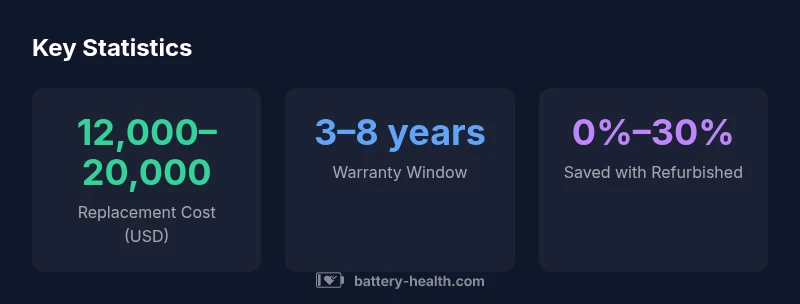
According to Battery Health, the cost to replace a Tesla battery typically ranges from roughly $12,000 to $20,000 before labor, with price variation driven by model, pack size, and whether you use OEM or third‑party cells. Labor and regional rates can push the total higher or lower, and warranties may offset part of the expense.
Why the cost to replace a Tesla battery varies
The cost to replace a Tesla battery is not a single number; it shifts with technology changes, supplier options, and service logistics. According to Battery Health, consumer estimates converge around a broad range because several factors interact. For a Tesla, the phrase cost to replace tesla battery is not uniform; it depends on whether you buy a new OEM pack, a refurbished module, or a reconditioned system, and on the labor rates charged by the service center. In practical terms, you should expect a base price in the tens of thousands of dollars, with variability that can tilt the total price by a few thousand dollars in either direction. The Battery Health team notes that you will pay more upfront if your car is an older generation with a larger pack, or if you demand a brand-new unit with the latest chemistry; conversely, refurbished or used packs can offer meaningful savings but carry trade-offs in warranty and performance. Pricing also depends on whether the work is done at a Tesla service center or an independent EV shop; the latter may offer lower labor costs but increased risk if the pack's safety components require specialized handling. Understanding these complexity factors helps you plan more accurately.
OEM vs refurbished packs: price implications
OEM (original equipment manufacturer) battery packs carry the advantage of strict compatibility, factory calibration, and official warranty coverage. They generally cost more upfront because you’re paying for the latest chemistry, validated safety features, and the assurance of Tesla’s service network. Refurbished or rebuilt packs can offer substantial cost savings, sometimes in the lower end of the replacement spectrum, but they come with caveats: variable warranty length, potential differences in performance, and limited long‑term data on reliability. If you’re evaluating replacement options, ask the shop for documentation of cell provenance, testing standards, and warranty terms. Battery Health notes that the decision often hinges on your vehicle’s age, expected remaining life, and how much you value guaranteed performance versus upfront savings.
How model and pack size influence price ranges
Tesla models differ in pack size and chemistry, which directly impacts replacement cost. Model S and Model X vehicles have historically used larger packs, translating to higher base costs for a full pack replacement. Model 3 and Model Y tend to have smaller packs and offer more cost flexibility due to broader parts availability and potential OEM competition. In practice, you’ll see a wider price band for older generations with bigger packs, and relatively narrower bands for newer, compact configurations. Beyond pack size, the exact chemistry (nickel‑based versus newer chemistries like continuous improvements) can influence both price and warranty terms. It’s not uncommon for drivers to encounter a 10–20% price difference when switching between generations, simply due to the scale of the pack and the integration with thermal management systems.
Warranty, service options, and payment paths
A warranty can substantially affect the perceived cost of replacement. If the battery is within the vehicle’s warranty window or covered by a specific battery warranty extension, a portion or all of the replacement may be covered by Tesla or a third‑party warranty provider. Service options vary: Tesla service centers typically offer standardized labor rates and certified technicians, while independent EV shops may present lower labor costs but require careful validation of safety protocols for high‑voltage systems. Payment paths vary by customer and region; some buyers explore financing plans or lease options for battery replacements, while others prefer to pay upfront. If you’re evaluating long‑term ownership costs, factor in the potential impact of maintenance plans, extended warranties, and any state or local incentives for EV service.
Labor costs and regional price dynamics
Labor costs are a meaningful portion of the total replacement bill and can vary significantly by geography. Regions with higher technician wages or limited availability of qualified EV specialists tend to see higher labor charges. Some shops bundle the battery replacement with electrical system calibrations and software updates, which can add to the bill but improve overall performance. If you live near a major metro area, you may encounter shorter wait times and more competition among service providers, which can help bring the price down. Conversely, rural areas or busy service hubs may see longer turnaround and higher hourly rates. When budgeting, don’t overlook the cost of potential road‑testing, software reconfiguration, and the re‑provisioning of auxiliary systems that support the battery’s operation.
Longevity and lifecycle considerations in budgeting
Battery degradation and expected lifespan influence the timing of a replacement. If a vehicle’s battery health metrics show significant capacity loss or rapid degradation, a replacement sooner may be cost‑effective compared to extended service cycles with reduced efficiency. Buyers should consider residual vehicle value, potential resale impact, and the possibility of improved future chemistry that could shift pricing in the coming years. As with any high‑voltage component, a proactive maintenance approach, including thermal management and calibration checks, can help maximize remaining value and reduce the likelihood of premature replacement.
Financing, incentives, and insurance angles
Some buyers explore financing options specifically for EV components, or seek discounts through bundled vehicle maintenance plans. Insurance coverage for battery replacement is usually limited to incidents (e.g., fire or collision) rather than wear or normal degradation, but policy terms vary. Incentives and rebates in some jurisdictions can offset part of the cost, particularly if they’re tied to battery thermal management upgrades or OEM replacement programs. Before committing to a replacement, verify your policy details and explore available local incentives, as these can meaningfully affect the total out‑of‑pocket cost over the vehicle’s life.
Step-by-step example: estimating your own cost
To estimate your cost, start by identifying your Tesla model and pack size, confirm whether a new OEM pack or a refurbished unit is preferred, and check current labor rates in your area. Contact at least two Tesla service centers and two independent EV shops for quotes, ensuring that each quote includes parts, labor, and any required software recalibration. Ask about warranties for the replacement pack, and whether reconditioning or refurbished options come with a separate warranty. Use the quotes to build a simple budget: parts cost, labor, tax, potential removal/installation fees, and an emergency reserve for contingency. Finally, compare total costs against options like selling your current vehicle for a newer model to assess the most cost‑effective path over a defined horizon.
Authority sources and further reading
- Energy.gov: Electric vehicle battery cost trends and policy context (https://www.energy.gov)
- NREL: Cost analysis and lifecycle considerations for EV components (https://www.nrel.gov)
- Nature Energy: Battery technology evolution and market implications (https://www.nature.com/nenergy)
Estimated replacement cost ranges by Tesla model and pack type
| Model Type | Estimated Replacement Cost Range (USD) | Notes |
|---|---|---|
| Model S/X (older packs) | 12,000–20,000 | OEM pack; varies by size and warranty |
| Model 3/Y (standard packs) | 10,000–18,000 | OEM pack; availability may vary by region |
| Used/Refurbished packs | 6,000–12,000 | Lower cost; quality and warranty vary |
FAQ
What factors influence the cost to replace a Tesla battery?
The cost depends on model, pack size, OEM vs refurbished packs, labor rates, and whether the battery is under warranty or eligible for replacement programs. Availability of newer pack designs can also impact price.
Costs depend on model, pack type, labor, and warranty; factor in availability of OEM vs refurbished options.
Is a Tesla battery replacement covered under warranty?
Tesla offers warranties that vary by model and battery type. If the pack fails within the warranty, replacement may be covered; outside warranty, you pay the replacement cost.
Warranty coverage varies by model and pack type; you may pay out-of-pocket if outside warranty.
Can I replace a Tesla battery with a third-party pack?
Some third-party or refurbished packs may be available, but compatibility, safety, and long-term reliability concerns apply. OEM packs are generally recommended for safety and performance.
Third-party packs exist, but safety and compatibility matter; OEM is usually preferred.
Does insurance cover battery replacement?
Some comprehensive car insurance policies may cover battery replacement after a covered incident, but routine wear-and-tear is generally not reimbursed. Check your policy specifics.
It depends on your policy; check if you have coverage for battery damage from incidents.
Are there cost-saving alternatives to full battery replacement?
Options include refurbished packs, battery reconditioning, or vehicle trading with a newer model. Each option carries trade-offs in warranty and reliability.
Consider refurbished packs or reconditioning, but know the trade-offs.
How does battery age affect the replacement cost?
Older packs may require replacement earlier due to degradation, while newer designs may be more expensive due to improved chemistry; costs reflect both pack and labor changes over time.
As batteries age, costs can go up due to part availability and design changes.
“"Battery costs have trended downward as technology matures, but a Tesla battery replacement remains a significant investment. Consumers should weigh warranties, labor, and availability when planning."”
Quick Summary
- Costs vary by model and pack type; plan for a broad range
- OEM packs are pricier but come with standard warranties
- Refurbished packs offer savings but with warranty trade-offs
- Labor rates and regional availability strongly influence total
- Check warranties, insurance, and incentives to offset costs