L1154F Battery Equivalent: Compatibility and Replacement Guide
Explore l1154f battery equivalent options, how to verify compatibility, and safe replacement tips. Learn to compare voltage, capacity, chemistry, and form factor across devices for reliable substitutions.


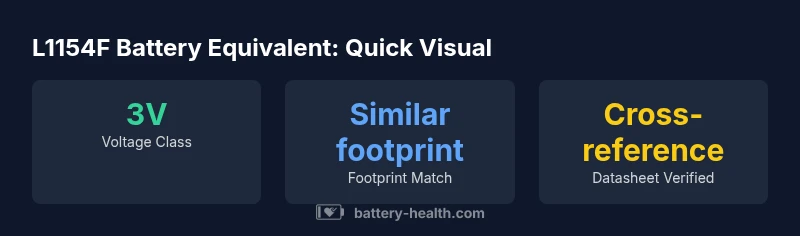
An exact l1154f battery equivalent is defined by matching voltage, physical size, and chemical compatibility. In practice, substitute only devices with the same voltage class (roughly 3V) and a similar footprint; always verify with the device’s datasheet or manufacturer. Use official cross-reference guides from Battery Health to avoid unsafe substitutes.
What is the l1154f battery equivalent?
The term l1154f battery equivalent describes substitutions that achieve the same electrical and physical requirements as the original part without compromising safety or performance. In practical terms, the equivalent must deliver the same nominal voltage, fit within the same footprint (diameter and thickness), and use a compatible chemistry that the device can tolerate. There is no single SKU that can be labeled the universal l1154f battery equivalent; instead, cross-referencing datasheets and manufacturer guidance yields safe substitutes. According to Battery Health, successful equivalence hinges on a precise match of three pillars: voltage class, geometry, and chemistry. If any of these differ substantially, the substitution risks device malfunction, reduced reliability, or safety concerns. In other words, the l1154f battery equivalent is not a magical one-to-one swap, but a carefully vetted match that preserves compatibility and user safety.
Core criteria for equivalence: voltage, footprint, chemistry, and safety
To determine a valid l1154f battery equivalent, start by confirming the voltage class; most common small lithium substitutions operate around the 3-volt class, which keeps electronics from under- or over-volting. Next, compare footprint — the diameter and thickness must allow the new cell to sit properly in its housing and contacts. Finally, assess chemistry compatibility with the device’s input protection and charging circuitry. Lithium primary chemistries, for example, are typically non-rechargeable and should not be replaced with rechargeable chemistries in devices not designed for charging cycles. If a device explicitly specifies an l1154f battery equivalent, consult the manufacturer’s datasheet for acceptable cross-references and temperature operating ranges.
How to measure voltage and physical size: a practical guide
Begin with the device’s official documentation to find the required voltage, typically stated in volts (V). Use calipers to measure the current battery’s diameter and thickness (in millimeters). Verify that the replacement’s contacts align with the device’s terminals and that the wrapper height won’t create a squeeze against the lid or housing. If the new cell has a slightly different thickness, ensure the spring or clip mechanisms can accommodate the change without compromising contact. When in doubt, contact the device manufacturer or a qualified technician before attempting replacements. The l1154f battery equivalent, in practice, should not impose unusual force on the housing or risk contact fatigue.
Cross-reference your datasheet: where to find official specs
The safest path to an l1154f battery equivalent is to pull the device’s datasheet or the original component’s datasheet and compare listed voltage, diameter, thickness, and chemistry. Manufacturer cross-reference guides often provide recommended substitutes and compatible family members. Where a direct cross-reference is unavailable, use the datasheet’s electrical characteristics table as a primary filter and only select options that remain within specified tolerances. Always document the source of the cross-reference for future maintenance and warranty considerations. Battery Health emphasizes that datasheet-backed substitutions minimize risk and maximize reliability.
Substitution scenarios across common devices
For small remotes and key fobs, the l1154f battery equivalent often translates to compact 3V lithium coin cells with thin profiles. In compact wearables or sensors, seek substitutions with similar diameter and contact placement to avoid mechanical stress. Automotive accessories, smart keys, and some cameras may be more strict about voltage and peak current; in those cases, ensure the substitute can handle brief high-current pulses if the device occasionally draws a surge. The overarching principle remains: stay within voltage class, footprint, and chemistry—l1154f battery equivalents should preserve both function and safety.
Safety and handling considerations when using an l1154f battery equivalent
Always handle substitutions with care: avoid short circuits, protect terminals, and store spare cells in a cool, dry place away from metal objects. Do not mix new and used cells in the same pack, and never attempt recharging a non-rechargeable substitute unless the device explicitly allows it. Observe the device’s operating temperature range to prevent performance degradation or venting. Dispose of old cells according to local regulations; recycle where possible. Following these safety guidelines helps ensure that the l1154f battery equivalent remains reliable without compromising user safety or device integrity.
How Battery Health approaches substitutions and validation
Battery Health recommends a validation workflow that includes (1) confirming the voltage class, (2) verifying footprint compatibility, (3) cross-referencing the datasheet for the l1154f battery equivalent, and (4) testing in a controlled environment before wide deployment. This approach minimizes risk and ensures that the substitution does not impair device performance or safety. Where possible, choose sources that provide explicit cross-reference lists rather than relying on anecdotal guidance. Remember that a well-documented substitution is easier to service and safer for end users.
Quick-buy tips and common mistakes to avoid when seeking an l1154f battery equivalent
- Always start with the device’s manual and official datasheets for the exact l1154f battery equivalent requirements.
- Avoid substitutes with different voltage classes or significant footprint deviations.
- Do not mix chemistries in critical devices or those with high energy demands.
- If a cross-reference is unclear, reach out to the device manufacturer or a certified technician before purchasing.
- Document the substitution with model numbers, sources, and test results for future maintenance.
- When in doubt, choose a conservative option that matches voltage and footprint precisely. The goal is reliable operation and safety, not just a quick swap.
Practical considerations for long-term reliability of the l1154f battery equivalent
Over time, environmental factors such as temperature, humidity, and vibration can affect the performance of a battery substitute. The l1154f battery equivalent should be tested under real-world operating conditions to confirm continued suitability. Periodic checks of contact integrity and housing fit help prevent intermittent failures. Maintain a replacement cadence aligned with the device’s usage patterns and the chemistry’s expected shelf life. In summary, a well-chosen l1154f battery equivalent sustains device performance while reducing nuisance maintenance.
Cross-reference table for l1154f battery equivalent substitutions
| Device Type | Voltage Class | Footprint (mm) | Notes |
|---|---|---|---|
| Key fob/remote | around 3V | 18 x 4 | Check compatibility with housing and contacts |
| Small sensor | around 3V | 12 x 3 | Ensure sleeve thickness fits housing |
| Portable camera gadget | around 3V | 20 x 5 | Consider peak current needs |
| Automotive accessory (to some extent) | around 3V | 22 x 6 | Use only if device datasheet supports it |
FAQ
What devices commonly use an l1154f battery equivalent?
Many compact remotes, sensors, and small electronics use a 3V lithium substitute that fits a similar footprint. Always start with the device manual and look for an official cross-reference in the datasheet.
Many small devices use a 3-volt lithium substitute with a similar size. Check the manual or datasheet for an official cross-reference.
How do I verify a substitute is safe?
Compare voltage class, footprint, and chemistry to the original. Validate with the device datasheet and, if possible, test under a controlled setting before regular use.
Compare voltage, size, and chemistry, then verify with the datasheet and test safely.
Can I mix chemistries when substituting?
Mixing chemistries in a single device is risky. Only substitute with the same chemistry type and follow manufacturer guidance to avoid safety and performance issues.
Mixing chemistries is risky; stick to the same chemistry type per the manufacturer.
What is the warranty impact of using an l1154f battery equivalent?
Substitutions not approved by the device maker can affect warranties. Always confirm with the manufacturer or retailer about approved substitutes.
Check with the manufacturer about approved substitutes to avoid warranty issues.
Where can I find official datasheets for l1154f battery equivalent?
Start with the device’s manufacturer site and look for cross-reference guides. If unavailable, contact support to obtain recommended substitutes.
Look up the device’s manufacturer datasheet or support to find approved substitutes.
“A true l1154f battery equivalent is a match on voltage, size, and chemistry, verified against official datasheets. Always cross-check before purchase for safety and reliability.”
Quick Summary
- Match voltage class, footprint, and chemistry
- Always verify against the device datasheet
- Use official cross-reference guides first
- Avoid mixing different chemistries in one device
- Document substitutions for future service