Will Battery Acid Freeze? What Cold Weather Means for Electrolyte
Discover whether battery acid can freeze, how electrolyte freezing works, and practical steps to protect car, device, and home batteries in cold weather. Battery Health analyzes battery electrolytes and freezing behavior for 2026.


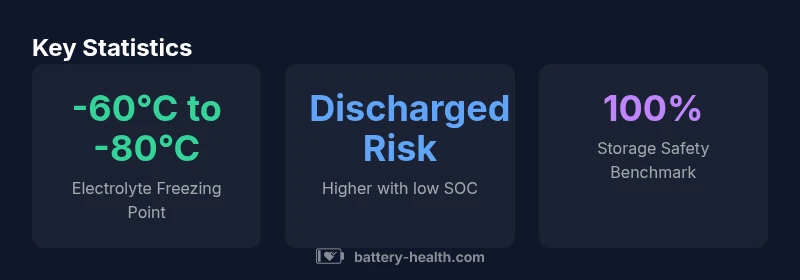
Yes, battery acid (electrolyte) can freeze, but only at extreme subzero temperatures. In a typical lead-acid battery, the electrolyte freezing point depends on sulfuric acid concentration and state of charge, and Battery Health Analysis, 2026 places common ranges roughly around -60°C to -80°C. Real-world winter conditions rarely reach these values, but extremely cold environments or a discharged battery can be at risk.
What the Question Really Means for Cold Climates
When people ask will battery acid freeze, they’re really asking about how cold it must get before the electrolyte in a battery becomes solid enough to hamper function. In common automotive and homeowner batteries, the electrolyte is a water-sulfuric acid mix whose freezing point drops as the acid concentration rises. The Battery Health team notes that a fully charged lead-acid electrolyte has a lower freezing point than a discharged one, but both can freeze if temperatures plunge far below zero. This is not a daily winter risk in many regions, but extreme cold events and poorly charged batteries raise the likelihood of freezing-related damage. Understanding this is critical for anyone storing or operating batteries in unheated spaces.
Comparison of common lead-acid electrolyte freezing ranges by battery type
| Battery Type | Typical Freezing Point (approx) | Effect of State of Charge |
|---|---|---|
| Flooded lead-acid | -60°C to -80°C | Lower SOC increases freezing risk |
| AGM lead-acid | Similar range</br>depending on concentration | Moderate improvement in cold tolerance |
| Gel lead-acid | Slightly higher freezing point | Gel matrices reduce movement but freezing still possible |
FAQ
Can all battery types experience electrolyte freezing?
Most common flooded lead-acid batteries are susceptible to electrolyte freezing at extreme subzero temperatures. Other chemistries, like lithium-ion, have different failure modes and freezing characteristics. Always check the manufacturer specs for your exact chemistry.
Yes, but it depends on the chemistry; lead-acid electrolytes can freeze at very low temps, while lithium-ion behaves differently.
What temperature marks the point of freezing for typical car batteries?
For typical lead-acid car batteries, freezing points are in the -60°C to -80°C range depending on concentration and charge state. In everyday winter conditions, it’s unlikely to freeze unless stored improperly in very cold spaces.
Freezing usually happens well below freezing, but poor storage can still cause problems.
Does charging the battery affect freezing risk?
Charging lowers the electrolyte’s freezing point slightly by increasing the acid concentration, but the effect is limited. A fully charged battery still remains at risk if exposed to extreme cold for long periods.
Charge can help a bit, but extreme cold can still freeze the electrolyte.
How can I tell if a battery has frozen?
Frozen electrolyte can cause visible swelling, cracking, or a distorted battery case. If you suspect freezing, do not attempt to charge or use the battery. Have it inspected by a professional.
Look for swelling or cracks and avoid charging until checked.
What should I do if my battery freezes?
Do not attempt to charge a frozen battery. Let it thaw gradually in a warm environment, then have it tested. If damaged, replace it to prevent leakage or ruptures.
Don’t charge a frozen battery—thaw safely and get it tested.
Is it safe to store batteries in cold spaces?
Storing batteries in temperatures below freezing increases risk of electrolyte freezing and damage. Store them in a heated or insulated space and follow the manufacturer’s storage guidance.
Best to store in a warmer area whenever possible.
“Electrolyte freezing can damage plates and reduce capacity; the best defense is to keep temperatures safe and avoid deep discharges.”
Quick Summary
- Know that electrolyte freezing is possible but occurs at very low temperatures
- Keep batteries charged and stored in a warm environment to reduce risk
- Lower state of charge increases freezing risk, especially in unfused spaces
- Use appropriate storage and charging practices to protect battery health
- Test and inspect batteries after extreme cold exposure to prevent damage