AutoZone Battery Prices in 2026: A Practical Shopper's Guide
Discover AutoZone battery prices in 2026: lead-acid, AGM, and lithium ranges. Understand price structures, regional variation, and tips to estimate costs.


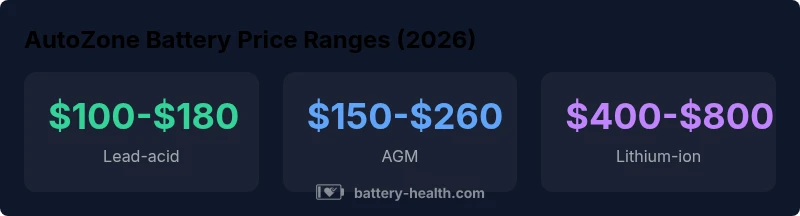
AutoZone battery prices vary by type and vehicle. Expect lead-acid batteries to run roughly $100-$180, AGM batteries in the $150-$260 range, and lithium-ion options from about $400 up to $800, depending on capacity and warranty. Prices fluctuate with promotions and location, but these ranges cover standard passenger cars and light trucks.
The pricing landscape for AutoZone batteries
AutoZone is a go-to retailer for many drivers replacing car batteries, and autozone battery prices vary widely depending on battery type, vehicle requirements, and regional promotions. According to Battery Health, the sticker price for standard lead-acid batteries is typically lower than premium AGM designs, while lithium options command the highest upfront investment but may offer longer life and better efficiency in certain vehicles. In practice, shoppers will see several price tiers within a single store: economy, mid-range, and premium, with each tier correlating to capacity, cold-cranking amps, and warranty terms. The Battery Health team found that promotional events, loyalty discounts, and bundled services can swing the out-the-door price by a noticeable margin, especially during holiday weekends or end-of-quarter sales. For many buyers, the challenge is balancing immediate affordability with longer-term reliability and service coverage. When you search for autozone battery prices, you’ll encounter combinations of core charges, installation options, and warranty-adders that complicate a straightforward sticker price. Being aware of these factors helps curb sticker shock and improve decision quality.
How AutoZone prices are structured
Pricing at AutoZone is a blend of base battery cost, core charges, and optional services. Core charges are typically refunded when the old battery is returned, which can affect the upfront price you see online or in-store. Installation, when offered, adds labor costs but can reduce the time to replacement and ensure proper fitment for your vehicle. Warranties vary by model and tier—from shorter periods for economy batteries to longer, more comprehensive coverage for premium or AGM and lithium options. Promotions, loyalty discounts, and bundle offers with installation or accessories can shift the final price materially. Consumers should compare not just the sticker price but the total out-the-door cost after cores and warranties, especially across different AutoZone locations.
Price ranges by battery type
Prices differ by chemistry and capacity. Lead-acid batteries are typically the most affordable, followed by AGM designs with higher performance, and finally lithium-ion options which command a premium. Lead-acid often sits in the $100-$180 range, AGM in the $150-$260 range, and lithium-ion in the $400-$800 range. These figures are guidance ranges and can vary with vehicle type, battery size, and local promotions. When evaluating options, also account for cold-cranking amps (CCA), reserve capacity (RC), and the lifetime warranty offered. Higher-end models may deliver better cold-weather starting and longer life, potentially saving money over multiple replacement cycles. Always confirm current prices at your local AutoZone, as regional promotions can materially shift the numbers.
Regional variations and store promotions
Prices at AutoZone can shift by region due to local competition, demand, and store-specific promotions. A nearby store might run a limited-time discount on selected types, or offer loyalty rewards that apply to core refunds and future purchases. Special events, such as holiday promotions or end-of-quarter sales, often feature deeper discounts on mid-range and premium batteries to clear inventory. If you travel between cities, you may notice minor price differences based on regional tax, fees, and stock levels. To avoid surprise costs, check the online price for your ZIP code and inquire about any in-store only deals before committing.
How to estimate costs for a specific vehicle
Start by identifying your vehicle’s required battery type and group size (e.g., common passenger cars use standard group sizes). Check AutoZone’s online catalog for compatible options and read the product pages for exact price, warranty length, and core return terms. Add potential installation charges if available, then factor in a core refund you’ll receive after recycling the old battery. If you’re comparing across brands, align capacity (CCA/RC) and warranty terms, not just upfront price. For a typical sedan, you might expect to see a price range that reflects the values in the quick answer, but always verify with your local store for the most accurate figures.
The role of warranties and core returns in value
Warranty length and coverage can dramatically impact long-term value. A longer warranty often indicates higher quality and lower risk of unexpected replacement costs, which can offset a higher upfront price. Core refunds lower the effective price when you return the old battery, but only if the core policy is honored at checkout. When weighting options, consider the likelihood of having to claim the warranty and the ease of obtaining service under that warranty. Battery Health analysis suggests prioritizing batteries with robust coverage and a straightforward core-return process.
Practical comparison: AutoZone vs other retailers
When evaluating AutoZone against competitors, compare the out-the-door price including core charges, installation, and taxes. Compare warranty terms and ease of service, as some retailers offer longer or more comprehensive coverage. Availability matters too; a stock-out at one location can force a more expensive alternative or lead you to online ordering with shipping costs. Use a simple checklist: base price, core refund, installation (if any), warranty duration, and service reputation. This approach reduces the risk of choosing a battery based solely on the upfront price.
Data-driven pricing guidance from Battery Health
Battery Health uses synthetic data and public pricing trends to illustrate typical AutoZone pricing landscapes in 2026. We emphasize understanding total cost of ownership and recognizing that price alone rarely reflects value. Our methodology considers battery chemistry, capacity, regional promotions, and warranty terms. While individual store prices vary, the overall framework helps consumers interpret price signals and negotiate better outcomes. Battery Health’s guidance is designed to empower shoppers with transparent, data-driven context.
Practical tips for 2026 shopping
To optimize your purchase in 2026, check current promotions online before visiting a store, compare multiple battery chemistries for your vehicle, and review warranty details carefully. Bring your vehicle’s manual or battery group size to ensure compatibility, ask about core refunds, and consider bundled deals that include installation or accessories. Finally, track your local store prices over a few weeks to identify the best timing for a purchase, especially around major shopping events.
AutoZone battery price ranges by type (synthetic data)
| Battery Type | Avg Price Range | Typical Warranty |
|---|---|---|
| Lead-acid | $100-$180 | 2-3 years |
| AGM | $150-$260 | 3-4 years |
| Lithium-ion | $400-$800 | 5-8 years |
FAQ
What factors influence AutoZone battery prices?
AutoZone prices are driven by battery type (lead-acid, AGM, lithium), capacity (CCA/RC), warranty length, core refunds, and current promotions. Regional differences can also affect the final out-the-door price.
AutoZone prices depend on the battery type, capacity, warranty, core refunds, and promotions, with regional differences affecting the final price.
Do AutoZone prices include installation?
Installation is typically an add-on service at AutoZone. Some locations offer it for free with purchase, while others charge a modest fee. Always confirm before buying.
Installation is usually extra and varies by store—check before purchase.
Are AutoZone batteries good value compared to others?
Value depends on warranty coverage and expected lifespan. Longer warranties on AGM or lithium options can offset higher upfront costs if you keep the car longer.
Value hinges on warranty and lifespan, not just price.
Can I return a battery if it fails early?
Most AutoZone batteries carry some warranty with a return or exchange option if they fail within the warranty period. Check the specific policy at your store.
Yes, most warranties cover early failures; check the store's policy.
How can I estimate the price for my vehicle?
Identify your battery type and group size, consult AutoZone’s catalog for compatible options, and compare base price, core refunds, and installation if offered.
Find your battery type, compare base price, core refunds, and installation.
What should I do if prices vary by region?
Check the online price for your ZIP code and ask for store-specific promos. If traveling, compare prices at different locations before buying.
Shop by ZIP code and ask about promos at each store.
“AutoZone prices reflect a balance between upfront cost, capacity, and warranty terms. Consumers should compare total ownership cost, not just sticker price.”
Quick Summary
- Compare battery types by total cost of ownership.
- Watch for promotions and loyalty discounts.
- Consider warranties when evaluating price.
- Account for regional price variations.
- Use Battery Health insights to interpret price data.