Battery 55d23l Error: Urgent Diagnosis & Fix Guide
An urgent, step-by-step guide to diagnose and fix the battery 55d23l error code. Learn meanings, quick fixes, a detailed repair flow, safety tips, and cost ranges.


The battery 55d23l is a fault code signaling a BMS or connection issue that demands quick action. The Battery Health team notes this code most often stems from loose terminals, corrosion, or a failing module within the pack. Start with safety precautions, inspect the terminals, and perform a quick voltage check before deeper repairs.
Understanding battery 55d23l: What the code means
The battery 55d23l code appears when the vehicle’s battery management system detects a fault in the battery chain. This is a safety flag that prompts you to stop driving if possible and diagnose the system before continuing. According to Battery Health, codes like battery 55d23l can originate from electrical connections, sensor readings, or modular failures within the pack. Interpreting the code correctly requires looking at symptoms, recent activity, and test results. In most cases, the issue is not a complete battery failure, but a network or connection problem that reduces performance and reliability. For immediate action, follow the steps below and avoid aggressive driving or high-load tasks until the fault is cleared.
Common causes of battery 55d23l errors
Identifying the root cause quickly improves your odds of a successful fix. Common culprits include:
- Loose or corroded terminals or grounding straps that disrupt current flow
- Damaged or pinched battery cables that increase resistance
- Faulty battery sensor or BMS module that misreads cell voltages
- Internal cell imbalance or degraded modules in the pack
- Charging-system issues such as alternator faults or poor charging history
- Extreme temperatures that skew voltage readings
Each cause has different implications for repair, so a systematic approach is essential. If the code persists after addressing terminals and basic connections, escalate to more advanced diagnostics.
Quick fixes you can try now
These are safe, low-effort steps you can perform without specialized tools:
- Prioritize safety: turn off the vehicle, remove keys, and wear eye protection and gloves.
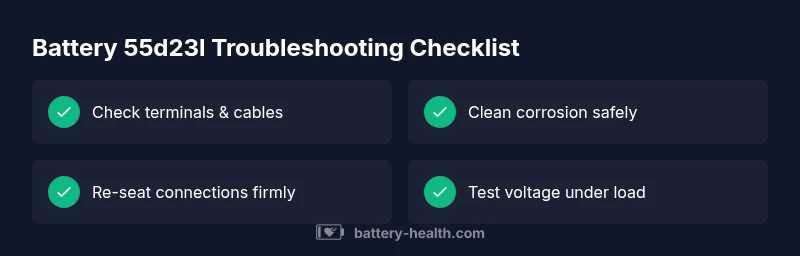
- Inspect terminals and cables for looseness or corrosion; visually verify clamps are tight.
- Clean corrosion with a baking soda solution and a soft brush, then dry completely before reconnecting.
- Reseat all connectors, ensuring a firm, vibration-free grip on the terminals.
- Reconnect the battery and clear the error codes, then restart the system to see if the code reappears.
- If you have access to a multimeter, verify battery voltage (12V system) and ensure it stays within normal range when the engine is off and running.
Step-by-step repair for the most common cause (terminals and connections)
This section expands the quick fixes into actionable steps for the most frequent trigger: loose or corroded terminals. Follow these steps carefully to reduce the risk of injury or further damage:
- Safety setup: Park on a flat surface, engage parking brake, and disconnect the negative battery terminal while the vehicle is off. Use insulated tools and avoid metal jewelry.
- Visual inspection: Look for loose clamps, frayed cables, or signs of burn marks near the terminal area. If anything looks damaged, proceed to cleaning or replacement.
- Disconnect and clean: Remove clamps one by one, clean the terminal surfaces with a wire brush and baking soda solution, rinse with distilled water, and dry completely.
- Reassemble with torque: Reattach clamps firmly, ensuring the clamps grip the posts without twisting or over-tightening. Use a torque spec if available for your battery model.
- Cable condition: Inspect the battery cables for cracks or wear; replace if needed, especially if insulation is damaged.
- Voltage check: Reconnect the battery and measure voltage with a multimeter. Confirm readings align with the vehicle’s service manual; a weak reading suggests a deeper issue.
- Reset and test: Clear fault codes using the service mode or OBD tool, restart the vehicle, and monitor for reoccurrence of battery 55d23l. If the code returns, move to the next diagnostic stage or consult a pro.
Other causes: Alternative faults and their fixes
If terminals aren’t the culprit, other potential causes include:
- Faulty BMS sensor: Calibration or replacement may be required; re-test after service.
- Internal cell imbalance: Professional testing may reveal which modules require replacement.
- Charging-system fault: Diagnosis of alternator or input power may be needed; wiring repairs could be required.
- Environmental factors: Extreme heat or cold can affect readings; take action to stabilize operating conditions.
- Software/firmware issue: Ensure the vehicle’s software is up to date; perform a system reset if recommended by the manufacturer.
For each scenario, the recommended fix may range from cleaning and reseating connectors to replacing modules or firmware updates. Always re-test after each intervention to confirm the fault is cleared.
Why professional help matters and when to escalate
Some battery issues require specialized diagnostic equipment and safety protocols. If the code persists after the basic checks and quick fixes, or if you notice swelling, leakage, or a burning smell, stop using the vehicle and contact a professional. A battery health specialist or authorized dealership can perform advanced diagnostics, including BMS calibration, cell balancing tests, and module-level replacements. Expect service costs to vary depending on the vehicle and region, with potential ranges for parts and labor when advanced repairs are needed.
Prevention and maintenance to avoid future battery 55d23l codes
Proactive maintenance reduces the likelihood of recurring faults. Consider:
- Regular terminal cleaning and anti-corrosion treatment to keep connections solid
- Periodic voltage checks and load tests to catch deterioration early
- Ensuring proper charging routines and avoiding deep discharges that stress the pack
- Verifying sensor and BMS firmware versions are current
- Safe storage practices for off-vehicle batteries to prevent sulfation or degradation
- Keeping the battery area clean and free of moisture or contaminants that can lead to corrosion
Real-world costs and timelines for addressing battery 55d23l
Costs for addressing battery 55d23l vary widely by vehicle type and the fault’s root cause. Simple fixes such as terminal cleaning and tightening typically incur minimal parts cost and can be completed within an hour. More extensive repairs—like module replacements or BMS recalibration—may require diagnostic fees plus parts and labor, often ranging from a few hundred to several hundred dollars. Always get a written estimate before proceeding, and consider the long-term value of battery health versus repeated fixes.
Conclusion and next steps
In critical battery diagnostics, moving methodically from safe quick fixes to deeper, professional diagnostics is essential. Use the steps outlined above to stabilize the system, document any symptoms, and seek expert help when the code persists. Battery health is paramount for safety and reliability, so do not delay professional assessment if the fault remains after initial checks.
Steps
Estimated time: 2-4 hours
- 1
Prioritize safety
Park on a flat surface, engage parking brake, and disconnect the negative terminal if safe. Wear eye protection and gloves to prevent injury from sparks or acid.
Tip: Never work near an open flame or smoking materials. - 2
Inspect terminal connections
Visually inspect all terminals for corrosion, looseness, or damage. Look for white powdery residue or darkened clamps.
Tip: Use a good flashlight to spot hidden corrosion. - 3
Clean and reseat
Clean terminals with a baking soda solution and a wire brush, rinse, dry, and reattach clamps tightly.
Tip: Apply a thin layer of dielectric grease after cleaning. - 4
Test voltage and continuity
With the battery connected, measure main terminal voltage and check for sudden drops under load. Use a multimeter and compare with specs.
Tip: If you lack a meter, consider professional testing. - 5
Check BMS and sensors
If voltage is stable, run a BMS self-test and inspect sensor connections. Update firmware if available.
Tip: Document any error codes shown by the BMS. - 6
Decide on repair path
If tests pass after terminal work, monitor for reoccurrence. If not, plan for module replacement or full battery pack service.
Tip: Keep records of readings for the technician. - 7
Test drive and verify
Reassemble, start the vehicle, and perform a careful test drive while monitoring for any alerts.
Tip: If the code reappears, stop and seek professional help.
Diagnosis: Warning light or dashboard message indicating battery 55d23l fault; vehicle may experience reduced performance or stalling.
Possible Causes
- highLoose or corroded battery terminals
- highDamaged battery cables or clamps
- mediumFaulty BMS sensor or module
- lowInternal cell imbalance or degraded modules
- lowCharging-system fault or alternator issue
Fixes
- easyInspect and clean terminals; reseat clamps firmly
- mediumTest voltage and continuity of cables; replace damaged wires
- hardRun BMS self-test; recalibrate or replace faulty sensor/module
FAQ
What does battery 55d23l mean exactly?
55d23l is a fault code indicating a problem in the battery system, most commonly linked to the BMS or terminal connections rather than a total battery failure. It requires diagnostic steps to identify the exact component involved.
55d23l is a fault code pointing to a battery system issue, often the BMS or connections. It needs diagnostic steps to find the exact cause.
Can I fix battery 55d23l myself?
Some fixes, like cleaning terminals and reseating connections, can be done by a careful owner. If there is any sign of a faulty BMS, bad module, or internal cell issues, professional service is recommended.
Some fixes are DIY-friendly, such as cleaning and reseating connections. For BMS or internal cell issues, see a professional.
How much does a repair typically cost?
Costs vary widely by vehicle and fault. Simple terminal fixes may be inexpensive, while module replacement or BMS recalibration can run higher, with ranges typically discussed during a diagnostic visit.
Costs vary; simple fixes are cheaper, while module or BMS work can be more costly. Get a written estimate before work begins.
Will battery 55d23l stop the car from starting?
If the fault impacts essential systems, the car may not start or run reliably. Immediate checks on terminals and BMS can prevent false starts, but persistent faults should be evaluated by a technician.
The car can fail to start or run poorly if the fault affects the main battery or BMS; seek diagnosis if it persists.
How long does a typical repair take?
A basic terminal fix can take under an hour; more involved diagnostics or module replacements may require several hours, depending on parts availability and service scheduling.
Minor fixes can be under an hour; extensive repairs may take a few hours.
Watch Video
Quick Summary
- Start with safety and terminal inspection
- Identify whether cause is wiring, sensor, or pack fault
- Use a systematic approach before replacing modules
- Document readings and codes for service
- Seek professional help when in doubt