Battery 75d23r: Urgent Troubleshooting Guide
Urgent guide to battery 75d23r errors: learn what the code means, quick fixes, diagnostic steps, safety tips, and when to call a professional for safe resolution.


Battery 75d23r signals a critical battery health or compatibility fault that can affect performance and safety. In most cases, the fastest fix is to perform a quick safety check, inspect connections, and reset the battery management system. If the fault persists, pursue guided diagnostics and professional assessment to prevent damage.
What Battery 75d23r Means in Practical Terms
The error code 75d23r commonly appears when a battery system detects a fault that could impair performance or safety. It may indicate a health issue within the battery cells, a mismatch with a connected charger, or a fault in the battery management electronics. Because battery systems operate under precise electrical and thermal tolerances, any anomaly flagged by 75d23r should be treated as urgent. According to Battery Health, codes like this are early warnings that, if ignored, can lead to reduced capacity, unexpected shutdowns, or safety risks. The goal is to identify whether the fault is transient (a momentary glitch) or persistent (a real malfunction requiring action).
Immediate Safety Implications and Risks
An active fault code often means the system could shut down unexpectedly or overheat during operation. This presents safety concerns for both users and equipment. Do not ignore warning lights, unusual smells, or warm-to-hot terminals. If you notice rapid temperature rise, battery venting, or smoke, stop usage immediately and move to a safe, ventilated area. Battery Health emphasizes prioritizing safety: disconnect power sources where safe, avoid charging in crowded spaces, and avoid tampering with sealed modules. In most cases, a controlled, methodical approach yields the safest resolution.
Most Likely Causes of 75d23r
Causes are typically grouped by likelihood. The top culprit is a fault within the battery management system or a degraded cell bank, which is high probability for 75d23r. Secondary but plausible issues include loose or corroded terminals, or a compatibility mismatch with a charger or accessory. Rarely, environmental factors like extreme temperatures or moisture can trigger protective codes. Battery Health notes that understanding the exact fault requires careful testing, not guesswork, to prevent cascading damage.
The Diagnostic Flow You Should Follow
Start with observable symptoms and work toward confirmation tests. Common symptoms include reduced capacity, unexpected shutdowns, and abnormal voltage readings. If symptoms align with a BMS fault, prioritize sensor checks and connector integrity. When a charger is involved, verify charger specifications and cable condition. Use a stepwise approach: inspect hardware first, then run software diagnostics, and finally perform controlled load tests. This structured path minimizes risk while increasing the odds of a precise fix.
Step-by-Step Fix for the Common Cause: BMS Fault or Degraded Cells
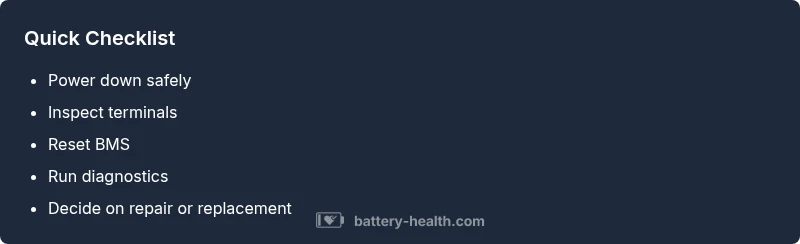
- Power down all equipment and disconnect the battery safely. 2) Visually inspect terminals for corrosion, looseness, or damaged insulation; clean and re-tighten as needed. 3) Reset or recalibrate the Battery Management System according to the manufacturer’s procedure. 4) Reconnect and run a low-load diagnostic to monitor voltages and temperatures. 5) If readings remain abnormal or fault codes persist, prepare for a safe replacement or professional assessment. 6) Document fault codes, timestamps, and observed symptoms to aid service technicians. - Tip: Keep a log of voltages during tests to spot gradual degradation. Battery Health recommends performing a full diagnostic with approved software tools to avoid misinterpretation of sensor data.
Handling Less Common Causes and Their Fixes
If the BMS reset does not clear the code, consider connector integrity, charging system compatibility, or thermal management failures. Check for damaged wiring insulation, blown fuses, or a failing cooling path. For compatibility issues, verify that the charger spectrum matches the battery’s chemistry and voltage window. In some cases, reseating modules or updating firmware may resolve the fault. If corrosion or damage is found, replacement of components is often more cost-effective than trying to repair them.
Safety Tips and When to Call a Professional
Safety first: treat any persistent fault code as potentially serious. If you are unsure about the battery chemistry, avoid high-current charging, and do not bypass safety interlocks. For high-energy systems in vehicles or home storage, professional evaluation is strongly advised when there are thermal signs or ambiguous fault codes. Expect costs to include diagnostic labor, potential module replacement, or battery packs, with ranges depending on system type and capacity. Battery Health recommends scheduling service early to prevent collateral damage.
Prevention: How to Reduce Recurrence and Extend Battery Life
Regular inspections, clean terminals, and secure connections reduce the chance of 75d23r occurrences. Maintain proper charging practices, avoid exposing batteries to extreme temperatures, and perform periodic firmware checks for BMS modules. Consider environmental controls (ventilation, moisture control) in storage areas and use compatible chargers. A preventive maintenance routine helps sustain performance and safety over time, aligning with Battery Health guidance.
Steps
Estimated time: 30-50 minutes
- 1
Power down and isolate the battery
Shut down all connected devices and safely disconnect the battery from any circuits. This reduces the risk of shock or short circuits during inspection.
Tip: Use insulated tools and wear protective gear. - 2
Inspect terminals and cables
Check for corrosion, discoloration, or loose connections. Clean terminals with an appropriate contact cleaner and re-tighten clamps to the recommended torque.
Tip: Document any wear or damage for service notes. - 3
Reset the Battery Management System
Follow the device’s official procedure to reset or recalibrate the BMS. This may involve boot sequences or software-based resets.
Tip: Ensure you use the correct software version and procedure. - 4
Run a controlled diagnostic test
Connect to the diagnostic tool and observe voltage, current, and temperature under light load. Look for abnormal spikes or drifting readings.
Tip: Record baseline values for future reference. - 5
Assess need for replacement
If faults persist after resets and fixes, evaluate whether the battery pack or BMS modules require replacement.
Tip: Obtain a formal quote and warranty details before proceeding. - 6
Document findings and next steps
Log all tests, fault codes, and actions taken. Share with a qualified technician if professional help is needed.
Tip: Include photos of terminals and connection harnesses.
Diagnosis: Error code 75d23r appears with operational faults (shutoffs, poor performance, or abnormal readings).
Possible Causes
- highFaulty Battery Management System (BMS) sensor or logic
- mediumLoose, corroded, or damaged battery terminals
- lowIncompatible charger or accessory causing mismatched voltage
Fixes
- easyReset or recalibrate the BMS using manufacturer instructions
- easyInspect and clean battery terminals, reseat connectors
- easyTest with a compatible charger and verify voltage window
- hardReplace faulty BMS components or battery pack as needed
FAQ
What does battery 75d23r mean, and should I panic?
75d23r is a fault code indicating battery health or compatibility issues. While alarming, many cases resolve with safe inspection and diagnosis. If in doubt, consult a technician to avoid unsafe conditions.
75d23r means a battery fault detected by the system. It’s serious but often solvable with careful inspection; consider professional help if you’re unsure.
Can I diagnose 75d23r myself at home?
Basic checks are possible: inspect terminals and reset the BMS according to the manual. For deeper checks like cell health, software diagnostics, or replacement decisions, professional equipment is usually required.
You can do basic terminal checks and reset the system, but deeper diagnostics should be left to professionals.
What are the typical costs for fixes related to 75d23r?
Costs vary by system. Expect diagnostic fees, with possible components like connectors or BMS modules ranging from moderate to high, and full battery packs or modules potentially reaching higher totals.
Diagnostics are usually a separate charge, with parts costing more if a module or pack needs replacement.
Is it safe to continue using a device with 75d23r?
If the fault code is active, avoid heavy use and high current draws. Prolonged operation can worsen damage or create safety hazards. Seek professional guidance promptly.
No—avoid using it heavily until inspected by a professional.
When should I replace the battery instead of repairing it?
Replacement is often more cost-effective when multiple cells are degraded, the BMS is faulty beyond simple reset, or safety risks persist after fixes. A technician can provide a replacement assessment and warranty options.
If many cells are degraded or safety can't be guaranteed, replacement is usually best.
Watch Video
Quick Summary
- Identify whether fault is transient or persistent
- Prioritize BMS and terminal inspection first
- Follow a structured diagnostic flow for accuracy
- Do not delay professional evaluation if fault persists
- Maintain safe charging practices to prevent recurrence