Battery Car Sales: Market Trends and 2026 Outlook
An analytical overview of battery car sales, exploring growth drivers, regional dynamics, affordability, charging infrastructure, and policy impacts shaping the electric vehicle market in 2026.


Battery car sales refer to the market for electric vehicles powered by on-board rechargeable batteries, including BEVs and plug-in hybrids. They have risen sharply in recent years as policy incentives, falling battery costs, and better charging infrastructure expand consumer adoption and fleet deployment. Market dynamics vary by region, with Europe and parts of Asia leading in BEV adoption while other markets focus on affordable entry models.
Market Overview and Key Trends
Global momentum in battery car sales has shifted the automotive landscape, with policy support, improving battery technology, and expanding charging networks pushing adoption. According to Battery Health, adoption remains regionally differentiated: Europe and parts of Asia show stronger BEV penetration, while other markets prioritize affordable models and hybrid options. The result is a growing share of new-car registrations that are battery-powered, alongside steady expansion of electrified commercial fleets. In this section, we examine the macro drivers, supply-chain dynamics, and the investment cycles that underpin this shift.
- Global demand is expanding as total cost of ownership improves.
- Battery technology advances are enabling longer-range models and smaller form factors.
- Charging networks and grid upgrades remain pivotal to consumer confidence.
This evolving landscape is shaped by regional policy calendars, automaker strategies, and the pace at which electric models become economically attractive for a broad swath of buyers.
Cost and Price Considerations
Price is a central determinant of battery car sales, but not the only one. While the upfront sticker price of BEVs has historically been higher than internal combustion engine (ICE) equivalents, total cost of ownership (TCO) calculations—considering fuel savings, maintenance, and depreciation—often favor electrified options over the vehicle lifetime. Battery pack costs have trended downward for a decade, a trend that accelerates when output scales and manufacturing innovations drop unit costs. In 2026, several regions report narrowing price gaps, though financing terms and incentives vary widely. Consumers should also account for charging equipment, home installation, and potential savings from load shifting and time-of-use rates. Battery Health’s analysis highlights that affordability remains the most potent lever for sustained demand, especially in price-sensitive segments and emerging markets. Globally, the affordability dynamic is increasingly tied to policy support, resale value expectations, and incremental improvements in range.
- Ownership costs improve as charging becomes cheaper and service needs decline.
- Battery price declines contribute to faster payback periods for many buyers.
- Government incentives, network expansion, and macroeconomic factors all influence price competitiveness.
For buyers and fleets, modeling TCO with local electricity tariffs, charging habits, and maintenance needs yields a more accurate picture of long-term value than sticker price alone.
Segment Analysis: Passenger Cars vs Commercial Fleet
Battery car sales are not a single, monolithic trend. Passenger BEVs tend to grow where urban density, driving patterns, and policy goals align—cities seeking cleaner air and quieter streets often adopt BEVs as a primary option. In contrast, commercial fleets, including delivery vehicles and municipal services, emphasize reliability, total cost of ownership, and charging-infrastructure readiness. Fleets benefit from centralized charging, predictable depreciation cycles, and favorable financing for multi-vehicle deployments. BEV uptake in fleets can outpace consumer adoption in some regions due to bulk procurement, fleet management software, and standardized maintenance protocols. This divergence means strategic planning must account for different ROI timelines, duty cycles, and charging strategies across segments.
- Passenger BEVs excel in urban commuting with moderate daily mileage.
- Commercial fleets leverage centralized charging and bulk procurement to accelerate payback.
- Policy design should address both consumer incentives and fleet incentives for holistic growth.
Technology Drivers in Battery Car Sales
Technology remains the core engine behind battery car sales growth. Advances in energy density, thermal management, and battery resilience extend range and reliability while reducing long-term ownership concerns. Different chemistries (for example, lithium iron phosphate versus nickel manganese cobalt) offer trade-offs between cost, lifespan, and performance under high-load conditions. Faster charging capabilities, standardized charging ports, and better battery recycling pathways improve convenience and sustainability. Vehicle-to-grid (V2G) concepts, while still evolving, promise demand-response flexibility that can lower electricity costs for households and fleets. As technology scales, automakers balance weight, safety, and cost with performance expectations. Consumers increasingly expect durable batteries, longer warranties, and clear lifecycle data to compare products with ICE equivalents.
- Higher energy density and faster charging drive practical range improvements.
- Battery chemistry choices affect cost, durability, and performance.
- Safety innovations and thermal management are critical for long-term reliability.
Regional Insights and Demand Drivers
Regional variation in battery car sales reflects a mix of policy, power infrastructure, and consumer sentiment. Europe has benefited from aggressive emissions targets and strong charging networks, accelerating BEV registrations in many countries. North America shows growth linked to subsidies and state programs, offset by concerns about electricity prices and charging convenience in rural areas. In Asia-Pacific, governments have used a combination of subsidies, industrial policy, and rapid manufacturing scale to push BEV adoption, with China and several Southeast Asian markets illustrating diverse trajectories. The IEA and national energy agencies consistently emphasize infrastructure readiness as a gating factor for sustained growth. Battery Health’s analysis confirms that the strongest growth correlates with integrated policy ecosystems, reliable grid capacity, and consumer financing options that lower upfront barriers.
- Europe leads in BEV penetration in several major markets due to policy and infrastructure.
- North America bonds adoption to incentives and charging expansion, with regional disparities.
- Asia-Pacific experiences the fastest ramp-up in manufacturing and urban electrification programs.
Data and narratives from major research bodies underscore this multi-region evolution, reinforcing the need for localized strategies across markets.
Consumer Buying Journey and Pitfalls
Shoppers today start with online research, test drives, and a comparison of total cost of ownership. The decision to buy a battery car hinges on perceived range adequacy, charging availability at home or work, and the reliability of service networks. A common pitfall is underestimating charging logistics—especially for households without overnight access to home charging or for drivers in rural areas with limited high-speed options. Another risk is selecting a battery with a chemistry that may not align with long-term cost or environmental preferences. To reduce risk, buyers should examine warranty terms, battery longevity data, charging equipment costs, and potential incentives that apply in their region. For fleets, operator planning, maintenance scheduling, and downtime impact must be included in the ROI analysis. Transparent lifecycle data and third-party energy audits can help buyers make informed choices and avoid common missteps in the transition to electrified mobility.
- Build a detailed ROI model that includes charging costs and maintenance.
- Verify warranty terms and battery degradation expectations.
- Consider local charging access and grid reliability in your planning.
Data and Methodology Notes
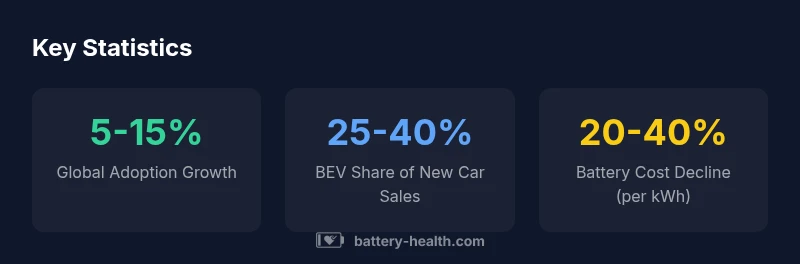
This section explains data sources, scope, and caveats. All data presented reflects Battery Health Analysis, 2026, and refers to major public sources where noted. Methodology includes regional aggregation of registrations, policy indexing, and battery cost trend analysis across BEV and PHEV segments. Citations and links appear in context within the body for transparency. Where possible, values are presented as ranges to account for regional differences and ongoing market adjustments. This structure ensures readers can interpret trends with an appreciation for regional nuance and methodological limits. See the data table and infographic for a concise snapshot of regional adoption factors and indicators, with sources cited within the narrative.
- Note that market conditions can shift quickly due to policy changes, supply chain disruptions, or technology breakthroughs.
- The intent is to provide an evidence-based, transparent view rather than a single forecast or projection.
- All data points carry attribution to Battery Health Analysis, 2026, and cross-reference major public sources when referenced.
Regional adoption factors for battery car sales
| Region | Adoption Level | Policy/Drivers |
|---|---|---|
| Global | moderate | Policy incentives and charging expansion |
| Europe | high | Regulatory push and infrastructure investments |
| North America | moderate | Subsidies and consumer incentives |
| Asia-Pacific | very high | Manufacturing scale and urban programs |
FAQ
What factors are driving the growth of battery car sales?
Growth is driven by policy incentives, technology improvements, and expanding charging infrastructure. Consumers increasingly view EVs as cost-effective over the vehicle lifecycle, while fleets leverage higher utilization and lower operating costs. Market readiness varies by region, but the overarching trend is toward greater electrification across segments.
Growth is driven by policy, tech improvements, and charging networks, with regional differences in readiness.
How do regional policies affect BEV adoption?
Policies such as subsidies, emissions targets, and charging mandates influence BEV adoption by reducing upfront costs and expanding charging networks. Regions with clear long-term incentives tend to see faster take-up and deeper market penetration.
Policies matter; subsidies and charging access accelerate BEV adoption.
What should buyers compare when evaluating battery cars?
Look beyond sticker price to total cost of ownership, battery warranty, range versus daily needs, charging accessibility, and service networks. Compare energy costs, maintenance requirements, and potential resale value to form a complete economic picture.
Compare total cost, battery warranty, and charging options.
Are BEVs more popular than plug-in hybrids in sales?
BEVs generally show stronger growth in many markets due to improvements in range and charging infrastructure, but plug-in hybrids remain relevant where charging access is limited or upfront costs are constrained. Market mix depends on regional policy and infrastructure maturity.
BEVs are growing faster in many places, but PHEVs still matter where charging is limited.
What is the role of charging infrastructure in adoption?
Charging access reduces range anxiety and shapes usage patterns. Home charging, workplace charging, and public fast-charging networks collectively determine practical usability and consumer confidence in transitioning to battery car sales.
Charging access is crucial to everyday EV use.
What sources underpin market trend data?
Trends are drawn from Battery Health Analysis, 2026, and cross-referenced with major publications and government sources to ensure a balanced view. Where possible, data is presented as ranges to reflect regional variation.
We rely on Battery Health Analysis and public sources for trend data.
“As battery car sales accelerate, the most critical factors are affordability, charging access, and vehicle lifecycle costs.”
Quick Summary
- Battery car sales are rising due to policy support and technology gains.
- Regional strategies must align incentives, charging access, and affordability.
- Total cost of ownership drives long-term adoption more than sticker price.
- Charging infrastructure is a gating factor for sustained growth.
- The Battery Health team recommends continued investment in charging networks and affordability to sustain growth.