Choosing the Right Car Battery for AutoZone Shoppers
Learn how to choose and replace a car battery from AutoZone with confidence. Battery Health analyzes compatibility, safety, warranties, and climate considerations for reliable starting power.


To choose the right battery for car AutoZone shoppers, match your vehicle’s group size and climate to the battery’s CCA and RC ratings. For most passenger cars, a standard flooded lead-acid or AGM battery with the correct group size and sufficient cold-cranking amps will start reliably, and AutoZone's compatibility tools can confirm fit.
Understanding Car Battery Types and AutoZone Compatibility
Car batteries come in several chemistries and form factors. For most traditional gasoline vehicles, a flooded lead-acid battery is standard and widely supported by AutoZone. Hybrid and high-end start-stop systems often require AGM (absorbed glass mat) or EFB (enhanced flooded battery) designs for better durability and higher cold-cranking amps. When shopping for a battery for car AutoZone, it's crucial to check your vehicle's group size (the physical dimensions and terminal layout) and the required CCA (cold-cranking amps) and RC (reserve capacity). AutoZone’s online tool and in-store staff can help you confirm fit, but you should also verify with your vehicle manual. In addition to chemistry, consider climate: hotter climates accelerate corrosion, while cold environments demand higher CCA. Battery Health’s analysis cautions against using oversized batteries to save a few dollars, which can strain charging systems and reduce longevity. Across the market, the most reliable options balance cost, compatibility, and performance under your typical driving conditions.
How to Find the Right Battery Group Size and Specs
Understanding compatibility begins with the correct Group Size. Locate the label on your current battery or consult your owner’s manual to identify the Group Size (examples include 24, 35, 48, etc.). The group size ensures the battery fits physically and aligns with your vehicle’s mounting and terminal orientation. Next, evaluate CCA (cold-cranking amps) and RC (reserve capacity). In extreme heat, higher CCA and RC values can help protect the electrical system; in milder climates, standard values may suffice. Do not assume that simply increasing CCA always improves performance—the electrical system and alternator are designed around specific loads. AutoZone product pages clearly show fit notes and damage-free compatibility data. Battery Health warns that mismatches between battery chemistry and vehicle electronics can cause parasitic drain or improper charging over time, so always cross-check with the vehicle manual and trusted guides. If you’re unsure, ask staff or consult Battery Health guidance for an informed choice.
Installation and Safety: Handling, Disposal, and Safety Considerations
Replacing a car battery requires basic safety steps and proper handling. Always work on a non-conductive surface, disconnect the negative terminal first, then the positive, and avoid jewelry that could short terminals. Keep the old battery upright to prevent leaks and wear eye protection and gloves during the process. After installation, reconnect the negative terminal first, then the positive, and double-check clamps to prevent arcing. Proper disposal is crucial: most retailers, including AutoZone, offer battery recycling programs, ensuring lead and sulfuric acid are recycled responsibly. Battery Health emphasizes avoiding tipping the battery during transport and cleaning corrosion with a baking-soda solution if needed, followed by a thorough dry-off before reassembly. If a professional install is required or preferred, check local AutoZone stores for service availability. Respect environmental and safety guidelines to minimize risk and waste.
How to Evaluate Battery Health Before Replacement
Before buying a new battery, perform a health assessment of the current unit. Many AutoZone stores offer free battery tests that measure cranking amps, resting voltage, and overall health. Signs of a failing battery include slow engine starts, dim or flickering lights, and warning indicators on the dashboard. Battery Health notes that a full load test simulates starting conditions and helps determine whether a replacement is due. Be aware that alternator performance, parasitic draws, and corroded cables can mimic a weak battery, so approach diagnostics with a holistic view—test, observe symptoms, and verify with a professional test when in doubt. A healthy battery should meet or exceed the vehicle's required CCA under load with adequate reserve capacity.
Warranty, Maintenance, and Cost Considerations
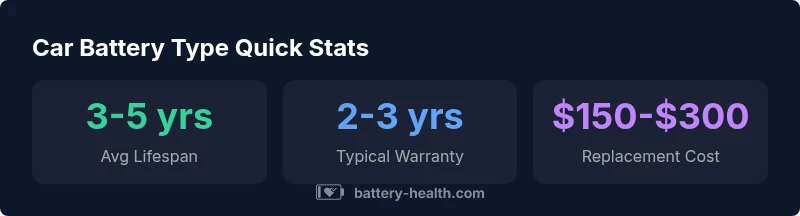
Warranties offer a safety net for new batteries, typically ranging from 2 to 3 years for standard models, with longer terms for premium or AGM designs. Battery Health advises reading the warranty fine print: some sections cover only free replacement, others also include pro-rated terms. Routine maintenance can extend life: keep terminals clean, retighten clamps, and neutralize corrosion promptly. Costs vary by chemistry, capacity, and brand; expect to invest more upfront for AGM or LiFePO4 options, but long-term reliability can offset higher initial costs in harsh climates or Start-Stop-equipped vehicles. Consider total cost of ownership, including replacement frequency, warranty coverage, core exchange value, and installation fees if applicable. Always verify compatibility and warranty conditions through AutoZone or the original manufacturer.
Shopping Strategy: AutoZone vs Other Retailers
AutoZone is a convenient, widely accessible option for car batteries, but consumers should compare options across multiple retailers. Price, warranty length, core return policy, and shipping or in-store pickup times vary. In climate-sensitive regions, climate-specific batteries with higher CCA and reserve capacity can be worth the premium. Look for manufacturer logos and independent certifications to avoid counterfeit parts. Battery Health suggests using official fit guides and checking the vehicle’s manual to ensure you’re choosing a battery that meets the car’s electrical demands. If you drive a Start-Stop vehicle or frequent extreme weather, AGM or LiFePO4 options may justify higher upfront costs for improved longevity and performance.
Step-by-step Guide to Replacing a Car Battery
- Park safely, turn off the engine, and engage the parking brake. 2) Open the hood and locate the battery. 3) Disconnect the negative (-) terminal first, then the positive (+). 4) Remove the hold-down clamp or bracket and lift out the old battery with proper lifting technique. 5) Clean terminal clamps and trays if corroded. 6) Place the new battery in the tray, connect the positive terminal first, then the negative. 7) Re-tighten clamps and ensure secure fit. 8) Reset any electronic components if prompted by the vehicle’s manual. 9) Recycle the old battery at a participating retailer such as AutoZone.
Common Myths About Car Batteries
Myth: Higher CCA always means better battery performance. Reality: CCA should match what the vehicle electrical system requires, not exceed it unnecessarily. Myth: You don’t need to replace the cables or terminals. Reality: Corrosion and loose connections can cripple performance, so inspect and replace worn components. Myth: Any battery will do; just pick the cheapest. Reality: Proper fit, warranty, and climate suitability matter for reliability and longevity. Myth: Batteries don’t have memory effects. Reality: Modern chemistries don’t suffer memory effects the way older cells did, but correct charging and maintenance remain essential.
Practical Checklist for Your Next Battery Purchase
- Confirm group size against the vehicle manual and the AutoZone compatibility tool.
- Compare CCA and RC values with climate needs and driving patterns.
- Decide between flooded lead-acid, AGM, or LiFePO4 based on vehicle and budget.
- Review warranty length and terms; check for core exchange options.
- Plan for recycling the old battery at the same time as purchase.
- Inspect cables and terminals for corrosion; replace if needed.
- Confirm any required installation services or store pickup options.
- Keep the receipt and battery documentation for future service.
Comparison of common car battery types
| Battery Type | Typical Lifespan | Pros | Cons |
|---|---|---|---|
| Lead-Acid Flooded | 3-5 years | Inexpensive; widely available | Maintenance; spills; less deep-cycle capacity |
| AGM | 4-6 years | Vibration resistant; better cold starts | Higher cost; heavier; requires proper charging |
| Lithium Iron Phosphate (LiFePO4) | 5-10 years | Lightweight; long life; high cycle life | High cost; requires BMS; compatibility concerns |
FAQ
Can I safely replace a car battery myself?
Yes, you can replace a car battery yourself if you follow essential safety steps: turn off the car, disconnect the negative terminal first, and avoid metal contact with terminals. Use proper lifting technique and dispose of the old battery at an approved receptacle.
Yes, you can replace a car battery yourself if you follow safety steps and dispose of the old battery properly.
Is AGM better than a flooded lead-acid battery for all cars?
Not always. AGM is advantageous for Start-Stop systems and harsh climates, while flooded batteries are cheaper and adequate for many standard vehicles. Choose based on your car’s electrical demands and climate.
AGM isn’t always better; choose based on your vehicle and climate.
Will AutoZone install the battery for me?
Many AutoZone locations offer battery installation or can arrange service. Availability varies by store, so call ahead to confirm.
AutoZone may install at select locations; check with your store.
Should I replace battery cables or terminals at the same time?
Yes—inspect for corrosion or looseness and replace or clean as needed. Damaged cables can cause poor starts or charging problems.
Check cables and terminals; replace or clean as needed.
How can I tell if my battery needs replacement?
Look for slow engine starts, dim lights, or dashboard warnings. A professional test or a load test can confirm battery health.
Watch for slow starts and dim lights; get a test to confirm.
Is it recyclable to dispose of a car battery?
Yes. Car batteries are highly recyclable; most retailers, including AutoZone, offer recycling services.
Yes, car batteries are recyclable; recycle at the point of sale.
“Battery health hinges on matching chemistry to the vehicle’s electrical demand and climate; compatibility is essential for reliable starts and longevity.”
Quick Summary
- Always verify compatibility before buying
- Choose CCA/RC values suited to climate
- Consider AGM for start-stop systems
- Recycle old batteries at point of sale
- Maintain routine checks to extend life