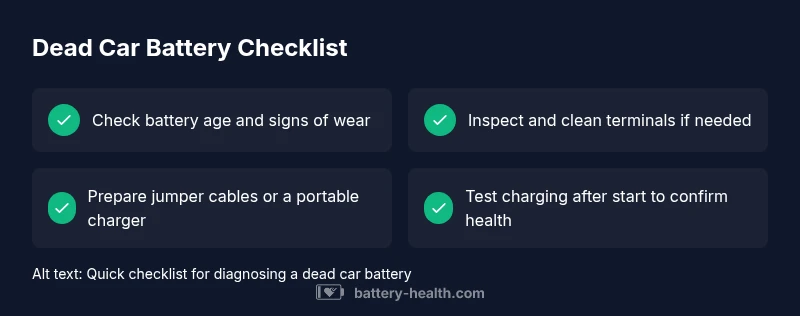
Battery is Dead in Car: Quick Troubleshooting Guide
Urgent, practical guide to diagnosing a dead car battery and getting you back on the road. Learn safe jump-starts, tests, and maintenance tips from Battery Health.


Direct answer: The most likely cause is a discharged battery or poor connections. Quick fix: attempt a jump-start with cables or a portable charger, then inspect battery terminals for corrosion and tight clamps. If the car starts, let it run for 15 minutes to recharge, and check the charging system. According to Battery Health, age and parasitic drains are common culprits.
Why the Battery Goes Flat: Most Common Causes
When a car won’t start, the battery is dead in car for many drivers. According to Battery Health, the core issues are age or wear, parasitic drain from electronics, and charging system problems. When the vehicle sits idle for days or experiences cold snaps, chemical reactions inside the battery weaken and reduce cranking power. Loose or corroded terminals can prevent efficient charging and starting power even if the battery itself isn't completely failed. Another frequent factor is an alternator or voltage regulator failure, which allows the battery to drain while the engine runs.
Understanding these causes helps you act quickly and safely. Start with simple checks, because many failures are solved by cleaning terminals or replacing a weak battery. If the battery is merely discharged, a boost and a test are often enough to determine next steps. Keep in mind that batteries are a wear item; depending on climate and usage, their life can vary widely. If you're unsure, a professional battery health check provides an accurate reading of capacity and charging ability.
Quick Safety Checks Before You Begin
Before you attack the problem, ensure you and your vehicle are safe. Park on a level surface, engage the parking brake, and turn off all electronics. Wear eye protection and gloves, because battery acid and sparks can be hazardous. Inspect the battery terminals for corrosion; white, bluish, or greenish buildup indicates corrosion that should be cleaned. If you see cracked or swollen casing, do not attempt to charge; replace the battery.
If you proceed, disconnect negative terminal first, then positive, and remove any jewelry that could short the terminals. Keep metal tools away from the battery to avoid sparks. Finally, confirm there is no fuel smell around the engine bay. If in doubt, call a roadside service.
Step-by-Step Jump-Start Procedure
- Position both vehicles so their batteries are within reach of the jumper cables, but not touching. 2) Turn off both engines and all accessories inside both vehicles. 3) Attach the positive (red) clamp to the dead battery’s positive terminal, then to the donor battery’s positive terminal. 4) Attach the negative (black) clamp to the donor battery’s negative terminal, and connect the other end to a solid ground on the donor car or chassis away from the dead battery. 5) Start the donor car and try to start the dead car. 6) If it starts, remove cables in reverse order: negative from dead car, negative from donor, then positive from donor, then positive from dead car. 7) Let the engine run for at least 15 minutes to recharge. 8) If it won’t start after several attempts, seek roadside assistance or a diagnostic check.
Tip: Ensure clamps are solidly attached and not touching each other during setup to prevent sparks. Safety gear and a clear area around the batteries help reduce risk.
Testing the Battery and Alternator: What to Expect
After a jump-start, test the system to confirm the battery and alternator are functioning. With the engine off, measure resting voltage; a healthy battery typically reads around 12.6 volts. Start the engine and observe voltage; a healthy alternator should push charging voltage into the range of about 13.8 to 14.8 volts. If resting voltage is low or the voltage under load remains under 13 volts, the battery may be sulfated or aged, and the alternator or charging circuit could be faulty. A professional load test provides a definitive assessment of capacity and charging ability.
What If the Car Still Won't Start? Additional Troubleshooting
If the vehicle still won’t start after a jump, the problem may be beyond the battery. Possible issues include a faulty starter motor, a blown fuse, a bad relay, or a parasitic drain returning power after startup. Check essential fuses and relays connected to the starting system, and inspect cables for overheating or damage. If the immobilizer or key fob isn't communicating with the car, the engine may not crank even with a charged battery. In these cases, professional diagnosis is recommended.
Maintenance Habits to Avoid Future Dead Batteries
To reduce the odds of another dead battery, practice regular maintenance. Keep terminals clean and free of corrosion by brushing with a baking soda solution and water, then dry thoroughly and apply a light coating of terminal protectant. Minimize parasitic drain by turning off interior lights and electronics when the car is parked for extended periods. Drive regularly or use a battery conditioner or trickle charger for long-term storage. Schedule periodic checks of the battery’s health, especially before winter and during extreme heat.
Choosing a Replacement Battery: Specs to Watch
When replacement is necessary, select a battery that fits your vehicle’s group size and meets the required cold-cranking amps (CCA) and reserve capacity. Consider AGM batteries for high-demand systems or if the car is frequently stored; conventional lead-acid batteries fit many vehicles and are generally more affordable. Look for solid terminal connections, a robust case, and a warranty that covers replacement within several years. Battery health and proper disposal or recycling should be part of your planning, especially in regions with strict regulations.
Steps
Estimated time: 30-60 minutes
- 1
Assess safety and gather gear
Park on level ground, engage parking brake, and turn off all electronics. Put on eye protection and gloves. Gather jumper cables or a portable charger and a flashlight.
Tip: Keep a roadside emergency kit handy for quick response. - 2
Inspect the battery and terminals
Look for corrosion, cracks, or swelling. If corrosion is present, prepare a baking soda solution and a brush to clean terminals after disabling the power.
Tip: Do not touch your face after handling the battery; wash hands thoroughly. - 3
Connect jumper cables safely
Connect the positive clamp to the dead battery, then to the donor battery. Attach the negative clamp to the donor battery and ground the other end to a metal surface on the dead car away from the battery.
Tip: Ensure clamps do not touch each other during connection. - 4
Start the donor car and attempt to start the dead car
Let the donor car run for a few minutes before trying to start the dead vehicle. If the engine starts, remove clamps in reverse order.
Tip: If you smell burning or see smoke, stop and seek help immediately. - 5
Let the engine run and test charging
Keep the engine running for at least 15 minutes to recharge. Test the resting and running voltage after a short drive or by using a multimeter.
Tip: A healthy system should show rising voltage when the engine runs. - 6
Evaluate next steps
If the car starts but dies again, there may be an ongoing drain or charging issue requiring professional testing.
Tip: Document symptoms for the technician to speed up diagnosis. - 7
Plan replacement if needed
If capacity is weak or swelling is present, replace the battery. Choose the right size, type, and warranty.
Tip: Dispose of the old battery at a recycling center. - 8
Follow-up maintenance
Clean terminals regularly, check connections, and schedule periodic battery tests to prevent future failures.
Tip: Consider a battery maintainer if you park for long stretches.
Diagnosis: Battery is dead in car
Possible Causes
- highBattery age or wear reducing capacity
- highParasitic drain from electronics or aftermarket devices
- highLoose or corroded battery terminals
- mediumFaulty alternator or charging circuit
- mediumExtreme temperatures affecting battery performance
- lowRecent short trips preventing full recharge
- lowDamaged or swollen battery case
- mediumWiring or fuse issues in the starting circuit
Fixes
- easyClean and tighten battery terminals; re-torque clamps
- easyPerform a safe jump-start or use a portable jump starter
- mediumCharge the battery with a smart charger or replace if battery health is poor
- mediumTest alternator output and inspect charging system for faults
- mediumCheck for parasitic drains with a diagnostic tool or manual inspection
- easyReplace battery if corrosion or swelling is present; inspect cables and fuses
FAQ
What are the most common causes of a dead car battery?
Most dead batteries result from age and repeated charging cycles, reducing capacity. Parasitic drains from electronics and poor connections are also frequent culprits. Understanding these helps you act quickly and prevent future failures.
Most dead car batteries come from aging, ongoing charging cycles, parasitic drains, or corroded connections. Knowing the main causes helps you act fast and prevent repeat failures.
How do I safely jump-start my car battery?
Ensure both cars are off, connect positive to positive, then connect negative to a solid ground away from the dead battery. Start the donor car, then attempt to start the dead car. Remove cables in reverse order and let the engine run.
First, connect the red clamp to both positives, then the black clamp to a solid ground. Start the donor, then the dead car, and remove in reverse order.
Can a car battery be recharged after it dies?
Yes, many dead batteries can be recharged with a proper charger or by a jump-start. If the battery fails to hold charge consistently or shows signs of swelling, replace it. A professional test can confirm battery health and charging ability.
A lot of dead batteries can be recharged with a charger or jump-start, but if it won’t hold a charge or looks swollen, replace it.
What should I check if the car starts but dies again?
The issue may be a draining accessory, a faulty alternator, or an immobilizer problem. Check for loose connections and test the alternator output. If unresolved, have a professional inspect the charging system.
If it starts but dies, there may be a drain or charging issue. Check connections, test the alternator, and consider professional help.
How long will a typical car battery last?
Battery life varies with climate, driving patterns, and maintenance. If you notice frequent dead starts or reduced performance, it’s time to test or replace. Regular checks extend reliability.
Battery life varies, but frequent dead starts are a sign to test or replace.
When should I replace a car battery?
Replace a battery that shows recurrent failures, cannot hold charge, or is swollen or cracked. Ensure you match the new battery to your vehicle's size and cold-start needs, and choose a solid warranty.
Replace a battery that keeps failing or can’t hold a charge, and choose a compatible model with a good warranty.
Watch Video
Quick Summary
- Diagnose cause before replacement
- Prioritize safe jump-starts and terminal maintenance
- Test both battery and alternator for full reliability
- Replace aging or damaged batteries promptly
- Practice regular maintenance to prevent future issues