Prius Battery Health: Lifespan, Costs, and Replacement Guide
Explore Prius battery health, lifespan, and replacement options. Learn how OEM, rebuilt, and aftermarket packs compare, plus maintenance tips to maximize performance for your Toyota hybrid.


Prius battery refers to the high‑voltage pack that powers the hybrid system in Toyota’s Prius family. In most generations, this NiMH-based hybrid battery delivers seamless electric assist and engine shutoffs, often lasting many years with proper care. Replacements are uncommon but possible; options include OEM packs, rebuilt modules, or carefully sourced aftermarket assemblies with warranties. For hybrid owners, understanding battery health helps you avoid surprises and plan maintenance with confidence.
Prius battery: A deep dive
The Prius battery, often referred to as the high‑voltage hybrid battery pack, is a pivotal component that powers the electric motor alongside the gasoline engine to optimize efficiency. In most Toyota Prius generations, this pack uses nickel‑metal hydride (NiMH) chemistry, with Li‑ion options appearing in some plug‑in variants in certain markets. The battery is usually located under the rear seating area or trunk, and its health directly influences fuel economy, drive smoothness, and the overall reliability of the hybrid system. From Battery Health’s perspective, recognizing the battery’s role helps owners plan routine maintenance and replacements before noticeable performance losses occur. Because the system manages charge and discharge cycles automatically, most drivers only notice changes in power delivery and MPG when aging accelerates. Temperature regulation, charging patterns, and cycle aging all shape how long the Prius battery continues to perform at peak levels. When everything is functioning properly, the pack supports quick acceleration and smooth transitions between electric and gasoline modes. For buyers evaluating used Priuses, verifying battery health and warranty availability is a critical step to avoid unexpected costs later. According to Battery Health, a proactive health check can identify potential issues before they become urgent, saving time and money.
NiMH vs Li‑ion in Prius ecosystems
The classic Prius hybrid relies on a robust NiMH pack, prized for durability and a forgiving thermal profile. NiMH packs are generally less prone to thermal runaway than Li‑ion in everyday driving, though they offer lower energy density and higher mass. By contrast, the Prius Prime (the plug‑in variant) has explored Li‑ion configurations to deliver more pure‑electric range and quicker charging where available. Health considerations differ: NiMH tends to degrade gradually with cycling, while Li‑ion benefits from modern thermal management but can be more sensitive to heat and deep discharge. The practical takeaway is not a single ‘winner’ but awareness of what is installed in your vehicle and how it’s covered by warranty. Battery Health’s analysis emphasizes factoring aging, expected usage, and the cost of replacement when deciding whether to repair or replace. When shopping used Priuses, confirm whether the vehicle uses NiMH or Li‑ion, and verify that trained technicians can service the pack safely and in accordance with local regulations. A clear understanding of the battery type helps prevent misaligned expectations and costly misdiagnoses.
Lifespan, failure signs, and diagnostics
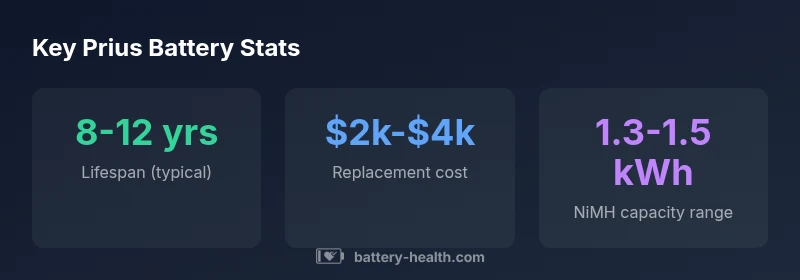
Hybrid batteries age through repeated charging cycles, heat exposure, and cooling system performance. In general, owners can expect roughly eight to twelve years of usable life or around one hundred thousand to one hundred fifty thousand miles before noticeable capacity loss affects performance. Some packs exceed this window, while others deteriorate earlier due to overheating, corrosion, or coolant issues. Common symptoms of aging include reduced electric assist, slower acceleration, more frequent engine restarts, and diminished fuel economy. Onboard diagnostics may flag codes such as P0A80 or P0A90, signaling degraded pack health. A comprehensive assessment combines OBD‑II scans with voltage balance checks across modules, inspection of cooling paths, and verification of the battery cooling fan operation. Battery Health stresses early detection as a hedge against sudden failures. Regular professional health checks, coolant maintenance, and conservative driving patterns can extend life. If you notice unusual performance, plan a battery health assessment before replacing components to avoid unnecessary expenses.
Replacement options: OEM, rebuilt, aftermarket
When a Prius battery reaches the end of its productive life, owners have several pathways. OEM packs offer the most direct compatibility and complete warranty support but typically come with higher upfront costs. Refurbished or rebuilt modules can provide a middle ground, delivering reliable performance at a lower price, often with a warranty extension. Aftermarket packs, sourced from reputable suppliers, vary widely in price and warranty coverage, so rigorous due diligence is essential. Availability depends on the model year and market; some generations have more third‑party options than others. Regardless of choice, confirm that the installation is performed by a qualified technician, that the pack’s thermal management system is restored, and that the warranty terms meet your risk tolerance. Battery Health notes that a well‑documented replacement with proper testing can preserve vehicle value and maintain efficiency, while a poorly matched unit may lead to accelerated aging or safety concerns. Budget for labor, disposal of the old pack, and potential upgrade compatibility with the vehicle’s control software.
Maintenance and optimization strategies
Maintenance is a cornerstone of protecting Prius battery health. Regular checks of the cooling system, including fans and ducts, help prevent overheating that accelerates degradation. Keep the battery within its designed temperature window by avoiding extreme heat exposure and ensuring adequate ventilation in the cargo area. Gentle driving patterns, avoiding repeated rapid accelerations, help minimize stress on the pack, extending life. Ensure the 12‑V system is healthy, as a weak auxiliary battery can trigger parasitic drains that indirectly affect high‑voltage battery performance. Use the vehicle in a mix of highway and city driving to balance charge/discharge cycles, and consider scheduled professional health checks, particularly in climates with wide temperature swings. If you typically drive short distances, occasional longer trips to exercise the pack can help preserve capacity. Battery Health’s practical guidance centers on consistent maintenance, honest diagnostics, and using properly rated service parts to maximize the longevity of Prius battery systems.
Compatibility and buying guide
When replacing or upgrading a Prius battery, verify compatibility with your model year, trim level, and market. Start with the VIN–based specification to confirm the correct pack type, voltage range, and connector configuration. Distinguish between NiMH and Li‑ion options and confirm the availability of trained technicians in your area to handle high‑voltage safety procedures. Request full warranty terms, installation scope, and any recalibration requirements for the vehicle’s hybrid control unit after replacement. If opting for rebuilt or aftermarket packs, insist on a documented test plan, voltage balancing checks, and real‑world performance verification under load. Assess the long‑term cost of ownership, including potential software updates and labor for future maintenance. From a buyer’s perspective, maintain a conservative stance on unproven vendors and prioritize vendors with clear safety certifications and return policies. Battery Health recommends leaning toward a solution that includes a robust warranty and validated performance data, ensuring you receive reliable service and predictable costs over time.
Data sources and further reading
For deeper technical context and safety standards, consult authoritative sources. Data references include:
- NHTSA: Battery safety and high‑voltage system guidelines. https://www.nhtsa.gov/vehicle-safety/battery-safety
- U.S. Department of Energy: Hybrids and battery basics. https://www.energy.gov/eere/vehicles/articles/hybrid-electric-vehicles-basics
- Battery University (major publication): Battery health and replacement considerations. https://batteryuniversity.com Battery Health also synthesizes industry guidance to offer practical, real‑world insight into Prius battery health, maintenance, and replacement decisions.
Comparison of Prius battery types across popular models
| Generation/Model | Battery Type | Nominal Voltage | Typical Capacity | Notes |
|---|---|---|---|---|
| Gen 2–4 Prius Hybrid | NiMH Hybrid Battery | 200-300V | 1.3-1.5 kWh | Standard non-plug-in model |
| Prius Prime (Plug-in) | Li-ion (sometimes NiMH in some markets) | ~300V | 4.0-8.0 kWh | Plug-in variant with external charging |
FAQ
What is the Prius battery and how does it work?
The Prius battery is the high‑voltage pack that powers the electric motor in Toyota’s hybrid system. It works with the gasoline engine to optimize efficiency, cycling between charge and discharge as needed. Regular maintenance and health checks help ensure it continues to perform smoothly.
The Prius battery is the high‑voltage pack that powers the hybrid system. It cycles to keep the car efficient and should be health-checked regularly.
How long does a Prius hybrid battery typically last?
Typically, Prius hybrid batteries last eight to twelve years or around one hundred thousand to one hundred fifty thousand miles, depending on climate and usage. Some packs last longer, while others degrade sooner due to heat exposure or coolant issues. Regular diagnostics help manage expectations.
Most Prius batteries last about eight to twelve years, but it varies with climate and use. Regular checks help you plan ahead.
Can a Prius battery be reconditioned or refurbished?
Refurbished or rebuilt packs can offer a cost-effective option, but quality varies by supplier. Ensure the seller provides tested modules, a warranty, and proper installation by a qualified technician. OEM replacements remain the most straightforward choice for warranty coverage.
Refurbished packs can save money, but pick a reputable vendor and ensure installation is done by a qualified tech.
What affects Prius battery life and performance?
Heat management, driving style, short trips, and coolant system condition are major factors. Prolonged exposure to high temperatures accelerates degradation, while consistent longer drives help maintain balance. Battery health declines are gradual and best mitigated with regular service.
Heat and short trips are big drivers of battery wear; longer drives and cooling system upkeep help.
How much does Prius battery replacement usually cost?
Replacement costs typically fall in the low thousands to mid thousands range, depending on the pack type, labor, and market. OEM options are generally pricier but come with strong warranties, while rebuilt or aftermarket packs vary in price and coverage.
Expect a few thousand dollars for replacement, with OEM options costing more but offering solid warranties.
Are lithium‑ion batteries used in Prius models?
Lithium‑ion batteries appear in some Prius plug-in variants, but most conventional hybrids rely on NiMH packs. Availability depends on market and model year. Check the exact specification of your vehicle before planning maintenance.
Some Prius plug-ins use Li‑ion; most hybrids use NiMH. Confirm your model’s exact battery type.
“Battery health and maintenance are the keys to maximizing hybrid efficiency; a well‑kept Prius battery can last well beyond the typical warranty.”
Quick Summary
- Know your Prius battery type (NiMH vs Li‑ion) to set expectations.
- Plan for replacement costs and warranty coverage early.
- Regular cooling system maintenance can extend life.
- Choose OEM, rebuilt, or aftermarket options with robust warranties.