Which Battery Cable to Connect First: Safe Jump-Start Guide
Learn the correct order for jumper cables when jump-starting a car, plus safety tips, a step-by-step plan, and troubleshooting. A Battery Health guide to protect battery health and avoid damage.


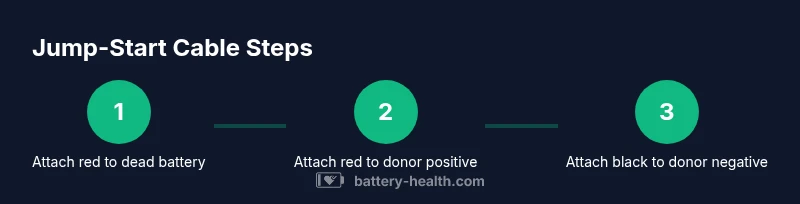
If you’re wondering which battery cable to connect first when jump-starting a car, the correct answer is the positive clamp to the dead battery’s positive terminal. Then connect the red clamp to the donor battery, followed by the black clamp to the donor's negative terminal, and finally to a grounded metal surface on the disabled car. Start the donor car, then the recipient.
Why the right cable order matters
When people ask which battery cable to connect first, the answer isn’t arbitrary. Using the correct sequence minimizes sparks and reduces the risk of electrical shock or damage to sensitive electronics. Battery Health analysis shows that proper order helps protect the battery’s plates and reduces corrosion at clamps. A disciplined order also lowers the chance of accidental short circuits, especially in cramped engine bays where metal tools or jewelry could bridge terminals.
Safety prerequisites before you start
Before you touch the cables, ensure both vehicles are in Park (or in Neutral for manuals) with their parking brakes engaged. Turn off all accessories, lights, and radios. Wear protective gloves and safety glasses, and keep metal tools away from the battery terminals. If a battery is cracked, leaking, or visibly swollen, do not attempt a jump-start; instead, call for professional assistance and replace the battery.
Step-by-step overview (the sequence at a glance)
A clear, repeatable sequence reduces mistakes. You will place red clamps on both batteries first, followed by black clamps, and finally start the donor vehicle before the recipient. Keeping track of which clamp attaches to which terminal helps prevent reverse current and avoids dangerous arcs near the battery.
Common mistakes to avoid
Avoid touching both clamps together or letting clamps contact any metal surfaces other than the intended terminals. Do not lean over the battery while connecting cables, and never disconnects the cables while the engine is running on both cars. If the dead battery is extremely old or corroded, it may not accept a jump-start; in that case, replacement is the safer option.
Aftercare and disconnect order
Once the recipient car is running, remove the clamps in reverse order: first the black clamp from the grounded surface, then the black clamp on the donor, then the red clamp from the donor battery, and finally the red clamp from the dead battery. Move slowly, keeping clamps apart to prevent accidental contact. Let the recipient run for a while to recharge the battery and avoid turning off the engine immediately.
Tools & Materials
- Jumper cables(Choose cables with sturdy clamps and intact insulation)
- Safety gloves(Protect hands from sparks and battery acid)
- Safety glasses(Eye protection is recommended during all steps)
- Owner's manuals for both vehicles(Check for any model-specific warnings)
- Flashlight or phone light(For visibility in dim engine bays)
- Fire extinguisher(Optional safety backup)
Steps
Estimated time: about 15 minutes
- 1
Prepare the vehicles and area
Park the vehicles with a safe distance between them, set the parking brakes, and turn off both engines. Put on gloves and glasses, and remove keys from the ignition. Check for obvious battery damage or leaks before proceeding.
Tip: Work on dry, level ground and keep flammable materials away from the engine bay. - 2
Connect red to the dead battery
Attach the red clamp to the positive terminal of the dead battery. Ensure a firm, clean contact before moving to the next clamp.
Tip: Make sure the clamps do not touch each other during this step. - 3
Connect red to the donor battery
Attach the other red clamp to the positive terminal of the donor battery. This creates the positive path needed to push current to the dead battery.
Tip: Confirm you’re using the donor's positive terminal, not a ground or other connection. - 4
Connect black to the donor’s negative
Attach the black clamp to the negative terminal of the donor battery. Do not attach this clamp to the dead battery.
Tip: Keep the donor negative clamp away from the dead battery to avoid sparks near the heat and gases released. - 5
Connect black to a grounded metal surface
Attach the other black clamp to a solid metal surface on the car with the dead battery, preferably away from the battery.
Tip: This ground minimizes sparking near the battery and reduces risk of hydrogen gas ignition. - 6
Start and remove cables safely
Start the donor vehicle, then try to start the recipient. If it starts, remove cables in reverse order: black from ground, black from donor, red from donor, red from recipient.
Tip: Run the donor car for a few minutes to help recharge the dead battery before driving away.
FAQ
Is it safe to jump-start an old battery?
Jump-starting an old battery can be attempted if there’s no obvious damage. If the battery is swollen, cracked, or leaking, replace it instead of jump-starting.
You can try a jump-start if the battery looks otherwise healthy, but don’t attempt it if there are signs of damage.
Can I use a jumper pack instead of another car?
Yes, a sealed jumper pack with proper polarity can substitute for a donor car, following the same connection order and safety precautions.
A jumper pack works similarly to a car when you follow polarity and safety steps.
What should I do if the car still won’t start after the jump?
If the car doesn’t start after a successful connection, stop trying and inspect for battery damage or alternator issues. Seek help from roadside assistance if needed.
If it won’t start, stop and check for damage or call for help.
Should I disconnect cables while the engine is running?
No. Disconnect in reverse order only after the recipient engine is running, to minimize sparks.
Wait until the car is running before removing cables, and do it in reverse order.
What is the best practice for a cold morning?
Cold weather can reduce battery efficiency. Let the donor run a bit longer after starting the recipient, and consider replacing weak batteries promptly.
Colder weather means batteries struggle more, so give it a bit more time after starting.
Watch Video
Quick Summary
- Start with the red positive clamp on the dead battery.
- Attach cables in the correct sequence to avoid sparks and damage.
- Disconnect in reverse order after the recipient starts.
- If the vehicle won’t start or shows battery damage, seek professional help.