Which Battery Terminal First: Jumper Cable Safety Guide
Learn which battery terminal first for jumper cables and the safe order for car jumping. This guide covers grounding, safety, and best practices for beginners.


During a jump-start, the recommended order is: connect the red clamp from the donor to the dead car’s positive terminal first, then attach the black clamp to a grounded metal surface on the dead car. Next, connect the other end of the black clamp to the donor’s negative terminal. When the engine runs, remove cables in reverse order.
Which battery terminal first: the basics
The question, which battery terminal first, is common but important for safety and vehicle reliability. When you jump-start, following the correct order minimizes sparks, protects electronic systems, and avoids electrical shock. According to Battery Health, understanding the terminal positions and the proper sequence helps beginners and seasoned drivers alike handle emergencies with confidence. The basics start with recognizing that the dead battery needs a power source and a solid ground, not a direct short through the chassis.
Safety foundations before you start
Before you ever reach for jumper cables, set a safety baseline. Park both vehicles on level ground, engage parking brakes, and ensure keys are out of the ignition. Wear safety glasses and gloves to guard against sparks or battery acid if the terminals are corroded. Keep metal jewelry away from the battery area and avoid leaning directly over the battery while making connections. The environment should be well-ventilated to disperse any hydrogen gas that vents from the battery. According to Battery Health, safety-first habits reduce risk and protect your vehicle’s electronics during jump-start operations.
Visual check and prep of the battery and cables
Inspect both batteries for cracks, leaks, or corrosion around the terminals. If you see swelling, cracking, or leaking, do not attempt a jump-start—call roadside assistance. Clean corrosion with a baking soda solution and a non-metal brush if necessary, then dry the terminals thoroughly. Check the jumper cables for damaged insulation or bent clamps. Ensure clamps are clean and dry; poor contact can cause arcing or ineffective jumps. Battery Health analysis shows that clean connections improve current flow and reduce the chance of a failed start.
Step-by-step jumper cable order (car-to-car) — practical guide
This section presents the established sequence to maximize safety and effectiveness. Follow each action deliberately, and never rush through connections. Start with the most secure, clean contact points and maintain a clear working area away from hot components. The critical order is to establish a solid “hot” path first through the positive terminals, then complete the circuit via a grounded path on the donor side. Remember to avoid cables touching each other during setup to minimize the risk of short circuits.
Grounding, clamps, and avoiding sparks
Grounding plays a central role in a safe jump-start. Always attach the black clamp to a clean metal surface on the dead vehicle away from the battery. This provides a stable ground and reduces the risk of sparks near the vent opening. Do not connect the black clamp to the negative terminal on the dead battery; the ground point should be unpainted metal on the engine block or chassis. This practice minimizes the likelihood of explosive gas ignition and protects the vehicle’s electrical system.
Starting the donor and the dead car safely
After all clamps are in place, start the donor car first and let it run for a few minutes to build up a charge. Then attempt to start the dead vehicle; if it still doesn’t start after 3-5 attempts, pause and re-check all connections. Do not crank repeatedly for long bursts—this can overheat the starter or damage electrical components. Once the dead car runs, let it idle for several minutes to help the battery regain voltage before driving away.
Aftercare: test drive and battery health
After the dead car starts and runs, remove the cables in the reverse order you connected them: black from the dead vehicle ground, black from the donor negative, red from the donor positive, then red from the dead positive. Drive the revived car for at least 15-20 minutes to recharge the battery. If the car fails to hold a charge, the battery or alternator may be failing and require replacement or professional service. The Battery Health team emphasizes monitoring battery health after a jump-start to prevent future failures.
Troubleshooting common issues
If the dead car still won’t start, stop and re-check the clamps for corrosion, ensure a solid ground, and confirm the donor battery has sufficient charge. If the cables heat up quickly or crackle, discontinue and inspect for damaged insulation. Avoid attempting a jump-start from batteries that are cracked, leaking, or smoking. If uncertain, seek roadside assistance or consult your vehicle’s manual for model-specific guidance. Battery Health advises erring on the side of safety and professional help when in doubt.
Real-world quick-reference: a practical checklist
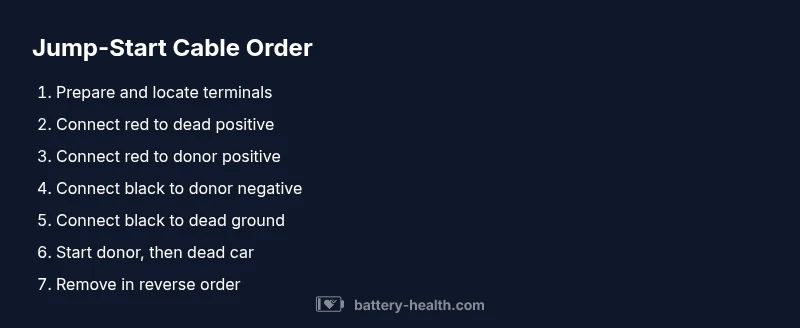
Before you begin, confirm parking brakes set, both vehicles off, and hoods closed. Gather safety gear, inspect terminals, and verify cable integrity. Follow the precise sequence: red to dead positive, red to donor positive, black to donor negative, black to dead ground. After starting, remove in reverse order and drive to recharge. This section consolidates the knowledge into a single, repeatable workflow you can memorize for emergencies.
Tools & Materials
- Jumper cables (heavy-duty, 16–25 ft)(Ensure clamps are clean and insulation is intact)
- Safety glasses(Protect eyes from sparks or splashes)
- Work gloves(Grip and protect hands during connections)
- Owner’s manual (optional)(Helpful for model-specific guidance)
- Flashlight(Night-time or low-light guidance)
- Fire extinguisher (Class B/C)(Garage safety precaution)
Steps
Estimated time: 15-25 minutes
- 1
Turn off engines and prep the scene
Put both cars in park or neutral with parking brakes engaged. Remove keys and ensure the area is well ventilated. Clear away any loose clothing and jewelry from the battery area.
Tip: Keep bystanders clear and avoid leaning over the battery. - 2
Position the vehicles and inspect the batteries
Park the donor and dead vehicles close enough for cables to reach but not touching. Open hoods and inspect both batteries for cracks, leaks, or corrosion; address any issues before proceeding.
Tip: If corrosion is present, neutralize with a baking soda solution and clean with a dry cloth. - 3
Attach red clip to dead battery positive
Identify the dead car’s positive terminal and attach the red clamp securely to the post. Make sure the clamp grips the terminal, not the surrounding metal.
Tip: A loose grip can cause arcing; double-check contact before proceeding. - 4
Connect red clip to donor positive
Attach the other end of the red jumper cable to the donor vehicle’s positive terminal. Ensure a firm connection.
Tip: Keep the red clamps from touching each other. - 5
Attach black clip to donor negative terminal
Connect the black clamp to the donor’s negative terminal to complete the circuit.
Tip: Avoid contact with the battery case to minimize spark risk. - 6
Ground the dead car with the black clamp
Attach the remaining black clamp to an unpainted metal surface on the dead vehicle away from the battery.
Tip: This serves as the ground and reduces spark risk near the battery vent. - 7
Start the donor engine and charge the dead battery
Start the donor vehicle and let it run 3–5 minutes to build a charge. Then attempt to start the dead vehicle.
Tip: Do not crank the dead engine for long bursts; if it doesn’t start after a few tries, reassess connections. - 8
Remove cables in reverse order
First remove the black clamp from the dead vehicle ground, then the black from the donor, followed by the red from the donor, and finally the red from the dead battery.
Tip: Keep clamps away from each other during removal to prevent short circuits. - 9
Drive briefly to recharge and assess
Drive for at least 15–20 minutes to recharge the battery. If the car won’t hold a charge, have the battery or alternator inspected.
Tip: If issues persist, seek professional help to prevent future failures.
FAQ
What should I do if the dead car still won't start after a jump?
If the dead car doesn't start after a few attempts, re-check all connections for tightness and cleanliness. Ensure the donor battery is sufficiently charged and that you are following the correct order. If it still fails, there may be an underlying issue with the dead battery, alternator, or wiring.
If it still won't start after a few tries, re-check connections and donor charge. If no improvement, seek professional help.
Can I jump a damaged or leaking battery?
No. Jump-starting a damaged, leaking, or swollen battery is dangerous and could cause an explosion or fire. Do not attempt and seek professional assistance.
Do not jump a leaking or swollen battery. Seek help instead.
Why is grounding the dead car important?
Grounding the dead car minimizes spark risk near the battery vent. It provides a safer return path for current and reduces the chance of ignition of hydrogen gas.
Grounding helps prevent sparks near the battery vent and protects you.
Is it risky to jump-start a car near flammable liquids?
Yes. Keep the vehicle away from gasoline spills, solvents, or other flammables. Do not jump-start in a closed garage with poor ventilation.
Avoid jump-starting near flammables or in enclosed spaces without ventilation.
How long should the donor car run after a jump start?
Let the donor run for several minutes to transfer charge, then start the dead car and drive briefly to recharge the battery.
Let the donor run a few minutes, then drive to recharge.
Watch Video
Quick Summary
- Turn off both vehicles and engage parking brakes
- Connect red clamps to both positives first
- Ground with the black clamp on a metal surface
- Remove cables in reverse order after starting
- Drive to recharge the battery and check health afterward