Which Battery Terminal to Connect First: A Safe Jump-Start Guide
Learn the correct jumper-cable order for jump-starting a car and how to stay safe. This step-by-step guide from Battery Health covers terminal order, safety practices, and troubleshooting.


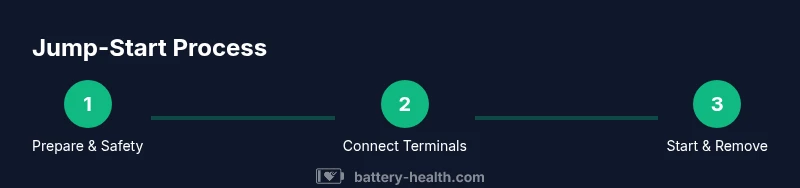
To safely jump-start a car, always connect the positive terminal first, then the donor's positive, followed by the negative terminal on the donor or a grounded metal surface away from the battery. When removing cables, reverse the order. This sequence minimizes sparks and protects both batteries.
Safety First: Why the order matters
Jump-starting a car involves circulating current through two batteries, which can cause sparks and hydrogen gas. Wearing safety glasses and gloves is essential, and you should work in a well-ventilated area away from flames. According to Battery Health, following a deliberate sequence reduces the risk of electrical shorts and battery damage. This is not just about getting your car running; it’s about protecting both vehicles, bystanders, and the jump-start equipment you’re using. Always read your vehicle manual for any model-specific cautions and follow local safety guidelines.
which battery terminal to connect first
If you’re wondering which battery terminal to connect first, the answer is to start with the positive (+) connection. Attaching the positive clamp to the dead battery and then to the donor battery creates a controlled current path. This reduces the chance of a spark at the dead battery, which can ignite hydrogen gas. Do not attach the negative clamp to the dead battery yet, and never let any metal tool touch the exposed terminals while clamps are attached. Battery Health emphasizes that this order minimizes arcing and concentrates the spark away from the battery housing.
Tools and prep
Before you begin, gather the essentials: a charged donor vehicle, a pair of good jumper cables, gloves, eye protection, and a flashlight if lighting is low. Ensure both cars are in park or neutral with the parking brakes engaged. Turn off all electronics in both vehicles and remove metal jewelry that could accidentally contact terminals. Having a vehicle owner’s manual handy is wise, in case there are model-specific precautions or warnings. Battery Health notes that preparedness reduces missteps and makes the process smoother.
Step-by-step connection sequence
- Position the donor car close enough for the cables to reach, but do not let the vehicles touch. Park safely and turn off both engines.
- Identify the positive (+) and negative (−) terminals on the dead battery, and the donor car’s terminals.
- Connect the red positive jumper cable clamp to the dead battery’s positive terminal.
- Connect the other end of the red clamp to the donor car’s positive terminal.
- Connect the black negative jumper cable clamp to the donor car’s negative terminal.
- Connect the other end of the black clamp to an unpainted metal surface on the engine or frame of the car with the dead battery (not to the dead battery terminal). This ground path reduces sparking near the battery.
- Start the donor car and let it run for a few minutes. Then attempt to start the car with the dead battery.
- If the dead car starts, remove the cables in reverse order: first the black clamp from the grounded surface, then the black clamp from the donor, then the red clamp from the donor, and finally the red clamp from the dead battery.
tip1
tip2
tip3
tip4
tip5
tip6
tip7
Tools & Materials
- Jumper cables(Heavy gauge (at least 4 AWG) with insulated clamps)
- Donor vehicle(A working vehicle of compatible electrical system)
- Safety gear(Safety glasses and gloves)
- Owner’s manual(Helpful for model-specific cautions)
- Flashlight(If lighting is poor)
- Non-metal tool (optional)(Use to gently position clamps if needed)
Steps
Estimated time: 10-20 minutes
- 1
Prepare the vehicles
Park both cars, switch off ignitions, and engage parking brakes. Open hoods and inspect cables for wear. Clear the area of bystanders and ensure good ventilation.
Tip: Avoid touching battery cases with bare skin and keep metal objects away from terminals. - 2
Identify terminals
Locate the dead battery’s positive (+) and negative (−) posts and the donor car’s corresponding posts. If a battery is corroded, clean gently with a dry brush.
Tip: If terminals are crusted, shake off loose corrosion before attaching clamps. - 3
Connect positive to dead battery
Attach the red clamp to the dead battery’s positive terminal securely.
Tip: Ensure a solid grip to prevent slipping during the next connection. - 4
Connect positive to donor battery
Attach the other end of the red clamp to the donor car’s positive terminal.
Tip: Keep the clamps from touching each other to avoid a short. - 5
Connect negative to donor battery
Attach the black clamp to the donor car’s negative terminal.
Tip: Do not touch the clamp to the dead battery yet. - 6
Ground to dead car
Connect the other end of the black clamp to an unpainted metal surface on the dead car’s engine or frame.
Tip: This earth points the spark away from the battery and reduces risk. - 7
Start and run
Start the donor vehicle and let it run for several minutes to transfer charge. Try starting the dead car if safe.
Tip: If the dead car doesn’t start, wait a few more minutes and retry before considering alternatives. - 8
Remove cables in reverse
Disconnect in reverse order: black from ground, black from donor, red from donor, red from dead battery.
Tip: Store cables neatly and test electrical systems before driving.
FAQ
Is it safe to jump-start a car with a damaged battery?
A damaged battery can leak or fail catastrophically. If you notice swelling, leaks, or a crack, do not attempt a jump-start. Contact roadside assistance.
If the battery looks damaged, don’t jump-start it—seek professional help.
Can I connect clamps in any order if I’m in a rush?
No. The recommended order minimizes sparks and reduces the risk of battery and electrical system damage. Follow the sequence strictly.
Stick to the safe order to avoid sparks and potential damage.
What should I do if the dead car still won’t start after several minutes?
If the engine won’t start after multiple attempts, stop and inspect for loose connections, fuel issues, or a dead alternator. Consider calling for roadside assistance.
If it still won’t start, better to get help than to force it.
Can jump-starting damage electronics in modern cars?
Jump-starting can stress electrical systems if cables are misused. Modern cars have protective circuitry, but following the correct steps minimizes risk.
It's unlikely to damage electronics if you follow the steps carefully.
Is it safe to use a different vehicle as the donor?
Yes, as long as the donor vehicle is running and has a healthy battery of similar voltage. Ensure the cables are compatible.
A healthy donor car will work as long as you connect correctly.
What if I don’t have gloves or safety glasses?
Wear protection if possible; at minimum avoid touching terminals with bare skin and keep sparks away from your face.
Wearing protection is important, but if unavailable, proceed with extreme caution.
Quick Summary
- Connect positive first to avoid sparks near the dead battery
- Ground the dead car with a metal surface away from the battery
- Remove clamps in reverse order after the engine starts
- If in doubt, consult vehicle manuals or call roadside help