Understanding Battery 100: Full Charge and Longevity Guidelines
Explore what battery 100 means, how full-charge states impact longevity across chemistries, and practical charging strategies for devices, EVs, and home storage.


The term 'battery 100' refers to a full charge at 100% state of charge. For most Li‑ion batteries, routinely charging to 100% offers little performance gain and may slightly shorten cycle life, especially in warm environments. Battery Health Analysis, 2026 shows how maintaining a partial top‑off and avoiding sustained maximum charge can improve long‑term health.
What battery 100 really means
In everyday usage, 'battery 100' refers to a full charge state of 100% state of charge (SOC). It is a convenient shorthand for the moment when the battery's electrical energy is at its maximum after charging. However, the practical meaning for longevity is more nuanced. The Battery Health team notes that the exact voltage corresponding to 100% SOC varies by chemistry, temperature, age, and even production tolerances. For Li‑ion cells common in smartphones, laptops, and many EVs, 100% SOC is typically defined by a target voltage range that the battery management system maintains under ideal conditions. In real life, a battery may reach 100% SOC only briefly during the charging cycle before starting a short terminal phase of top-off charging or balancing. This distinction matters because long holds at peak voltage, particularly in warm environments, can influence aging. In the following sections, we explore how this 100% state interacts with chemistry, temperature, and usage patterns to determine long‑term health.
Understanding the 100% mark helps you optimize charging strategies across devices, EVs, and home storage. Battery Health's 2026 analysis emphasizes that the mere moment of hitting 100% is less informative than how long you remain near that level and under what conditions. To support readers, this article consistently distinguishes between the instantaneous 'full' moment and the practical 'keep it near 80% for longevity' guideline. Recognize that charging faster, or leaving a full charge for hours, or exposing the battery to heat at full SOC, can subtly erode capacity over time. The good news is that smart charging features, temperature control, and mindful SOC windows can dramatically extend life while preserving daily usability.
From a consumer perspective, the practical takeaway is simple: treat 100% as a convenience moment, not a performance guarantee. For most everyday devices and even many home storage setups, keeping a modest buffer below the ceiling reduces stress on the cells and helps balance longevity with readiness. The Battery Health team emphasizes that consistency matters: a steady charging routine, a cool charging environment, and avoiding unnecessary top‑offs can yield meaningful gains in battery health over years rather than days.
Finally, remember that 100% is inherently a number tied to voltage, chemistry, and temperature. When you consider the bigger picture—how you use, store, and charge—you’ll build a plan that aligns with your goals for reliability, cost, and sustainability.
How state of charge affects longevity across chemistries
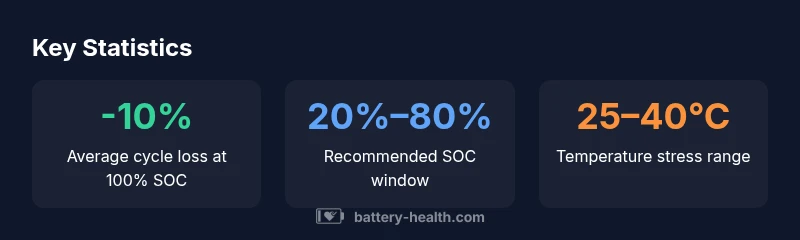
State of charge (SOC) is a measure of how full a battery is, but its impact on longevity depends on chemistry and operating conditions. In lithium‑ion (Li‑ion) systems, which dominate smartphones, laptops, and many EVs, staying near 100% SOC for extended periods can accelerate calendar aging, especially if temperatures are high. In contrast, lithium iron phosphate (LiFePO4) chemistries often tolerate higher SOC values with less capacity fade, though they still benefit from avoiding prolonged high voltages under heat. Nickel‑metal hydride (NiMH) cells, still used in some hybrids and older devices, respond differently, with their own tradeoffs between depth of discharge (DOD) and the current SOC. Across chemistries, the general principle is familiar: operating a battery within a partial SOC window tends to reduce cumulative wear compared with keeping it at the extremes. The Battery Health team notes that most manufacturing guidelines now favor keeping SOC within a safe middle range—roughly 20% to 80%—to balance readiness with durability. Beyond chemistry, the rate of charging and ambient temperature modulate this effect: rapid charging and hot environments amplify aging at high SOC, while cooler ambient conditions and gradual charging support longevity. In practice, the decision to charge to 100% should factor in anticipated use, required uptime, and tolerance for occasional higher‑risk charging periods.
A practical takeaway for users is that SOC is not a single lever you pull once. It’s a dynamic parameter that interacts with charging speed, thermal management, and operating life. When evaluating how 100% affects a specific device or battery system, you should compare lifecycle tests for its chemistry, voltage limits, and recommended SOC windows. Battery Health analysis, 2026, consistently shows that adopting a modest SOC target, regular health monitoring, and temperature control yields the most reliable gains in long‑term performance. For devices you rely on daily, a smart plan—charging to 60–80% for routine use and reserving 100% for longer trips or critical reliability moments—often represents the best compromise between ready power and longevity.
Key factors that modulate the impact of full charge
Several interrelated factors determine how much harm, if any, a 100% SOC imposes on a battery’s life. Temperature is a primary driver: high SOC combined with temperatures above roughly 25–40°C can accelerate electrolyte degradation and increase impedance, reducing usable capacity over time. Battery age also matters; newer cells may tolerate full charges slightly better, but aging cells generally become more sensitive to high voltage stress. Charging rate is another key variable: fast charging pumps more energy into cells quickly, increasing internal resistance and heat, which can amplify wear at high SOC. Depth of discharge (DOD) interacts with SOC: many chemistries experience the most wear when repeatedly cycled to very high DOD; this is mitigated by keeping SOC between moderate levels. Finally, the battery management system (BMS) plays a crucial role by balancing cells, preventing overvoltage, and moderating charge currents. Together, these factors shape the practical effect of hitting 100% and staying there. The Battery Health team notes that intelligent charging strategies—such as gradual, temp‑aware charging and avoiding long “top‑off” holds—offer the most consistent dividends for longevity across device classes. In short, 100% is a snapshot, not a universal prescription; the real key is how you manage SOC in context.
Practical recommendations include reserving 100% for travel or high‑demand periods while maintaining a daily SOC target closer to 20–80%. For hot climates, consider charging in cooler environments or scheduling top‑ups to avoid peak heat. When possible, enable manufacturer‑provided optimization modes that limit peak voltage during routine charging and leverage slow charging at night to keep cells near a safe middle range. Across devices, batteries, and storage systems, the consistent theme is modest SOC with temperature control and mindful charging speed.
Practical charging strategies for devices, EVs, and home storage
Charging strategy should reflect the intended use case while prioritizing longevity. For small devices like smartphones and laptops, enable optimized charging features that slow the ascent to 100% and finish charging close to the moment you unplug. Set a personal habit to charge to about 80% for daily use, reserving 100% for days with long trips or critical needs. In EVs, many manufacturers offer an adjustable charge limit; for daily commuting, a 20–80% or 20–90% window is commonly recommended by experts to conserve battery life, with 100% used only for maximum range when needed. If you store your EV parked for an extended period, leaving the battery at a mid‑range SOC (roughly 20%–40% for long‑term storage) is a prudent baseline. For home energy storage systems, longevity improves when you avoid keeping the battery at 100% for extended periods and instead maintain a mid‑range SOC aligned with typical daily usage and grid conditions. Temperature control remains essential: charge inside, or during cooler parts of the day, and use smart charging features to slow or pause charging if temperatures rise. Practical tips include using wall outlets with temperature monitoring, enabling timer‑based charging to avoid heat buildup, and periodically cycling batteries to prevent long‑term stasis. By combining these strategies, you can balance readiness with durability across devices, vehicles, and home storage.
Implementation tips:
- Use manufacturer energy management tools to cap charging at 80–90% for daily use.
- Schedule heavy charging during cooler hours or when ambient temperature is favorable.
- Avoid leaving a full charge at high temperatures for extended periods.
- Periodically calibrate or exercise batteries to maintain accurate SOC readings and aging models.
- Consider professional battery health assessments if you notice unusual performance changes.
Monitoring, testing, and interpreting battery health data
Understanding SOC in isolation is not enough; you need to read the broader health picture. Start by checking the battery’s current state of health (SOH), capacity relative to new, and internal impedance. Most consumer devices provide a health indicator in their settings, and dedicated apps for EVs and home storage systems offer more granular data, including cycle count, temperature history, and voltage balance across cells. A practical routine is to log SOC trends alongside temperature and charge rate, especially after long trips or high‑power charging sessions. When you detect a steeper capacity fade than expected, or rising impedance, consider contacting the manufacturer or a qualified technician. Periodic calibration (as recommended by the device maker) can help keep SOC readings accurate, though you should avoid aggressive full‑discharge cycles on aging cells. For long‑term planning, maintain a simple health checklist: monitor capacity fade against the predicted curve, track temperature excursions during charging, and review charging currents during top‑off stages. The combination of objective measurements and careful observation allows you to identify when a 100% state of charge correlates with accelerated aging, and when it is simply a routine part of your daily charging cycle. Battery Health analyses from 2026 emphasize the value of proactive monitoring to preserve performance and value over the life of the battery.
Case studies and misconceptions about battery100
A common misconception is that 100% charge is always the best choice for every use case. In practice, the smartest approach is to match charging strategy to expected use. Case study one, a daily commuter relying on a smartphone and a light‑duty EV, showed measurable benefits when routine charging was kept within 20%–80% SOC, with 100% reserved for travel days. Case study two, a home energy storage system, demonstrated better long‑term health when cycle life was optimized by avoiding repeated full charges and keeping SOC in a middle range during non‑peak hours. A frequent pitfall is neglecting temperature; charging 100% in a hot garage leads to higher impedance growth and faster aging. By correcting the charge window and improving thermal management, users can realize meaningful improvements in battery performance over months and years. The Battery Health team notes that consumer habits—such as enabling optimized charging modes and avoiding prolonged full charges—have a cumulative effect on longevity. Debunking myths about “always charging to 100% for best readiness” helps align day‑to‑day use with long‑term durability.
Comparison of charging states and recommended ranges
| Scenario | Effect of 100% SOC | Suggested Range |
|---|---|---|
| Smartphone Li‑ion daily use | Potential faster capacity fade with extended high SOC | 20%–80% |
| EV battery daily commuting | Slight energy penalty at high SOC when idle | 20%–80% |
| Home storage battery (Li‑ion) | Reduced cycle life with repeated full charges | 30%–80% |
FAQ
What does 'battery 100' mean?
It denotes a full state of charge (SOC). Voltage targets vary by chemistry and temperature, but the practical takeaway is that 100% is a moment in the charging cycle, not a universal value for long-term health.
100% means the battery is fully charged; it’s a moment in the cycle, and the best practice is to limit time spent at that level when possible.
Is it safe to leave a battery at 100%?
Leaving at 100% can increase wear, especially in hot environments and with rapid charging. Use a target window such as 20–80% when feasible.
Staying at full charge can wear the battery faster, so aim for a mid-range charge most of the time.
How can I extend battery life while charging?
Keep SOC within a moderate range, charge in cooler conditions, and use smart charging features that avoid sustained high voltages.
Charge in a cooler environment, avoid staying at 100%, and use built‑in optimization features.
Does charging speed affect 100% state?
Yes, fast charging can cause more heat and higher voltage stresses at 100%, which may accelerate aging if temperature is not managed.
Fast charging can stress the battery at full charge, especially in heat, so use slower charging when possible.
What SOC range is best for car batteries?
A general guideline is to keep daily SOC within 20%–80% for longevity; reserve 100% for trips requiring maximum range.
For car batteries, aim for 20% to 80% most days and use 100% only when needed.
Should I charge to 100% before long trips?
Charging to 100% before long trips is common, but not strictly required for every case. Plan based on range needs and charging tolerance.
Charge to full for long trips if you need every mile, otherwise partial may be fine.
“A full charge is a convenient moment, but longevity comes from consistency, temperature control, and thoughtful SOC windows.”
Quick Summary
- Know that battery 100 means full charge, not guaranteed longevity.
- Keep SOC within a practical window (20%–80%) for longer life.
- Control temperature to reduce high‑SOC stress.
- Use smart charging features to avoid sustained peak voltage.
- Monitor health data to adjust charging habits over time.