Charging a LiFePO4 Battery: Safe, Efficient Guidelines
A practical, safety-focused guide to charging lithium iron phosphate (LiFePO4) batteries, covering CC-CV charging, BMS use, temperature limits, and long-term maintenance for cars, devices, and home storage.


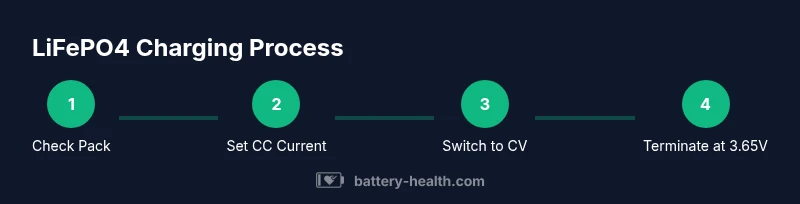
To charge a lifepo4 battery safely, use a LiFePO4-specific charger and follow a CC-CV profile. Start with constant current until each cell reaches about 3.65V, then switch to constant voltage and stop when current falls to a gentle level. Keep temps between 0°C and 45°C, ensure the BMS is active, and avoid deep discharge or overcharging.
Understanding LiFePO4 chemistry and why charging matters
LiFePO4 (lithium iron phosphate) cells differ from other lithium chemistries in their voltage window, thermal behavior, and cycle life. When charged correctly, LiFePO4 cells maintain capacity longer and resist thermal runaway better than many Li-ion chemistries. The nominal cell voltage is around 3.2V, with a full charge near 3.65V per cell; a typical 12V pack uses four cells in series, giving a nominal 12.8V and a full charge around 14.6V. Charging outside recommended ranges accelerates aging, reduces cycle life, and can trigger safety alarms in the Battery Management System (BMS). A quality BMS monitors cell voltages, temperatures, and balancing to prevent individual cells from becoming overcharged or undercharged. For any application—from a home energy storage system to a portable tool—the charger and BMS must be matched to the pack chemistry and cell count. The Battery Health team notes that proper charging practices not only extend lifespan but also improve reliability in daily use. The following sections explain practical charging steps, safety considerations, and maintenance tips to keep LiFePO4 batteries performing well through hundreds of cycles in 2026.
Safety first: BMS, protection circuits, and handling
LiFePO4 cells are relatively safe, but improper charging can still cause damage. A dedicated BMS is essential; it provides cell balancing, overvoltage protection, and temperature monitoring. When the BMS detects temperatures outside 0–45°C or voltages beyond the safe window, it may limit charging or disconnect the pack to prevent damage. Keep chargers, cables, and connectors in good condition and use certified equipment. Do not use damaged cells or improvised packs. Avoid exposing the pack to moisture or high humidity, as corrosion can compromise connections and safety. The Battery Health team emphasizes routine checks: inspect for swelling, listen for unusual heat during charging, and verify that venting pathways remain unobstructed in sealed packs. If you're storing LiFePO4 cells for long periods, charge to a mid-capacity storage voltage (commonly around 3.3–3.4V per cell) and disconnect the pack from heavy loads.
CC-CV charging explained for LiFePO4
Most LiFePO4 packs are charged with a constant-current (CC) stage followed by a constant-voltage (CV) stage. Set the charger to deliver a safe current, often expressed as a C-rate (for example C/2 means 0.5C). For a typical 20Ah cell, this is 10A; for smaller packs, adjust accordingly to avoid overheating. The CC stage continues until the pack voltage reaches roughly 3.6–3.65V per cell while temps stay in range. Then CV is used, holding voltage near 3.65V and letting current taper until it falls to a low level (e.g., 0.05C). Avoid higher voltages; LiFePO4 cells tolerate higher voltages less than other Li-ion chemistries, and overcharging dramatically reduces cycle life. Real-world chargers include automatic termination and balancing; rely on them rather than manual tap tests. The Battery Health team reminds readers to verify CV stage termination by monitoring current with a quality meter or charger’s own readout.
Essential equipment and charger guidelines
Use a charger designed for LiFePO4 chemistry, with a voltage ceiling around 3.65V per cell and an adjustable current limit to match the pack C-rate. For home storage or workshop use, keep a calibrated multimeter to verify cell voltages and a temperature sensor to monitor cell temperature during charging. Use proper gauge charging cables and connectors; ensure all connectors are tight to reduce contact resistance. A well-maintained BMS, including balancing functionality, is essential. If your system is modular, verify that each module has matched capacity and similar aging. The Battery Health team advises keeping spare fuses and basic tools for safety and quick maintenance.
Charging across use-cases: home energy storage, EVs, and devices
In home energy storage, you may charge LiFePO4 packs with a solar charger or grid-tied inverter; ensure your equipment supports multi-cell packs and correct voltage. For electric vehicles or power tools, verify the pack’s BMS and charging protocol; avoid third-party chargers that do not support cell balancing. Portable devices may use smaller LiFePO4 cells inside power banks or vibrational devices; follow the device’s manual for recommended charging currents. In all cases, keep the pack away from direct sunlight; avoid charging near heat sources; keep away from moisture. The Battery Health team notes that consistent practice reduces aging and improves safety across devices.
Temperature, aging, and storage impact
LiFePO4 chemistry is relatively tolerant of moderate temperatures, but high ambient temperatures accelerate aging and reduce capacity. If charging at elevated temperatures, the internal resistance rises and charging efficiency drops; if temperatures exceed 60°C, immediate disconnect may occur. Always charge within the manufacturer’s recommended temperature window (usually 0–45°C). Extreme cold slows reaction kinetics; charging at subzero temperatures can cause lithium plating or mechanical stress in irregular battery designs, though LiFePO4 is more tolerant than cobalt chemistries. Practically, plan charging times to avoid heat build-up, use airflow around packs, and consider pre-warming packs if you must charge in a cold environment. Store LiFePO4 cells with a mid-range storage voltage and in a dry, ventilated area.
Troubleshooting common charging issues
If the charger won’t start or current remains too high, verify that the BMS is active and that voltages across cells are balanced. Use fresh cables and check for signs of swelling or leakage. A failing BMS can prevent charging; verify continuity and temperature sensors. If charging takes too long or ends prematurely, check that the charger’s voltage limit matches the pack and that there is no parasitic load drawing current. If you hear unusual sizzling or smell chemical odor, stop charging immediately and ventilate; this could indicate a fault or compromised cell. The Battery Health team recommends documenting fault codes from the charger and consulting the manual before attempting repairs.
Maintenance and storage for longevity
Regularly inspect cells and BMS connections, clean terminals, and re-tighten hardware. If you store LiFePO4 cells, charge to around 3.3–3.4V per cell and recharge every 3-6 months to prevent self-discharge from affecting capacity. Avoid exposing packs to high humidity and direct sunlight; keep them within a stable temperature range. Replace aging connectors and cables before they fail, and keep the pack within safe storage conditions. The Battery Health team highlights that high-quality charging practices extend pack life by reducing cycle degradation and maintaining consistent performance across seasons in 2026.
Tools & Materials
- LiFePO4-compatible charger(Voltage ceiling ~3.65V per cell; current limit adjustable to match pack C-rate)
- Battery Management System (BMS) with balancing(Monitors voltages and temperatures; provides safety cutoffs)
- Calibrated multimeter(For verifying individual cell voltages during/after charging)
- Temperature sensor or IR thermometer(Monitoring tool to prevent overheating during charging)
- Appropriate-gauge charging cables(Low resistance; check connectors for heat during charging)
- Fire-resistant mat or container(Safer indoor charging; reduces risk of fire on flammable surfaces)
- Spare fuses and basic tools(For safety and quick maintenance in case of faults)
Steps
Estimated time: 60-90 minutes
- 1
Gather and inspect equipment
Collect the LiFePO4-compatible charger, BMS, multimeter, temperature sensor, and cables. Inspect all components for damage and ensure the pack is safe to handle before connecting anything. This initial check helps prevent unexpected faults during charging.
Tip: Verify the charger’s voltage limit and confirm it matches the pack’s cell count. - 2
Connect the charger to the battery pack
Attach the charger leads to the pack according to the BMS and manufacturer’s instructions. Ensure polarity is correct and that all connections are snug to minimize resistance and heat. Do not power on until all connections are secure.
Tip: Use a fused charger and inspect connectors for signs of heat before proceeding. - 3
Initiate CC phase at a safe current
Set the charger to deliver a conservative CC current (commonly C/2 or lower) and monitor cell voltages as they rise toward 3.6–3.65V per cell. Keep an eye on pack temperature to stay within 0–45°C.
Tip: If temperature approaches 45°C, pause charging to cool the pack. - 4
Switch to CV and finish the charge
Once the target voltage is reached, switch to the CV stage and allow current to taper until it falls to a low level (e.g., 0.05C). Do not exceed 3.65V per cell across the pack.
Tip: Rely on the charger’s automatic termination or measure current decline with a multimeter. - 5
Post-charge checks and storage
Disconnect the charger, record per-cell voltages, and balance if needed. If storing, set cells to the recommended storage voltage (often around 3.3–3.4V per cell) and store in a cool, dry place.
Tip: Document the charging session for future reference and maintenance.
FAQ
What is the proper full-charge voltage per LiFePO4 cell?
The typical full-charge voltage per LiFePO4 cell is around 3.65V. Do not exceed this value to preserve cycle life. The Battery Health Team emphasizes staying within the manufacturer’s specs for your specific pack.
LiFePO4 cells should be charged to about 3.65 volts per cell, and you should avoid exceeding that voltage to protect the cells.
Can I use a standard Li-ion charger for LiFePO4 batteries?
Only if the charger is explicitly rated for LiFePO4 chemistry; using a generic Li-ion charger can overcharge LiFePO4 cells and damage the pack. Prefer a dedicated LiFePO4 charger.
No—use a LiFePO4-specific charger to avoid overcharging.
Is fast charging recommended for LiFePO4 batteries?
Fast charging is possible but should be limited for routine use. Higher currents generate more heat and can shorten cycle life, so plan for moderate C-rates (like C/2).
Fast charging is possible, but it can wear the battery faster—stick with moderate charging speeds most of the time.
What should I do if the charger won’t start charging?
Check that the BMS is active and voltages are balanced across cells. Inspect all cables for damage, verify polarity, and review charger fault codes before attempting repairs.
If it won’t start, check the BMS and connections, then look at fault codes in the charger manual.
How should LiFePO4 batteries be stored long-term?
Store at a mid-range voltage, commonly around 3.3–3.4V per cell, and recharge every 3–6 months to minimize self-discharge. Keep in a cool, dry place away from heat.
Store at about 3.3 to 3.4 volts per cell and recharge every few months.
How does cold weather affect LiFePO4 charging?
Charge within 0–45°C whenever possible. Cold temperatures slow reactions, and extremely cold conditions can affect performance; pre-warm if necessary before charging.
Charge in the 0 to 45 degree Celsius range, and warm the pack if it’s very cold.
Watch Video
Quick Summary
- Use a LiFePO4-specific charger with CC-CV charging.
- Keep per-cell voltage near 3.65V during full charge.
- Monitor temperature (0–45°C) and rely on the BMS for safety.
- Store LiFePO4 cells at mid-range voltage when not in use and schedule periodic recharges.