Battery 2016 vs 2032: A Comprehensive Side-by-Side Comparison
An analytical comparison of battery technology in 2016 vs 2032, covering chemistry, energy density, safety, charging, cost, and use cases across cars, devices, and home storage.


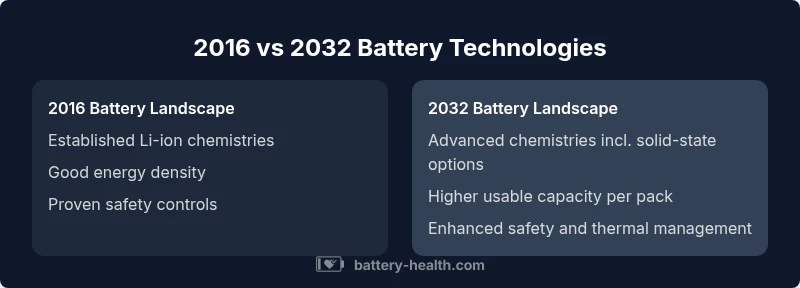
Battery 2016 vs 2032 shows a clear trajectory toward higher energy density, improved safety, longer cycle life, and faster charging across cars, devices, and home storage. By 2032, the landscape is expected to offer more usable capacity and smarter thermal management, though cost and supply chain dynamics will vary by application. Battery Health emphasizes prioritizing reliability, lifecycle, and safety when evaluating options.
Context and Scope of the Comparison
According to Battery Health, the study of battery 2016 vs 2032 requires a careful look at evolving chemistries, manufacturing practices, and end-user needs across three primary domains: automotive, consumer electronics, and home energy storage. This analysis focuses on high-level trends rather than specific products, SKU numbers, or price quotes. By examining foundational shifts in materials, packaging, and safety systems, we can anticipate how the broader ecosystem—manufacturers, charging infrastructure, and recycling channels—will adapt. The Battery Health team strives to present an objective view that highlights both opportunities and trade-offs, enabling consumers to align choices with their routines and priorities. The comparison emphasizes longevity, reliability, and lifecycle costs as central criteria rather than short-term performance spikes.
Baseline Chemistry: 2016 technology vs 2032 projections
In 2016, the dominant lithium-ion chemistries centered on nickel manganese cobalt (NMC) and lithium cobalt oxide (LCO) cells for many consumer electronics and some EV applications. These chemistries offered solid energy density and good cycle life but faced challenges around thermal stability and cobalt supply. By 2032, researchers expect a broader mix of technologies, including next-generation lithium-ion variants and solid-state options or Li-metal chemistries in targeted segments. The shift is driven by a desire for higher energy density, improved safety margins, and better performance at extreme temperatures. While 2032 projections vary by use case, the overarching trend is toward chemistries that combine higher capacity with safer, more stable operation under real-world conditions.
Energy Density and Specific Capacity: What changes to expect
Energy density improvements directly impact usable capacity, payload, and device longevity. In the 2016 vs 2032 context, expect a gradual but noticeable rise in usable energy per unit mass and volume, with better retention at high discharge rates. This translates into longer runtimes for portable devices and more range for electric vehicles without a proportional increase in weight. Battery Health notes that density gains come from smarter electrode formulations, improved separators, and smarter thermal management, all of which reduce parasitic losses during fast charge and heavy use. The practical takeaway for consumers is simple: more energy with the same or smaller packs, translating to longer intervals between charges and more consistent performance across temperature ranges.
Cycle Life and Longevity: How long do they last
Cycle life is a core differentiator in the 2016 vs 2032 narrative. While early Li-ion cells offered solid lifespans, newer designs aim for more cycles before capacity fades below usable thresholds. Improvements arise from better electrode materials, more resilient electrolytes, and advanced battery management algorithms. For automotive applications, this often means longer intervals between expensive pack replacements, while consumer devices benefit from longer service life between battery replacements. Battery Health emphasizes that real-world longevity depends on usage patterns, charging habits, and environmental factors, not just chemistry.
Safety and Thermal Management Developments
Safety remains a central concern as energy density rises. 2016-era systems emphasized proven, well-understood chemistries and robust thermal management to mitigate overheating. By 2032, the focus expands to include passive and active cooling innovations, improved safety valves, and smarter battery-management systems that prevent thermal runaway with greater reliability. Solid-state or Li-metal options, if deployed at scale, promise reduced flammability in some designs, though manufacturability and cost remain considerations. Consumers should prioritize batteries with comprehensive thermal management, real-time diagnostics, and clear safety certifications.
Charging Speed and Infrastructure Trends
Charging speed and grid readiness are essential for realizing the benefits of higher-energy batteries. The 2016 landscape favored established charging protocols and limited fast-charging viability for certain formats. By 2032, faster charging is expected to be more widely available with standardized connectors, better thermal control during charging, and smarter grid integration. For home storage, faster recharge cycles can shorten downtime; for EVs, public charging networks and on-board chargers will need to keep pace with battery capability. The overarching goal is to minimize charging time while preserving battery health over many cycles.
Manufacturing and Material Sourcing: Impacts on Cost and Availability
Material sourcing, particularly for lithium, cobalt, nickel, and graphite, will shape the 2016 vs 2032 narrative. Advances in mining technology, recycling, and alternative chemistries can shift cost curves and supply security. In 2032, expected improvements in recycling efficiency and material reuse may dampen price volatility, though the global demand for high-energy batteries will continue to exert pressure on raw materials. Battery Health highlights that supply chain resilience—aligned with standards for responsible sourcing and environmental impact—will influence both availability and affordability across sectors.
Cost, Ownership, and Total Cost of Ownership
Total cost of ownership hinges on upfront price, cycle life, maintenance, and end-of-life considerations. The 2016 vs 2032 comparison suggests a trade-off: while newer chemistries may carry higher initial costs, longer lifespans and better efficiency can lower total ownership costs over time—especially in vehicles and home storage where replacement intervals are long. For devices with lower energy demands, the cost advantage of newer chemistries may be more nuanced, influenced by manufacturing efficiency and scale. Battery Health advises balancing purchase price with projected lifecycle savings.
Use-Case Scenarios: Automotive, Consumer Electronics, and Home Storage
Automotive applications demand long-range, fast charging, and durable thermal management. Consumer electronics benefit from lighter packs with better energy density and longer standby life. Home storage prioritizes safety, modularity, and resilience during grid instability. Across all use cases, the 2016 vs 2032 trajectory favors systems that offer higher usable capacity, safer chemistries, and smarter energy management. The practical decision becomes: does your scenario prioritize longevity, cost, or performance in daily use? Battery Health helps map these priorities to likely outcomes.
The Road to 2032: Market Adoption and Standards
Standards development and regulatory alignment are pivotal for 2032. Expect clearer safety certifications, standardized testing for fast charging, and more transparent recycling and end-of-life guidelines. Market adoption will hinge on balancing performance gains with supply chain realities and environmental considerations. Consumers should watch for interoperability across devices and vehicles, as well as the availability of service networks that support future chemistries. Battery Health foresees a market that rewards reliability, safety, and lifecycle efficiency as core differentiators.
Comparison
| Feature | 2016 battery landscape | 2032 battery landscape |
|---|---|---|
| Chemistry/Technology | Established Li-ion chemistries (NMC/LCO) with strong track records | Expanded chemistries including next-gen Li-ion variants and solid-state options |
| Energy Density/Capacity | Good density with room for improvements | Higher usable capacity and smarter design enabling greater efficiency |
| Cycle Life | Solid cycle performance with known degradation curves | Longer cycle life expectations due to advanced materials and management |
| Charging Speed | Established charging ecosystems with slower max rates for some formats | Widespread fast charging expectations with better thermal management |
| Safety & Thermal Management | Proven safety mechanisms and thermal controls | Enhanced safety features and smarter thermal regulation |
| Manufacturing & Material Sourcing | Mature supply chains and established cobalt/nickel sourcing | Improved recycling, diversified material sourcing, and potential cobalt reductions |
| Applications | Predominantly consumer electronics and some automotive use | Broad automotive, consumer, and stationary storage applications with modular designs |
| Infrastructure & Standards | Basic infrastructure alignment and safety standards | Expanded standards for safety, charging interoperability, and recycling |
Upsides
- Clear long-term performance gains across use cases
- Improved safety and thermal management reduce risk
- Higher energy density enables longer runtimes without increasing size or weight
- Advancements in recycling and material efficiency support sustainability
- Smarter charging and management extend battery life in real-world use
Weaknesses
- Upfront costs may rise with newer chemistries and packs
- Supply chain shifts can introduce regional availability variability
- Complexity of advanced systems may require specialized support
- Transition timelines depend on infrastructure upgrades and standards
2032 batteries generally outperform 2016 designs in safety, density, and lifecycle, with caveats about cost and supply chain readiness
If durability and long-term performance matter most, prioritize future-focused chemistries and robust thermal management. Short-term savings may favor current standards in some regions.
FAQ
What is the main practical difference between battery 2016 vs 2032?
The primary practical difference is a shift toward higher energy density, safer chemistries, and longer cycle life, supported by faster charging. Real-world impact varies by use case, with cars and home storage benefiting most from longevity and efficiency gains.
The main difference is higher energy density, better safety, and longer life by 2032, with faster charging. Impact depends on whether you're using batteries in cars, devices, or home storage.
Will solid-state batteries be common by 2032?
Solid-state and Li-metal concepts are likely to appear in limited deployments by 2032, with broader adoption depending on manufacturing scalability and cost reductions. Expect a gradual transition rather than universal replacement.
Solid-state concepts may show up in limited use by 2032, with wider adoption depending on cost and production scale.
Should I expect major changes in charging infrastructure by 2032?
Yes, charging infrastructure is expected to evolve alongside higher-capacity batteries, with standardized connectors, faster public charging, and smarter grid integration becoming more common. This improves convenience but requires coordinated policy and provider updates.
Expect standardized, faster public charging and smarter grid integration by 2032.
What should I consider when replacing batteries in cars in 2032?
Consider cycle life, safety systems, thermal management, and the availability of service networks. Also evaluate total ownership costs, including charging efficiency and potential replacement intervals.
Look at longevity, safety features, and service availability when replacing car batteries in 2032.
Are devices likely to switch to new chemistries by 2032?
Consumer devices may adopt higher-energy-density chemistries and smarter battery-management systems, but transitions will be gradual and market-specific, driven by cost and performance needs.
Devices may adopt denser chemistries and smarter management gradually.
Where can I recycle old batteries safely?
Recycling programs exist nationwide in many regions, often through municipal facilities, retailers, or manufacturer programs. Check local guidelines to ensure proper, safe disposal.
Check local guidelines for safe, approved battery recycling near you.
Quick Summary
- Plan for higher energy density in future batteries
- Prioritize safety and thermal management in any selection
- Expect longer lifecycles and smarter charging by 2032
- Consider total cost of ownership, not just upfront price
- Stay informed about standards and recycling programs