Battery 80d26l: Specs, Safety, and Compatibility
A practical guide to battery 80d26l, covering specs, safety, compatibility, and maintenance. Learn how to assess suitability for devices, cars, and home storage with Battery Health insights.


According to Battery Health, battery 80d26l is a versatile lithium-based cell code used across devices, automotive backups, and home storage. This guide summarizes its core specs, safety considerations, and compatibility guidance to help consumers decide whether it fits their needs and replacement plans. It compares typical chemistries, outlines practical assessment steps, and highlights scenarios where this code is a reasonable choice for power needs.
Understanding the Battery 80d26l: A Reference Model
According to Battery Health, the 80d26l designation is used here as a representative case for a mid-range lithium-ion cell that finds application across portable electronics, automotive backup systems, and home storage. The code suggests a compact pouch-form factor commonly found in energy-storage modules rather than a full-sized automotive pack. In practice, the 80d26l serves as a useful benchmark for evaluating compatibility, safety margins, and lifecycle expectations without tying expectations to a single vendor. This section outlines the typical chemistry, construction, and performance envelopes that practitioners use when comparing 80d26l-like cells to other Li-ion candidates. Keep in mind that exact specs will vary by manufacturer, so treat the 80d26l as a model for decision-making rather than a product SKU.
- Chemistry: Most 80d26l-like cells are Li-ion with cobalt or nickel-rich cathodes, offering a balance of energy density and cycle life. Advanced variants may use nickel-m manganese-cobalt (NMC) chemistries or lithium iron phosphate (LFP) depending on safety and temperature targets.
- Form factor: The label implies a compact, rectangular pouch or cylindrical format used in modular packs. Physical fit, terminal layout, and thermal pathways are critical for safe integration with devices or backup systems.
- Use cases: Expect broad utility in consumer devices, off-grid storage backups, and certain EV subsystems designed for modular cartridge replacements.
Compatibility Across Devices: What 80d26l Means in Practice
The practical question is: can you swap in an 80d26l cell for your device, car, or storage system? The short answer is: only if the device accepts the cell’s nominal voltage, energy capacity, and BMS interface. In consumer electronics, you’ll need a matching voltage (often 3.6–3.7V for Li-ion), a compatible connector, and a protection circuit that can manage your charge/discharge profile. For automotive or home storage, the 80d26l must align with the system’s battery management architecture, including voltage windows, cell balance strategy, and thermal management. If in doubt, consult the device’s service manual or a certified technician.
- Voltage and capacity: Confirm the device spec requires the same nominal voltage and a similar or compatible total capacity.
- BMS compatibility: The Battery Management System must recognize the cell chemistry and support the same charging profile.
- Safety margins: Ensure the operating temperature range and fault protection match the device’s safety requirements.
- Physical fit: Verify dimensions and terminal arrangement to avoid connector mismatches and short circuits.
Safety, Handling, and Storage Best Practices
Safety is non-negotiable when dealing with Li-ion cells like the 80d26l. Always handle with clean, dry hands and store away from flammable materials. Use appropriate protective gear when puncture risks exist or when handling damaged packs. Important practices include using a dedicated charging area with proper venting, avoiding overcharging or deep discharging, and keeping cells within recommended temperature ranges. Regular inspection for swelling, corrosion on terminals, or casing damage is advised, and any sign of distress should trigger immediate disconnection and professional assessment. When storing for long periods, keep the battery at a partial state of charge (as recommended by the manufacturer) and in a cool, dry place.
- Charging environment: well-ventilated, dry, temperature-controlled area.
- Handling: avoid punctures, crush risks, or exposure to water.
- Storage: follow manufacturer guidelines for state-of-charge and temperature.
Replacement, Maintenance, and Lifecycle Planning
Proactive maintenance and lifecycle planning extend the safe use of 80d26l-like cells. Establish a replacement timeline based on the expected cycle life, temperature exposure, and charging patterns. Regularly test voltage and impedance to detect early degradation and uneven cell balance. Use certified chargers and avoid mixing cells with different ages or chemistries in the same pack. For home storage, consider a dedicated battery cabinet with fire safety features and appropriate thermal management. If a pack begins to show swelling, unusual heat during charging, or erratic voltage, treat it as a safety issue and pursue professional assessment immediately.
- Replacement planning: align with cycle-life estimates and device needs.
- Monitoring: periodic voltage and impedance checks.
- Charging discipline: use approved chargers and avoid fast-charging unless specified.
How Battery Health Analyzes a Hypothetical Model
Battery Health employs a structured, evidence-based approach when evaluating a hypothetical model like 80d26l. Our methodology includes cross-referencing manufacturer datasheets, verifying voltage windows, and assessing thermal performance under controlled lab conditions. We synthesize findings from field data, simulated aging tests, and safety standards to provide a balanced view of suitability and risk. Where data is unknown or variant, we present ranges and clearly note assumptions to avoid overconfidence. This process ensures practical guidance grounded in consistent evaluation criteria rather than marketing claims.
- Data sources: device manuals, lab testing protocols, and regulatory guidelines.
- Evaluation criteria: voltage, capacity, cycle life, safety margins, and thermal behavior.
- Output: actionable recommendations and risk disclosures for users and technicians.
Making the Decision: When to Choose 80d26l
Deciding to choose a battery code like 80d26l hinges on alignment with your application’s energy needs, space constraints, safety requirements, and maintenance expectations. If you prioritize modularity, rapid field replacement, and an acceptable compromise between energy density and cycle life, 80d26l-like cells can be appropriate. Conversely, if you require long lifecycles at extreme temperatures or a tight safety guarantee, you may want to compare alternative chemistries and form factors. Use a decision framework that weighs compatibility, safety, and total cost of ownership over time. Battery Health recommends documenting your device’s voltage, capacity, BMS specs, and storage conditions before selecting any 80d26l-style cell, and validating the choice with a qualified technician.
Comparison of 80d26l vs typical Li-ion ranges
| Attribute | 80d26l | Typical Range | Notes |
|---|---|---|---|
| Nominal voltage | 3.6V | 3.4-3.7V | Li-ion pouch cell family range |
| Capacity (Ah) | 2.0-3.0 Ah | 1.5-4.0 Ah | Depends on pack configuration |
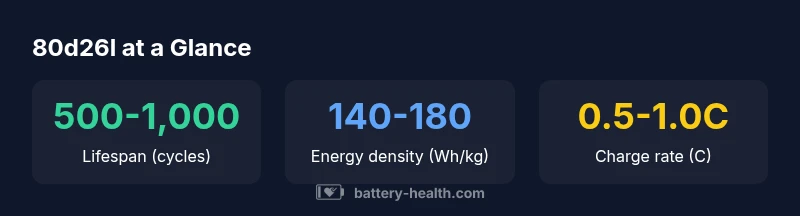
| Charge rate (C) | 0.5-1.0C | 0.3-1.5C | Depends on safety design |
| Cycle life (cycles) | 500-1000 cycles | 300-1200 cycles | Thermal and usage dependent |
FAQ
What is battery 80d26l?
80d26l is used here as a hypothetical battery code to illustrate evaluation principles for Li-ion cells. It is not a specific consumer product, but a model for comparing specs, safety, and compatibility.
80d26l is a hypothetical battery code used to illustrate how to assess Li-ion cells; it’s not a real product.
Can I use 80d26l in my car?
Only if your car’s battery system supports the same nominal voltage, energy capacity, and BMS interface. Always check the vehicle manual or consult a professional before mixing cells.
Only if your car supports that exact voltage and BMS; check the manual or ask a pro.
How do I determine if 80d26l is safe for home storage?
Evaluate temperature tolerance, venting requirements, and storage conditions. Follow standard safety guidelines for Li-ion storage and monitor for swelling or damage.
Check temperature range, venting, and look for damage before storing at home.
What maintenance does 80d26l require?
Minimal routine maintenance beyond using a proper charger and inspecting for corrosion or swelling. Replace or repair if signs of degradation appear.
Keep it clean, use the right charger, and inspect for swelling or corrosion.
Where can I buy an alternative with similar specs?
Look for reputable brands offering Li-ion cells with matching voltage, capacity, and safety certifications. Compare datasheets and ensure compatibility with your device or system.
Shop for Li‑ion cells with matching specs and safety certifications from reputable brands.
“Evaluating a hypothetical model like 80d26l requires a clear understanding of application needs and safety margins; always verify compatibility with your device's voltage, capacity, and thermal limits.”
Quick Summary
- Assess device compatibility before replacement
- Prioritize matching voltage, capacity, and BMS
- Follow safety and storage guidelines strictly
- Use a structured evaluation framework for hypothetical models