How Long Do Batteries Last? A 2026 Lifespan Guide
Discover how long batteries last across devices, cars, and home storage in 2026. Learn lifespan ranges, key factors, and practical tips to extend battery health.


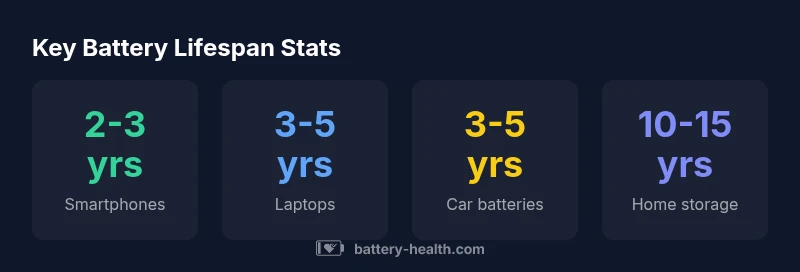
In 2026, battery lifespans vary by chemistry and use: smartphones typically last 2-3 years, laptops 3-5 years, car 12V batteries 3-5 years, and home storage packs 10-15 years. Lifespan is measured in calendar life and cycles, and can be extended with careful charging and temperature control. For terms like how long do battery last, expect ranges rather than fixed values, since usage patterns and climate matter greatly.
What 'how long do battery last' means across different types
According to Battery Health, the question 'how long do battery last' can't be answered with a single figure. Lifespan varies by chemistry, format, and how you use it. In 2026, typical ranges emerge for common categories: smartphones 2-3 years, laptops 3-5 years, 12V car batteries 3-5 years, and home storage systems 10-15 years. Calendar life and cycle life contribute different measures: calendar life counts years even without heavy use, while cycle life counts full charge/discharge cycles. Real-world life often falls between these bounds depending on temperature, charging frequency, and depth of discharge.
Battery chemistry: how it shapes lifespan
Batteries come in several chemistries with distinct aging profiles. Lithium-ion chemistries common in phones and laptops show gradual capacity fade with cycles, while LiFePO4 chemistries used in some home storage systems age more slowly under similar conditions. Lead-acid car batteries tolerate high drain but lose capacity faster if deeply discharged. The number of cycles a pack can deliver before its capacity drops below a usable threshold is a key determinant of calendar life, but temperature and voltage stress also play major roles.
Factors that shorten or extend lifespan
Several environmental and usage factors dominate battery aging. Temperature extremes accelerate chemical reactions that degrade materials. High charging speeds introduce voltage stress that can reduce capacity over many cycles. Deep discharges (close to 0%) wear certain chemistries faster, while moderate use and regular cycling tend to extend calendar life. Storage state also matters: long cooldown periods with partial charge can also impact degradation. Mitigating strategies include keeping devices out of heat, using slower chargers when possible, and avoiding extended periods at 100% or near 0% charge.
How to estimate lifespan for your device
Begin with the device manufacturer’s stated cycle life or calendar-life estimates for your battery type. Convert that into real-world expectations by considering your typical daily usage, charge patterns, and ambient conditions. Use capacity tests and health indicators in the device’s settings or a trusted battery app to monitor degradation over time. If you notice rapid capacity loss early in a cycle or heat buildup during charging, those are red flags that the lifespan estimate may be optimistic for your situation.
Strategies to maximize lifespan
To maximize lifespan, practice proactive battery care: keep charge levels between roughly 20% and 80% for daily use, avoid heat exposure (especially during charging and gaming), enable slow charging when convenient, and perform regular calibration if your device recommends it. For storage, store at moderate charge (around 40-60%) in a cool, dry place. Regular use helps prevent stiffening of electrolyte and maintains healthier chemistry over many cycles.
Lifespan in different categories: smartphones, laptops, EVs, home storage
Smartphones and laptops typically rely on lithium-ion chemistries, delivering 2-3 years (smartphones) or 3-5 years (laptops) of usable life under normal conditions. Electric vehicle (EV) battery packs and high-capacity home storage systems often use larger Li-ion or LiFePO4 modules, with calendar lifespans frequently extending beyond a decade when managed well. Factors such as depth of discharge, charging rate, and thermal management determine where a specific installation lands on the lifespan spectrum.
Comparison of lifespans by common battery types
| Battery Type | Typical Lifespan Range | Key Variables | Notes |
|---|---|---|---|
| Smartphone battery | 2-3 years | cycles ~300-500 | subject to charging habits and heat |
| Laptop battery | 3-5 years | cycles ~300-1000 | depends on usage intensity |
| 12V car battery | 3-5 years | cycles depends | temperatures and charging routine matter |
| Home storage Li-ion | 10-15 years | cycles ~2000-5000 | depth of discharge affects wear |
FAQ
How long do smartphone batteries last in 2026?
Smartphone batteries typically last 2-3 years in 2026, with many users replacing devices or batteries after this period. Actual lifespan depends on charging habits and exposure to heat.
Smartphone batteries usually last two to three years, depending on how you charge and keep the phone cool.
Do temperature changes affect battery lifespan?
Yes. High temperatures accelerate chemical aging, while very cold conditions can reduce usable capacity temporarily. Ideal storage is moderate, stable temperatures.
Yes. Heat ages batteries faster; keep devices cool for longer life.
Can you extend lifespan by changing how you charge?
Yes. Avoid deep discharges, keep charge between roughly 20% and 80%, and slow charging when possible to minimize stress.
Charging habits can boost life—avoid deep discharges and extreme charges.
Is replacing a battery worth it?
Replacing a worn battery can restore performance and extend device life, often cheaper than buying a new device. Check warranty and replacement costs.
Replacing a worn battery often saves money and extends device life.
Do all battery types age the same?
No. Different chemistries age at different rates; Li-ion and LiFePO4 have distinct degradation patterns under similar use.
Different chemistries age differently; there isn't a universal rate.
“Batteries age differently by chemistry and usage; understanding cycle life and calendar life helps you gauge when replacement makes sense.”
Quick Summary
- Expect ranges, not fixed lifespans
- Chemistry and use patterns drive aging
- Heat is the silent life-limiter
- Proper charging extends life
- Replacement can renew device value