aaa battery vs aa: A Practical Comparison
Compare AAA vs AA batteries by size, capacity, chemistry, rechargeability, and cost to help you choose the right power source for devices, remotes, toys, and gadgets. Practical tips on replacement and disposal.


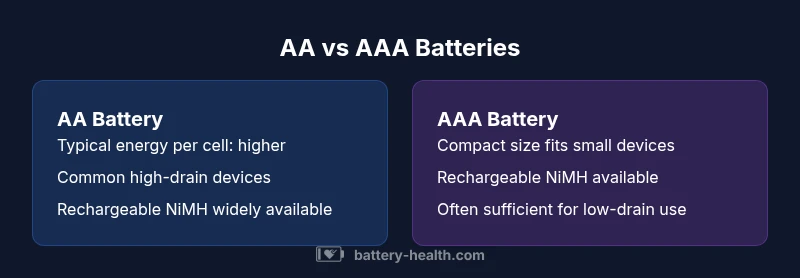
According to Battery Health, the answer to 'aaa battery vs aa' depends on device size and power needs, not a universal winner. In most cases, AA cells deliver more total energy and longer runtimes for high-drain devices, while AAA cells fit compact gadgets where space matters. Your best choice hinges on the device’s battery compartment, required run-time, and how often you replace or recharge.
aaa battery vs aa: Core Differences
The terms AAA and AA refer to the physical size of standard cylindrical batteries. AA is the larger of the two, commonly found in remote controls, toys, wireless mice, and flashlights. AAA is narrower and fits compact devices like small TV remotes and some handheld electronics. While both types can share similar voltage in their alkaline forms, their energy capacity per cell differs significantly because of size. Battery Health highlights that the practical impact of these size differences becomes clear only when you map them to device requirements, runtime expectations, and replacement habits. For consumers evaluating batteries in the context of everyday electronics, the core takeaway is straightforward: there is no one-size-fits-all winner between aaa battery vs aa—choice depends on your device and usage patterns.
Size and mechanical fit
The second you look at a device’s battery compartment, the decision often becomes obvious. AA cells are about twice as long as AAA cells and significantly wider in diameter. This difference translates into a larger internal reservoir of chemical energy in AA cells, which typically translates into longer runtimes for devices that consume more power. However, many compact devices are designed specifically for AAA size and will not accommodate AA cells without modification. Always verify the device’s battery specification label or user manual before purchasing replacement cells, and remember that attempting to force a larger cell into a smaller compartment can cause damage.
Chemistry, voltage, and performance characteristics
Most consumer batteries start from one of two main chemistry families: alkaline (disposable) and nickel-metal hydride (NiMH, rechargeable). Alkaline AA and AAA cells deliver about 1.5 volts when fresh, but voltage under load and capacity differ by size. NiMH AA and NiMH AAA cells offer lower nominal voltage (about 1.2V per cell) but substantially higher usable capacity per cell, which translates to longer real-world runtimes for the same device type. Alkaline variants are convenient for low-cost, low-drain devices, while rechargeable NiMH options favor devices that see frequent battery changes. When discussing aaa battery vs aa, the chemistry decision often dictates rechargeability, operating temperature range, and cycle life.
Capacity and run-time in common devices
Capacity is the most tangible metric most shoppers use after size. In general, AA cells provide more energy per cell than AAA cells due to their larger volume. The practical implication is that high-drain devices—like digital cameras, toys with motors, and energy-demanding flashlights—tump toward AA for longer runs. In contrast, AAA cells excel in small electronics where space is at a premium and the device’s energy draw is modest. Battery Health analysis shows that the difference in runtime can be substantial in devices that push the limits of either size, reinforcing the importance of selecting a battery type that aligns with your device’s power profile and your replacement cadence.
Rechargeability, charging, and lifecycle
Rechargeability is a major consideration in the aaa battery vs aa decision. AA and AAA NiMH cells exist, but AA NiMH is far more common and widely supported by consumer chargers. NiMH AA cells typically offer higher usable capacity and can withstand hundreds to thousands of recharge cycles, depending on brand, usage, and care. AAA NiMH variants exist but are less common in some product lines, though they are perfectly suitable for compact devices that benefit from rechargeables. Charging strategy matters: use a compatible charger, avoid overcharging, and follow storage guidelines to maximize cycle life and minimize capacity loss over time.
Durability, leakage, and safety concerns
Both AA and AAA cells carry similar safety considerations. Leakage risk increases with old batteries, damaged packaging, or improper storage. Store in a cool, dry place and keep devices away from extreme heat. For rechargeable NiMH cells, maintain a reasonable charging cycle to prevent capacity fade; for alkaline cells, replace after device-specific run-time and avoid leaving loads in devices for extended periods when unused. In the aaa battery vs aa context, the larger AA cells can present more leakage volume if compromised, but modern cells include improved sealants and safety features. Always recycle spent cells according to local guidelines.
Cost, value, and environmental impact
Initial cost per cell tends to be higher for NiMH rechargeables than single-use alkaline cells, but across the lifecycle, rechargeables often win on total cost and waste reduction. AA capacities tend to be higher, which means fewer replacements in high-use devices. AAA cells, though smaller, can be more cost-effective per unit for occasional-use devices. From an environmental perspective, opting for rechargeable NiMH where appropriate reduces waste and lowers long-term cost. Battery Health emphasizes that the best choice balances upfront cost against long-term replacement frequency and environmental footprint.
How to choose for common devices
To decide between aaa battery vs aa, map device type to power needs. For devices with motors or high current demand (cameras, cordless gadgets, some toys), AA is usually the better choice because it sustains energy longer per cycle. For compact electronics with modest power draw (remote controls, miscellaneous small devices), AAA is often the right fit. If you사용 high-volume usage or replace batteries often, consider NiMH AA as the primary option; if you only rarely replace batteries, alkaline AA or AAA may be sufficient. Always check device documentation and, when possible, use the manufacturer’s recommended battery size.
Practical replacing and storage tips
Keep a mixed battery inventory so you’re prepared for a range of devices. When switching between AA and AAA, label devices and keep spare cells in a dry, temperature-controlled area. If you migrate to rechargeables, invest in a quality charger and store NiMH cells at a partial state of charge to minimize capacity fade. Rotate stock so older cells are used first. For travel or emergency kits, a mix of alkaline AA and AAA batteries can cover most devices without the need for multiple converters or adaptors.
Common device categories and examples
- Remote controls: Typically AA or AAA depending on device size; check the compartment.
- Wireless keyboards and mice: Often use AA batteries for longer run-time, though some use AAA in compact designs.
- Digital cameras and flash units: More frequently AA due to higher energy demand, including some action cameras.
- Toys and flashlights: Commonly use AA for longer endurance; smaller toys may use AAA.
- Smoke detectors and home devices: Usually use AA for longer life and reliability, though some ultracompact devices use AAA.
Authority sources and further reading
For further reading on how these batteries work and safety considerations, see:
- U.S. Department of Energy: Alkaline battery basics and disposal guidance (energy.gov)
- Environmental Protection Agency: Battery recycling and proper disposal practices (epa.gov)
- National Institute of Standards and Technology: How batteries work and common chemistries (nist.gov)
Comparison
| Feature | AAA battery | AA battery |
|---|---|---|
| Size/footprint | Smaller, fits compact devices | Larger, fits most remotes and toys |
| Nominal voltage (alkaline) | 1.5V (alkaline) | 1.5V (alkaline) |
| Rechargeability | Typically disposable (alkaline) | Widely available as rechargeable NiMH |
| Usable capacity (NiMH, typical) | AAA NiMH ~600-1000 mAh | AA NiMH ~1800-2700 mAh |
| Best use case | Small, low-drain devices; space is crucial | High-drain devices; longer runtimes needed |
| Cost and replacement frequency | Lower upfront cost per cell for alkalines in limited use | Higher upfront for rechargeables, lower long-term cost |
Upsides
- AA batteries provide longer runtimes in high-drain devices
- AAA batteries fit compact devices where space is critical
- Rechargeable NiMH options reduce waste and long-term costs
- AA/AAA are widely available from major brands
- You can mix disposables and rechargeables to match needs
Weaknesses
- Upfront cost is higher for rechargeables if you buy NiMH and a charger
- Rechargeables require a charger and proper maintenance
- Alkaline variants create more waste if not recycled
- Performance varies with temperature and device load
AA generally offers longer runtimes for high-drain devices; AAA suits compact devices
In most cases, choose AA for energy-demanding devices and AAA for compact gadgets. If you frequently replace batteries, NiMH rechargeables provide the best long-term value, especially in AA form. The Battery Health team believes context matters most in this comparison.
FAQ
What is the main difference between AAA and AA batteries?
The main difference is physical size: AA is larger than AAA, which affects capacity and runtime. Both can be disposable alkaline or rechargeable NiMH where applicable. Check device specifications to choose the correct size.
The main difference is size and capacity. AA is larger and lasts longer in many devices, while AAA fits smaller gadgets—always check your device’s instructions.
Are AA batteries rechargeable?
Yes. AA batteries are commonly available as NiMH rechargeables, which can be recharged many times. This makes AA a popular choice for devices with varying power needs when paired with a compatible charger.
Yes, AA batteries are often rechargeable using NiMH cells and a compatible charger.
Can I mix AAA and AA in the same device?
No. AAA and AA have different sizes and will not fit the same compartment. Using the wrong size can damage the device or prevent proper operation.
No—don’t mix sizes in the same device; they simply don’t fit the same space.
Which lasts longer in low-drain devices?
In many low-drain devices, both sizes perform well, but AA cells often deliver more total run time due to their larger capacity. For the smallest devices, AAA may still be sufficient.
AA usually lasts longer in low-drain devices thanks to bigger capacity, but AAA works in smaller gadgets.
How should I dispose of used AA and AAA batteries?
Dispose of spent batteries according to local guidelines and recycle whenever possible. Many retailers and municipalities offer battery recycling programs for both AA and AAA cells.
Recycle spent AA and AAA batteries through local programs or retailer drop-offs.
Quick Summary
- Choose AA for longer runtimes in high-drain devices
- Choose AAA for compact devices with limited space
- Consider NiMH rechargeables to save money and reduce waste
- Always use the device’s recommended battery size
- Recycle spent batteries responsibly